Results by title
13 books match the query 'Asylum, Right of'
Adopting the Stranger as Kindred in Deuteronomy
Mark R. Glanville
SBL Press, 2018
Investigate how Deuteronomy incorporates vulnerable, displaced people
Deuteronomy addresses social contexts of widespread displacement, an issue affecting 65 million people today. In this book Mark R. Glanville investigates how Deuteronomy fosters the integration of the stranger as kindred into the community of Yahweh. According to Deuteronomy, displaced people are to be enfolded within the household, within the clan, and within the nation. Glanville argues that Deuteronomy demonstrates the immense creativity that communities may invest in enfolding displaced and vulnerable people. Inclusivism is nourished through social law, the law of judicial procedure, communal feasting, and covenant renewal. Deuteronomy’s call to include the stranger as kindred presents contemporary nation-states with an opportunity and a responsibility to reimagine themselves and their disposition toward displaced strangers today.
Features:
- Exploration of the relationship of ancient Israel’s social history to biblical texts
- An integrative methodology that brings together literary-historical, legal, sociological, comparative, literary, and theological approaches
- A thorough study of Israelite identity and ethnicity
African Asylum at a Crossroads
Activism, Expert Testimony, and Refugee RightsIris Berger
Ohio University Press, 2015
African Asylum at a Crossroads: Activism, Expert Testimony, and Refugee Rights examines the emerging trend of requests for expert opinions in asylum hearings or refugee status determinations. This is the first book to explore the role of court-based expertise in relation to African asylum cases and the first to establish a rigorous analytical framework for interpreting the effects of this new reliance on expert testimony.
Over the past two decades, courts in Western countries and beyond have begun demanding expert reports tailored to the experience of the individual claimant. As courts increasingly draw upon such testimony in their deliberations, expertise in matters of asylum and refugee status is emerging as an academic area with its own standards, protocols, and guidelines. This deeply thoughtful book explores these developments and their effects on both asylum seekers and the experts whose influence may determine their fate.
Contributors: Iris Berger, Carol Bohmer, John Campbell, Katherine Luongo, E. Ann McDougall, Karen Musalo, Tricia Redeker Hepner, Amy Shuman, Joanna T. Tague, Meredith Terretta, and Charlotte Walker-Said.
Beyond Sanctuary
The Humanism of a World in MotionAnanya Roy and Veronika Zablotsky, editors
Duke University Press, 2025
Contributors. Leisy Abrego, Damon Azali-Rojas, Amy Sara Carroll, Sharad Chari, Nicholas De Genova, Ricardo Dominguez, Lorgia García-Peña, Sarah Haley, Gaye Theresa Johnson, Moon-Kie Jung, Maria Kaika, Saree Makdisi, Kyle T. Mays, Ananya Roy, Charles Sepulveda, SA Smythe, Vanessa E. Thompson, Charalampos Tsavdaroglou, João H. Costa Vargas, Rinaldo Walcott, Veronika Zablotsky, Maite Zubiaurre
Citizenship in Question
Evidentiary Birthright and StatelessnessBenjamin N. Lawrance and Jacqueline Stevens, editors
Duke University Press, 2017
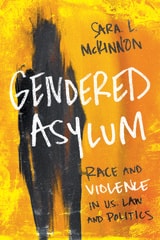
Gendered Asylum
Race and Violence in U.S. Law and PoliticsSara L. McKinnon
University of Illinois Press, 2016
Sara L. McKinnon exposes racialized rhetorics of violence in politics and charts the development of gender as a category in American asylum law. Starting with the late 1980s, when gender-based requests first emerged in case law, McKinnon analyzes gender- and sexuality-related cases against the backdrop of national and transnational politics. Her focus falls on cases as diverse as Guatemalan and Salvadoran women sexually abused during the Dirty Wars and transgender asylum seekers from around the world fleeing brutally violent situations. She reviews the claims, evidence, testimony, and message strategies that unfolded in these legal arguments and decisions, and illuminates how legal decisions turned gender into a political construct vulnerable to American national and global interests. She also explores myriad related aspects of the process, including how subjects are racialized and the effects of that racialization, and the consequences of policies that position gender as a signifier for women via normative assumptions about sex and heterosexuality.
Wide-ranging and rich with human detail, Gendered Asylum uses feminist, immigration, and legal studies to engage one of the hotly debated issues of our time.
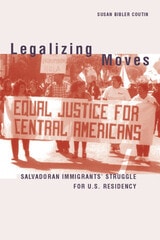
Legalizing Moves
Salvadoran Immigrants' Struggle for U.S. ResidencySusan Bibler Coutin
University of Michigan Press, 2003
Susan Bibler Coutin is Assistant Professor in the Department of Criminology, Law, and Society, at the University of California, Irvine.
On Transits and Transitions
Trans Migrants and U.S. Immigration LawTristan Josephson
Rutgers University Press, 2023
Queer Migrations
Sexuality, U.S. Citizenship, and Border CrossingsEithne Luibheid
University of Minnesota Press, 2005
Safe Third Countries
Extending the EU Asylum and Immigration Policies to Central and Eastern EuropeSandra Lavenex
Central European University Press, 1999
The refugee issue has always been controversial and Lavenex's analyses add fuel to an already heated debate. She analyses the various bi- and multilateral processes by which the countries of Central and Eastern Europe (CEECs) are being gradually incorporated into a restrictive refugee regime established among the EU member states, in which the CEECs serve as "gate-keepers" for refugees and immigrants heading towards Western Europe.
At a time when many transition countries are trying to enter the EU, Lavenex highlights the CEECs consent to adapt to Western European policies aimed at fighting illegal immigration and reducing the numbers of asylum seekers as a political bargaining tool in exchange for future membership in the EU. She also argues that the regime undermines the values of international refugee protection and diffuses states' responsibilities by establishing a system of negative redistribution for the handling of asylum claims.
Safe Third Countries is the first comprehensive study on the extension of the emergent European refugee regime and highlights, in an innovative manner, the complex entanglement of domestic policies, European integration and international relations.
Sanctuary Everywhere
The Fugitive Sacred in the Sonoran DesertBarbara Andrea Sostaita
Duke University Press, 2024
Technologies of Suspicion and the Ethics of Obligation in Political Asylum
Bridget M. Haas
Ohio University Press, 2019
Across the globe, migration has been met with intensifying modes of criminalization and securitization, and claims for political asylum are increasingly met with suspicion. Asylum seekers have become the focus of global debates surrounding humanitarian obligations, on the one hand, and concerns surrounding national security and border control, on the other. In Technologies of Suspicion and the Ethics of Obligation in Political Asylum, contributors provide fine-tuned analyses of political asylum systems and the adjudication of asylum claims across a range of sociocultural and geopolitical contexts.
The contributors to this timely volume, drawing on a variety of theoretical perspectives, offer critical insights into the processes by which tensions between humanitarianism and security are negotiated at the local level, often with negative consequences for asylum seekers. By investigating how a politics of suspicion within asylum systems is enacted in everyday practices and interactions, the authors illustrate how asylum seekers are often produced as suspicious subjects by the very systems to which they appeal for protection.
Contributors: Ilil Benjamin, Carol Bohmer, Nadia El-Shaarawi, Bridget M. Haas, John Beard Haviland, Marco Jacquemet, Benjamin N. Lawrance, Rachel Lewis, Sara McKinnon, Amy Shuman, Charles Watters
The Death of Asylum
Hidden Geographies of the Enforcement ArchipelagoAlison Mountz
University of Minnesota Press, 2020
Investigating the global system of detention centers that imprison asylum seekers and conceal persistent human rights violations
Remote detention centers confine tens of thousands of refugees, asylum seekers, and undocumented immigrants around the world, operating in a legal gray area that hides terrible human rights abuses from the international community. Built to temporarily house eight hundred migrants in transit, the immigrant “reception center” on the Italian island of Lampedusa has held thousands of North African refugees under inhumane conditions for weeks on end. Australia’s use of Christmas Island as a detention center for asylum seekers has enabled successive governments to imprison migrants from Asia and Africa, including the Sudanese human rights activist Abdul Aziz Muhamat, held there for five years.
In The Death of Asylum, Alison Mountz traces the global chain of remote sites used by states of the Global North to confine migrants fleeing violence and poverty, using cruel measures that, if unchecked, will lead to the death of asylum as an ethical ideal. Through unprecedented access to offshore detention centers and immigrant-processing facilities, Mountz illustrates how authorities in the United States, the European Union, and Australia have created a new and shadowy geopolitical formation allowing them to externalize their borders to distant islands where harsh treatment and deadly force deprive migrants of basic human rights.
Mountz details how states use the geographic inaccessibility of places like Christmas Island, almost a thousand miles off the Australian mainland, to isolate asylum seekers far from the scrutiny of humanitarian NGOs, human rights groups, journalists, and their own citizens. By focusing on borderlands and spaces of transit between regions, The Death of Asylum shows how remote detention centers effectively curtail the basic human right to seek asylum, forcing refugees to take more dangerous risks to escape war, famine, and oppression.
The Right Kind of Suffering
Gender, Sexuality, and Arab Asylum Seekers in AmericaRhoda Kanaaneh
University of Texas Press, 2023
2024 Evelyn Shakir Non-Fiction Academic Award, The Arab American National Museum
An examination of Arab asylum seekers who feel compelled to package their tales of disenfranchisement and suffering to satisfy a deeply reluctant immigration system.
From the overloaded courts with their constantly changing dates and appointments to the need to prove oneself the “right” kind of victim, the asylum system in the United States is an exacting and drawn-out immigration process that itself results in suffering. When anthropologist Rhoda Kanaaneh became a volunteer interpreter for Arab asylum seekers, she learned how applicants were pushed to craft specific narratives to satisfy the system’s requirements.
Kanaaneh tells the stories of four Arab asylum seekers who sought protection in the United States on the basis of their gender or sexuality: Saud, who relived painful memories of her circumcision and police harassment in Sudan and then learned to number and sequence these recollections; Fatima, who visited doctors and therapists in order to document years of spousal abuse without over-emphasizing her resulting mental illness; Fadi, who highlighted the homophobic motivations that provoked his arrest and torture in Jordan, all the while sidelining connected issues of class and racism; and Marwa, who showcased her private hardships as a lesbian in a Shiite family in Lebanon and downplayed her environmental activism. The Right Kind of Suffering is a compelling portrait of Arab asylum seekers whose success stories stand in contrast with those whom the system failed.