Results by title
2 books match the query 'Atatürk'
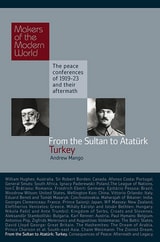
From the Sultan to Atatürk
TurkeyAndrew Mango
Haus Publishing, 2009
World War I sounded the death knell of empires. The forces of disintegration affected several empires simultaneously. To that extent they were impersonal. But prudent statesmen could delay the death of empires, rulers such as Emperor Franz Josef II of Austria-Hungary and the Ottoman Sultan Abdülhamid II. Adventurous rulers - Kaiser Wilhelm of Germany and Enver Pasha in the Ottoman Empire - hastened it. Enver's decision to enter the war on the side of Germany destroyed the Ottoman state. It may have been doomed in any case, but he was the agent of its doom. The last Sultan Mehmet VI Vahdettin thought he could salvage the Ottoman state in something like its old form. But Vahdettin and his ministers could not succeed because the victorious Allies had decided on the final partition of the Ottoman state. The chief proponent of partition was Lloyd George, heir to the Turcophobe tradition of British liberals, who fell under the spell of the Greek irredentist politician Venizelos. With these two in the lead, the Allies sought to impose partition on the Sultan's state. When the Sultan sent his emissaries to the Paris peace conference they could not win a reprieve. The Treaty of Sèvres which the Sultan's government signed put an end to Ottoman independence. The Treaty of Sèvres was not ratified. Turkish nationalists, with military officers in the lead, defied the Allies, who promptly broke ranks, each one trying to win concessions for himself at the expense of the others. Mustafa Kemal emerged as the leader of the military resistance. Diplomacy allowed Mustafa Kemal to isolate his people's enemies: Greek and Armenian irredentists. Having done so, he defeated them by force of arms. In effect, the defeat of the Ottoman empire in the First World War was followed by the Turks' victory in two separate wars: a brief military campaign against the Armenians and a long one against the Greeks. Lausanne - where General Ismet succeeded in securing peace on Turkey's terms - was the founding charter of the modern Turkish nation state. But more than that it showed that empires could no longer rule peoples against their wishes. This need not be disastrous: Mustafa Kemal demonstrated that the interests of developed countries were compatible with those of developing ones. He fought the West in order to become like it. Where his domestic critics wanted to go on defying the West, Mustafa Kemal saw that his country could fare best in cooperation with the West.
[more]
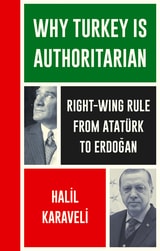
Why Turkey is Authoritarian
Right-Wing Rule from Atatürk to ErdoganHalil Karaveli
Pluto Press, 2018
For the last century, the Western world has regarded Turkey as a pivotal case of the 'clash of civilisations' between Islam and the West. Why Turkey is Authoritarian offers a radical challenge to this conventional narrative. Halil Karaveli highlights the danger in viewing events in Turkey as a war between a 'westernising' state and the popular masses defending their culture and religion, arguing instead for a class analysis that is largely ignored in the Turkish context.
This book goes beyond cultural categories that overshadow more complex realities when thinking about the 'Muslim world', while highlighting the ways in which these cultural prejudices have informed ideological positions. Karaveli argues that Turkey's culture and identity have disabled the Left, which has largely been unable to transcend these divisions.
This book asks the crucial question: why does democracy continue to elude Turkey? Ultimately, Karaveli argues that Turkish history is instructive for a left that faces the global challenge of a rising populist right, which succeeds in mobilising culture and identity to its own purposes.
Published in partnership with the Left Book Club.
[more]