Results by title
50 books match the query 'Athens (Greece)' and 8 start with a

A Midsummer Night's Dream
William Shakespeare
Arizona Center for Medieval and Renaissance Studies, 2021
Tony Award–winning and Oscar-nominated storyteller Jeffrey Whitty offers his adaptation of A Midsummer Night’s Dream, mindfully adapted into modern language. Matching the Bard line for line, rhyme for rhyme, Whitty illuminates Shakespeare’s meaning for modern audiences while maintaining the play’s storytelling architecture, emotional texture, and freewheeling humor. Designed to supplement, not supplant, the original, Whitty’s Midsummer cuts through the centuries to bring audiences a fresh, moment-by-moment take, designed to flow as effortlessly for modern audiences as Shakespeare’s beloved classic played to the Elizabethans.
This translation was written as part of the Oregon Shakespeare Festival’s Play On! project, which commissioned new translations of thirty-nine Shakespeare plays. These translations present the work of "The Bard" in language accessible to modern audiences while never losing the beauty of Shakespeare’s verse. These volumes make these works available for the first time in print—a new First Folio for a new era.
A Student Commentary on Pausanias Book 1
Patrick Paul Hogan
University of Michigan Press, 2014
A Student Commentary on Pausanias Book 2
Patrick Paul Hogan
University of Michigan Press, 2018
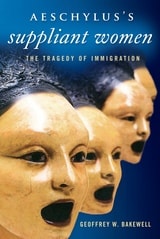
Aeschylus’s Suppliant Women
The Tragedy of ImmigrationGeoffrey W. Bakewell
University of Wisconsin Press, 2013
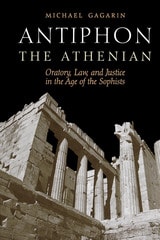
Antiphon the Athenian
Oratory, Law, and Justice in the Age of the SophistsBy Michael Gagarin
University of Texas Press, 2002
Winner, Friends of the Dallas Public Library Award from the Texas Institute of Letters, 2003
Antiphon was a fifth-century Athenian intellectual (ca. 480-411 BCE) who created the profession of speechwriting while serving as an influential and highly sought-out adviser to litigants in the Athenian courts. Three of his speeches are preserved, together with three sets of Tetralogies (four hypothetical paired speeches), whose authenticity is sometimes doubted. Fragments also survive of intellectual treatises on subjects including justice, law, and nature (physis), which are often attributed to a separate Antiphon the Sophist. Were these two Antiphons really one and the same individual, endowed with a wide-ranging mind ready to tackle most of the diverse intellectual interests of his day?
Through an analysis of all these writings, this book convincingly argues that they were composed by a single individual, Antiphon the Athenian. Michael Gagarin sets close readings of individual works within a wider discussion of the fifth-century Athenian intellectual climate and the philosophical ferment known as the sophistic movement. This enables him to demonstrate the overall coherence of Antiphon's interests and writings and to show how he was a pivotal figure between the sophists and the Attic orators of the fourth century. In addition, Gagarin's argument allows us to reassess the work of the sophists as a whole, so that they can now be seen as primarily interested in logos (speech, argument) and as precursors of fourth-century rhetoric, rather than in their usual role as foils for Plato.
Aristotle Detective
An Aristotle Detective NovelMargaret Doody
University of Chicago Press, 2014
In Aristotle Detective, we first meet Stephanos—naive Watson to Aristotle’s learned Holmes—a young landed Athenian and student of Aristotle. With the aid of his cunning, olive-loving teacher, Stephanos must clear his exiled cousin of murder and save his family’s honor in a tense public trial. Will Stephanos survive to cinch the case?
Aristotle and Poetic Justice
An Aristotle Detective NovelMargaret Doody
University of Chicago Press, 2014
Stephanos and his teacher return in Aristotle and Poetic Justice, when a party given by wealthy Athenian silver miners leads to kidnapping, a ghost, a road trip to Delphi, and, of course, murder. More historical fiction than a detective novel, this sequel runs the gamut of Athenian social customs, myth, politics, and economics—from the trials of virgin love to the dangers of silver lust.
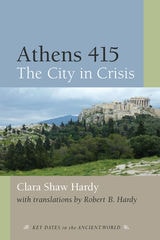
Athens 415
The City in CrisisClara Shaw Hardy, with translations by Robert B. Hardy
University of Michigan Press, 2020
On a summer night in 415 BCE, unknown persons systematically mutilated most of the domestic “herms”—guardian statues of the god Hermes—in Athens. The reaction was immediate and extreme: the Athenians feared a terrifying conspiracy was underway against the city and its large fleet—and possibly against democracy itself. The city established a board of investigators, which led to informants, accusations, and flight by many of the accused. Ultimately, dozens were exiled or executed, their property confiscated.
This dramatic period offers the opportunity to observe the city in crisis. Sequential events allow us to see the workings of the major institutions of the city (assembly, council, law courts, and theater, as well as public and private religion). Remarkably, the primary sources for these tumultuous months name conspirators and informants from a very wide range of status-groups: citizens, women, slaves, and free residents. Thus the incident provides a particularly effective entry-point into a full multifaceted view of the way Athens worked in the late fifth century.
Designed for classroom use, Athens 415 is no potted history, but rather a source-based presentation of ancient urban life ideal for the study of a people and their institutions and beliefs. Original texts—all translated by poet Robert B. Hardy—are presented along with thoughtful discussion and analyses by Clara Shaw Hardy in an engaging narrative that draws students into Athens’ crisis.