Results by title
4 books match the query 'Atkins, Leah Rawls'
Alabama Governors
A Political History of the StateSamuel L. Webb
University of Alabama Press, 2001
The story of Alabama's governors has been often bizarre, occasionally inspiring, but never dull. Several of the state's early governors fought duels; one killed his wife's lover. A Reconstruction era-governor barricaded himself in his administrative office and refused to give it up when voters failed to reelect him. A 20th-century governor, an alumnus of Yale, married his first cousin and served as an officer in the Ku Klux Klan.
This collection of biographical essays, written by 34 noted historians and political scientists, chronicles the foibles and idiosyncrasies, in and out of office, of those who have served as the state's highest elected official. It also describes their courage; their meaningful policy initiatives; their accomplishments and failures; the complex factors that led to their actions or inaction; and the enormous consequences of their choices on the state's behalf.
Taken together, the essays provide a unified history of the state, with its recurring themes of race, federal-state relations, economic development, taxation, and education. Alabama Governors is certain to become an invaluable resource for teachers, students, librarians, journalists, and anyone interested in the colorful history and politics of the state.
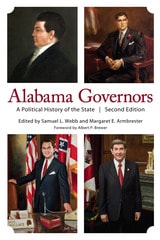
Alabama Governors
A Political History of the StateSamuel L. Webb
University of Alabama Press, 2014
An entirely revised and updated edition of the best-selling 2001 original guide to the leaders, politics, and personalities that shaped Alabama's history.
This collection of biographical essays, written by thirty-four noted historians and political scientists, chronicles the times, careers, challenges, leadership, and legacies of the fifty-seven men and one woman who have served as the state's highest elected official. The book is organized chronologically into six sections that cover Alabama’s years as a US territory and its early statehood, the 1840s through the Civil War and Reconstruction, the late nineteenth-century Bourbon era, twentieth-century progressive and wartime governors, the Civil Rights era and George Wallace’s period of influence, and recent chief executives in the post-Wallace era.
The political careers of these fifty-eight individuals reflect the story of Alabama itself. Taken together, these essays provide a unified history of the state, with its recurring themes of race, federal-state relations, tensions between north and south Alabama, economic development, taxation, and education.
Alabama Governors expertly delineates the decisions and challenges of the chief executives, their policy initiatives, their accomplishments and failures, and the lasting impact of their terms. The book also includes the true and sometimes scandalous anecdotes that pepper Alabama’s storied history. Several of the state's early governors fought duels; one killed his wife's lover. A Reconstruction era-governor barricaded himself in his office and refused to give it up when voters failed to reelect him. A twentieth-century governor, an alumnus of Yale, served as an officer in the Ku Klux Klan.
This entirely updated and revised edition includes enlarged and enhanced images of each governor. Alabama Governors is certain to become a valuable resource for teachers, students, librarians, journalists, and anyone interested in the colorful history of Alabama politics.
Alabama
The History of a Deep South StateWilliam Warren Rogers
University of Alabama Press, 1994

Alabama
The History of a Deep South State, Bicentennial EditionWilliam Warren Rogers, Robert David Ward, Leah Rawls Atkins, and Wayne Flynt
University of Alabama Press, 2018
A definitive bicentennial history of Alabama and its place in the American South.
Alabama: The History of a Deep South State, Bicentennial Edition is a comprehensive narrative account of the state from its earliest days to the present. This edition, updated to celebrate the state’s bicentennial year, offers a detailed survey of the colorful, dramatic, and often controversial turns in Alabama’s evolution. Organized chronologically and divided into three main sections—the first concluding in 1865, the second in 1920, and the third bringing the story to the present—makes clear and interprets the major events that occurred during Alabama’s history within the larger context of the South and the nation.
Once the home of aboriginal inhabitants, Alabama was claimed and occupied by a number of European nations prior to becoming a permanent part of the United States in 1819. A cotton and slave state for more than half of the nineteenth century, Alabama seceded in 1861 to join the Confederate States of America, and occupied an uneasy and uncertain place in America’s post-Civil War landscape. Alabama’s role in the twentieth century has been equally tumultuous and dramatic.
General readers as well as scholars will welcome this up-to-date and scrupulously researched history of Alabama, which examines such traditional subjects as politics, military history, economics, race, and class. It contains essential accounts devoted to Native Americans, women, and the environment, as well as detailed coverage of health, education, organized labor, civil rights, and the many cultural developments, from literature to sport, that have enriched Alabama’s history. The stories of individual leaders, from politicians to creative artists, are also highlighted. A key facet of this landmark historical narrative is the strong emphasis placed on the common everyday people of Alabama, those who have been rightly described as the “bone and sinew” of the state.