Results by title
8 books match the query 'Atmospheres'
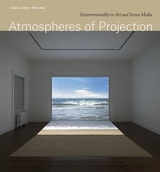
Atmospheres of Projection
Environmentality in Art and Screen MediaGiuliana Bruno
University of Chicago Press, 2022
Bringing together cultural history, visual studies, and media archaeology, Bruno considers the interrelations of projection, atmosphere, and environment.
Projection has long been transforming space, from shadow plays to camera obscuras and magic lantern shows. Our fascination with projection is alive on the walls of museums and galleries and woven into our daily lives. Giuliana Bruno explores the histories of projection and atmosphere in visual culture and their continued importance to contemporary artists who are reinventing the projective imagination with atmospheric thinking and the use of elemental media.
To explain our fascination with projection and atmosphere, Bruno traverses psychoanalysis, environmental philosophy, architecture, the history of science, visual art, and moving image culture to see how projective mechanisms and their environments have developed over time. She reveals how atmosphere is formed and mediated, how it can change, and what projection can do to modify a site. In so doing, she gives new life to the alchemic possibilities of transformative projective atmospheres. Showing how their “environmentality” produces sites of exchange and relationality, this book binds art to the ecology of atmosphere.
[more]

Atmospheres of Violence
Structuring Antagonism and the Trans/Queer UngovernableEric A. Stanley
Duke University Press, 2021
Advances in LGBTQ rights in the recent past—marriage equality, the repeal of Don't Ask, Don't Tell, and the expansion of hate crimes legislation—have been accompanied by a rise in attacks against trans, queer and/or gender-nonconforming people of color. In Atmospheres of Violence, theorist and organizer Eric A. Stanley shows how this seeming contradiction reveals the central role of racialized and gendered violence in the United States. Rather than suggesting that such violence is evidence of individual phobias, Stanley shows how it is a structuring antagonism in our social world. Drawing on an archive of suicide notes, AIDS activist histories, surveillance tapes, and prison interviews, they offer a theory of anti-trans/queer violence in which inclusion and recognition are forms of harm rather than remedies to it. In calling for trans/queer organizing and worldmaking beyond these forms, Stanley points to abolitionist ways of life that might offer livable futures.
[more]
Comparative Climatology of Terrestrial Planets
Edited by Stephen J. Mackwell, Amy A. Simon-Miller, Jerald W. Harder, and Mark A. Bullock
University of Arizona Press, 2014
The early development of life, a fundamental question for humankind, requires the presence of a suitable planetary climate. Our understanding of how habitable planets come to be begins with the worlds closest to home. Venus, Earth, and Mars differ only modestly in their mass and distance from the Sun, yet their current climates could scarcely be more divergent. Only Earth has abundant liquid water, Venus has a runaway greenhouse, and evidence for life-supporting conditions on Mars points to a bygone era. In addition, an Earth-like hydrologic cycle has been revealed in a surprising place: Saturn’s cloud-covered satellite Titan has liquid hydrocarbon rain, lakes, and river networks.
Deducing the initial conditions for these diverse worlds and unraveling how and why they diverged to their current climates is a challenge at the forefront of planetary science. Through the contributions of more than sixty leading experts in the field, Comparative Climatology of Terrestrial Planets sets forth the foundations for this emerging new science and brings the reader to the forefront of our current understanding of atmospheric formation and climate evolution. Particular emphasis is given to surface-atmosphere interactions, evolving stellar flux, mantle processes, photochemistry, and interactions with the interplanetary environment, all of which influence the climatology of terrestrial planets. From this cornerstone, both current professionals and most especially new students are brought to the threshold, enabling the next generation of new advances in our own solar system and beyond.
Contents
Part I: Foundations
Jim Hansen
Mark Bullock
Scot Rafkin
Caitlin Griffith
Shawn Domagal-Goldman and Antigona Segura
Kevin Zahnle
Part II: The Greenhouse Effect and Atmospheric Dynamics
Curt Covey
G. Schubert and J. Mitchell
Tim Dowling
Francois Forget and Sebastien Lebonnois
Vladimir Krasnopolsky
Adam Showman
Part III: Clouds, Hazes, and Precipitation
Larry Esposito
A. Määttänen, K. Pérot, F. Montmessin, and A. Hauchecorne
Nilton Renno
Zibi Turtle
Mark Marley
Part IV: Surface-Atmosphere Interactions
Colin Goldblatt
Teresa Segura et al.
John Grotzinger
Adrian Lenardic
D. A. Brain, F. Leblanc, J. G. Luhmann, T. E. Moore, and F. Tian
Part V: Solar Influences on Planetary Climate
Aaron Zent
Jerry Harder
F. Tian, E. Chassefiere, F. Leblanc, and D. Brain
David Des Marais
[more]
Origin and Evolution of Planetary and Satellite Atmospheres
Edited by S. K. Atreya, J. B. Pollack, and M.S. Matthews
University of Arizona Press, 1989
An integrated discussion of the similarities and differences between the atmospheres of various bodies of the solar system, including the Earth.
[more]
Postcolonial Air and Atmospheres
Elemental life and environmental crisisEdited by Sarah Nuttall and Isabel Hofmeyr
University College London, 2026
This study expands the traditional scope of air and atmosphere studies to explore atmospheres and aesthetics in postcolonial contexts.
This volume puts two traditions of scholarship into conversation: Euro-American work on air and atmospheres, and emergent postcolonial debates on these themes. Drawing on the strengths of the first, this collection probes its limits, while mapping an emergent field of postcolonial research on air and atmospheres.
Postcolonial Air and Atmospheres recontextualizes debates on atmospheres and aesthetics, exploring these themes in relation to the uneven hemispheric terrains of material decay and toxicity. It extends the narrow spatial purview of the Euro-American scholarship by taking an empire-wide perspective, considering historical questions of air and enslavement alongside South Asian histories of air conditioning and the toxic atmospheres of extractive industries. It develops a phenomenology of breathing in a range of postcolonial settings to revisit the theorizations of air and breath in Western critical theoretical scholarship. The collection comprises three sections. “Affective Atmospheres” explores the materialities of air while foregrounding atmospheres as sites of affect, politics, and power in the postcolony. “Unfree and Impure Airs” foregrounds clean and toxic air and who breathes them, along with the politics and technologies of how these unequal forms of air were and are produced. “Breathing In” centers practices of breath as a means of analyzing air and atmospheres.
[more]

Selected Papers, Volume 1
Stellar Structure and Stellar AtmospheresS. Chandrasekhar
University of Chicago Press, 1989
This is the first of six volumes collecting significant papers of the distinguished astrophysicist and Nobel laureate S. Chandrasekhar. His work is notable for its breadth as well as for its brilliance; his practice has been to change his focus from time to time to pursue new areas of research. The result has been a prolific career full of discoveries and insights, some of which are only now being fully appreciated.
Chandrasekhar has selected papers that trace the development of his ideas and that present aspects of his work not fully covered in the books he has periodically published to summarize his research in each area.
Volume 1, Stellar Structure and Stellar Atmospheres, covers primarily the period 1930-40 and includes early papers on the theory of white dwarfs. In the Preface, Chandrasekhar explains the criteria for selection and provides historical background. Each subsequent volume will include a foreword by an authority on the topics covered.
[more]
Selected Papers, Volume 2
Radiative Transfer and Negative Ion of HydrogenS. Chandrasekhar
University of Chicago Press, 1989
This is the second of six volumes collecting significant papers of the distinguished astrophysicist and Nobel laureate S. Chandrasekhar. His work is notable for its breadth as well as for its brilliance; his practice has been to change his focus from time to time to pursue new areas of research. The result has been a prolific career full of discoveries and insights, some of which are only now being fully appreciated.
Chandrasekhar has selected papers that trace the development of his ideas and that present aspects of his work not fully covered in the books he has periodically published to summarize his research in each area.
Volume 2 covers primarily the period 1940-50 and includes papers on the theory of radiative transfer and on the physics and astrophysics of the negative ion of hydrogen. Of particular note are Chandrasekhar's Gibbs Lecture to the American Mathematical Society in 1946 and his "Personal Account" presented at a conference at Erevan in the U.S.S.R. in 1981. A foreword by T. W. Mullikin, a distinguished scholar in the area of radiative transfer, and an author's note provide a historical context for the papers.
[more]
Theory of Neutron Star Magnetospheres
F. Curtis Michel
University of Chicago Press, 1990
An incomparable reference for astrophysicists studying pulsars and other kinds of neutron stars, Theory of Neutron Star Magnetospheres sums up two decades of astrophysical research. It provides in one volume the most important findings to date on this topic, essential to astrophysicists faced with a huge and widely scattered literature.
F. Curtis Michel, who was among the first theorists to propose a neutron star model for radio pulsars, analyzes competing models of pulsars, radio emission models, winds and jets from pulsars, pulsating X-ray sources, gamma-ray burst sources, and other neutron-star driven phenomena. Although the book places primary emphasis on theoretical essentials, it also provides a considerable introduction to the observational data and its organization. Michel emphasizes the problems and uncertainties that have arisen in the research as well as the considerable progress that has been made to date.
F. Curtis Michel, who was among the first theorists to propose a neutron star model for radio pulsars, analyzes competing models of pulsars, radio emission models, winds and jets from pulsars, pulsating X-ray sources, gamma-ray burst sources, and other neutron-star driven phenomena. Although the book places primary emphasis on theoretical essentials, it also provides a considerable introduction to the observational data and its organization. Michel emphasizes the problems and uncertainties that have arisen in the research as well as the considerable progress that has been made to date.
[more]