Results by title
10 books match the query 'Atomic & Molecular'
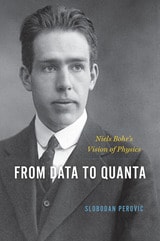
From Data to Quanta
Niels Bohr’s Vision of PhysicsSlobodan Perovic
University of Chicago Press, 2021
Niels Bohr was a central figure in quantum physics, well known for his work on atomic structure and his contributions to the Copenhagen interpretation of quantum mechanics. In this book, philosopher of science Slobodan Perović explores the way Bohr practiced and understood physics, and analyzes its implications for our understanding of modern science. Perović develops a novel approach to Bohr’s understanding of physics and his method of inquiry, presenting an exploratory symbiosis of historical and philosophical analysis that uncovers the key aspects of Bohr’s philosophical vision of physics within a given historical context.
To better understand the methods that produced Bohr’s breakthrough results in quantum phenomena, Perović clarifies the nature of Bohr’s engagement with the experimental side of physics and lays out the basic distinctions and concepts that characterize his approach. Rich and insightful, Perović’s take on the early history of quantum mechanics and its methodological ramifications sheds vital new light on one of the key figures of modern physics.
Image and Logic
A Material Culture of MicrophysicsPeter Galison
University of Chicago Press, 1997
Image and Logic is the most detailed engagement to date with the impact of modern technology on what it means to "do" physics and to be a physicist. At the beginning of this century, physics was usually done by a lone researcher who put together experimental apparatus on a benchtop. Now experiments frequently are larger than a city block, and experimental physicists live very different lives: programming computers, working with industry, coordinating vast teams of scientists and engineers, and playing politics.
Peter L. Galison probes the material culture of experimental microphysics to reveal how the ever-increasing scale and complexity of apparatus have distanced physicists from the very science that drew them into experimenting, and have fragmented microphysics into different technical traditions much as apparatus have fragmented atoms to get at the fundamental building blocks of matter. At the same time, the necessity for teamwork in operating multimillion-dollar machines has created dynamic "trading zones," where instrument makers, theorists, and experimentalists meet, share knowledge, and coordinate the extraordinarily diverse pieces of the culture of modern microphysics: work, machines, evidence, and argument.
Kaon Physics
Edited by Jonathan L. Rosner and Bruce D. Winstein
University of Chicago Press, 2001
Topics covered include the history of kaon physics, direct CP violation in kaon decays, time reversal violation, CPT studies, theoretical aspects of kaon physics, rare kaon decays, hyperon physics, charm: CP violation and mixing, the physics of B mesons, and future opportunities for kaon physics in the twenty-first century.

Propagation, Scattering and Diffraction of Electromagnetic Waves
A.S. Ilyinski
The Institution of Engineering and Technology, 1993
Quantum Statistical Physics of Molecular Systems
František Šanda
Karolinum Press, 2026
A text designed for courses in quantum statistical physics, which explains the concept of the density matrix and links it with the quantum theory of relaxation and decoherence and with the most common spectroscopic probes.
This book covers the material for a one-semester introductory course in quantum statistical physics, designed for Master’s students in chemical physics and biophysics preparing to work in the fields of NMR, vibrational spectroscopy, or electronic spectroscopy. The course introduces the density matrix formalism and connects it to students’ existing knowledge of classical statistical physics. It then presents the main results of quantum relaxation theory in terms of population transfer and decoherence, and relates quantum relaxation to its most widely used experimental probes in spectroscopy.
Stars as Laboratories for Fundamental Physics
The Astrophysics of Neutrinos, Axions, and Other Weakly Interacting ParticlesGeorg G. Raffelt
University of Chicago Press, 1996
Raffelt presents the many uses of stellar astrophysics for research in basic particle physics. He focuses primarily on the properties and nongravitational interactions of elementary particles. Numerous graphs and figures complement the text.
Stars as Laboratories for Fundamental Physics is a valuable reference for cosmologists, astrophysicists, and particle physicists.
The Greatest Scientific Gamble
A Story of Impossible Odds, Rival Scientists, and the Atomic BombMichael Joseloff
Michigan State University Press, 2026
During World War II, a group of physicists who had once been close friends found themselves on opposite sides of a deadly race. German scientist Werner Heisenberg and American physicists Robert Oppenheimer, Enrico Fermi, and Sam Goudsmit were all leading figures in nuclear research. But after the attack on Pearl Harbor, their shared passion for science turned into a high-stakes competition to build the world’s first atomic bomb—a weapon that could determine the outcome of the war. Heisenberg had a two-year head start, and the possibility that Nazi Germany might beat the Allies to the bomb terrified American scientists. The Manhattan Project, led by U.S. Army General Leslie Groves, became a massive effort to catch up. Fear of Heisenberg haunted Manhattan Project scientists. At one point, Groves even approved plans to bomb Heisenberg’s lab and assassinate him to stop Germany’s progress. Meanwhile, Sam Goudsmit led a secret military unit tasked with tracking down Heisenberg and uncovering the truth about the Nazi nuclear program. What they found would surprise everyone. The Greatest Scientific Gamble tells the dramatic and little-known story of how personal relationships, wartime fear, and scientific ambition collided in the race to unlock the power of the atom.
The Man Who Broke Reality
Niels Bohr and the Making of Modern PhysicsPhilip Ball
University of Chicago Press, 2026
From the brilliant Philip Ball, a thrilling biography of Nobel Prize–winning Danish physicist Niels Bohr, the most radical quantum mechanician of all.
In the first half of the twentieth century, the tremendous energy locked up in the nucleus of an atom was discovered and then liberated, bringing both the promise of utopia and the threat of apocalypse. The dawn of the nuclear age is often associated with Albert Einstein, whose iconic equation E = mc2 revealed the staggering energy available from radioactive transformation, or with J. Robert Oppenheimer, who led the project at Los Alamos to build the first nuclear bombs. But the person who arguably did more than any other to shape the Promethean era in which we now live was the Danish physicist Niels Bohr.
In The Man Who Broke Reality, renowned science communicator Philip Ball reveals that it was Bohr who first explained the physics of the nuclear atom, and it was his model of the atom’s dense nucleus that enabled scientists to understand how it could be split apart. Ball also shows how Bohr was the central figure in the development of quantum mechanics, the theory of matter and energy that destabilized centuries of thinking not just about the microscopic nature of the world but about physical reality itself.
Bohr’s story is the story of modern physics and its transformative impact on the world. But The Man Who Broke Reality is not merely an intellectual drama. It chronicles a heroic life lived in turbulent times, across two world wars, the Manhattan Project, and the arms race of the Cold War. And it establishes Bohr as one of the most profound, inventive, and iconoclastic thinkers of the twentieth century.
The Man Who Broke Reality
Niels Bohr and the Making of Modern PhysicsPhilip Ball
University of Chicago Press, 2026
From the brilliant Philip Ball, a thrilling biography of Nobel Prize–winning Danish physicist Niels Bohr, the most radical quantum mechanician of all.
In the first half of the twentieth century, the tremendous energy locked up in the nucleus of an atom was discovered and then liberated, bringing both the promise of utopia and the threat of apocalypse. The dawn of the nuclear age is often associated with Albert Einstein, whose iconic equation E = mc2 revealed the staggering energy available from radioactive transformation, or with J. Robert Oppenheimer, who led the project at Los Alamos to build the first nuclear bombs. But the person who arguably did more than any other to shape the Promethean era in which we now live was the Danish physicist Niels Bohr.
In The Man Who Broke Reality, renowned science communicator Philip Ball reveals that it was Bohr who first explained the physics of the nuclear atom, and it was his model of the atom’s dense nucleus that enabled scientists to understand how it could be split apart. Ball also shows how Bohr was the central figure in the development of quantum mechanics, the theory of matter and energy that destabilized centuries of thinking not just about the microscopic nature of the world but about physical reality itself.
Bohr’s story is the story of modern physics and its transformative impact on the world. But The Man Who Broke Reality is not merely an intellectual drama. It chronicles a heroic life lived in turbulent times, across two world wars, the Manhattan Project, and the arms race of the Cold War. And it establishes Bohr as one of the most profound, inventive, and iconoclastic thinkers of the twentieth century.

The Story of Spin
Sin-itiro Tomonaga
University of Chicago Press, 1998
"This piece of the history of physics will provide excellent and exciting reading. . . . It also provides the personal touch of an expert in the field that is so often lacking in the physics literature. I recommend it very highly."—Fritz Rohrlich, Physics Today
Sin-itiro Tomonaga was awarded the Nobel Prize for Physics in 1965.