Results by title

5 books match the query 'Attica'
cover of A Student Commentary on Pausanias Book 1

A Student Commentary on Pausanias Book 1

Patrick Paul Hogan

University of Michigan Press, 2014
Patrick Paul Hogan’s A Student Commentary on Pausanias Book 1 introduces the first book of Pausanias’ “Description of Greece” to students of Classical Greek. Pausanias’ second century CE work is the only surviving ancient description of the monuments and artwork of mainland Greece. Book 1 of the “Description” covers Athens, its demes, and Megara—that is, Attica, the heart of the ancient Greek world. It offers not only a walking description of buildings, statues, and artwork by an ancient traveler but also insight into the mindset of an educated Greek of the Roman imperial age: his reaction to Roman domination and Classical Greek history and culture, his deeply felt religious beliefs, and his ideas regarding Hellenism and Hellenic identity.

This textbook, the first on Pausanias aimed at students in almost a century, brings Pausanias back into the classroom for a new generation of readers. It is based on the Greek text edited by M. H. Rocha-Pereira and includes philological and historical commentary by Hogan. This volume elucidates difficult syntax and helps the reader with the immense number of names and places Pausanias mentions. It is suitable for students of Classical Greek at the graduate and undergraduate levels, whether Classical philologists or Classical archaeologists and art historians. Professors of archaeology will find this textbook an excellent starting point for any course on Pausanias and easily supplemented by their own knowledge of material remains and modern finds.
[more]
cover of A Student Commentary on Pausanias Book 2

A Student Commentary on Pausanias Book 2

Patrick Paul Hogan

University of Michigan Press, 2018
Patrick Paul Hogan guides students through Pausanias’ description of the strategic and rich city of Corinth and its neighbors
[more]
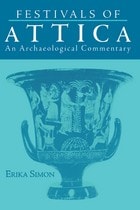
cover of Festivals of Attica: An Archaeological Commentary

Festivals of Attica

An Archaeological Commentary

Erika Simon

University of Wisconsin Press, 2002

The festivals of the Athenian sacred calendar constitute a vital key to classical Greek culture and religion.  Erika Simon sets out here to explicate those complex and often obscure festivals.  By careful marshaling of a variety of proofs from literary, historical, and archaeological sources, she is able to justify some startling conclusions and achieve a comprehensive and truly original synthesis that clarifies, as never before, the probable origins and meanings of the Attic cults.
[more]
cover of The Phratries of Attica

The Phratries of Attica

S. D. Lambert

University of Michigan Press, 1998
The Phratries of Attica provides the first comprehensive account in English of a key institution in ancient Athens: the Attic phratries. These hereditary groups of citizens, linked to one locale or more in Attica, played a crucial role in regulating access to Athenian citizenship. The author concentrates upon the evidence — largely empirical— for the period 450-250 B.C., but he also considers the role of the phratry in the reforms of Cleisthenes and examines the institution’s probable demise in the second century B.C.S. D. Lambert adopts an innovative view in his argument that phratries reflected the democratic norm of the era, rather than being dominated by aristocrats. In presenting this view heincludes a complete account of the festival Apatouria, of the procedures for admission to citizenship, of the role of women in phratries, and of known phratry property and financial transactions.The Phratries of Attica will be indispensableto students of Greek and Athenian history and anthropology. An Appendix contains all inscriptions connected to Attic phratries, with translation and selective commentary.
[more]
cover of When the Smoke Cleared: Attica Prison Poems and Journal

When the Smoke Cleared

Attica Prison Poems and Journal

Celes Tisdale, editor

Duke University Press, 2022

Following the Attica prison uprising in September 1971, Celes Tisdale—a poet and then professor at Buffalo State College—began leading poetry workshops with those incarcerated at Attica. Tisdale’s workshop created a space of radical Black creativity and solidarity, in which poets who lived through the uprising were able to turn their experiences into poetry. The poems written by Tisdale’s students were published as Betcha Ain’t: Poems from Attica in 1974. When the Smoke Cleared contains the entirety of Betcha Ain’t, Tisdale’s own poems and journal entries from the three years he taught at Attica, a previously unpublished collection of poems by Attica poets, and a critical introduction by poet Mark Nowak. In addition to the poetry, Tisdale’s journal entries give readers a unique opportunity to experience what it was like to enter Attica as an educator and return week after week to discuss poetry. When the Smoke Cleared showcases these poets’ achievements, their desire for self-determination, and their historical role as storytellers of Black life in a prison monitored exclusively by white guards and administrators.
[more]