Results by title
18 books match the query 'Audiences'
Acting the Part
Audience Participation in PerformanceE. B. Hunter
University of Michigan Press, 2025

Audiences and Publics
When Cultural Engagement Matters for the Public SphereEdited by Sonia Livingstone
Intellect Books, 2005
Empathy and Performance
Enactments of Power in Latinx AmericaLaura V. Sández
Vanderbilt University Press, 2024
To survey different answers to these queries, Sández studies Indigurrito (Nao Bustamante); Dominicanish (Josefina Báez); ¡Bienvenidos Blancos! or Welcome White People! (Alex Torra); the apology delivered by the group Veterans Stand with Standing Rock during protests against the Dakota Access Pipeline; and Kukuli Velarde’s body of work, from We, the Colonized Ones to A Mi Vida. In these artistic enactments, which range from 1992 to 2021, the historical construct of boundaries and bodies becomes evident. Following recent work on empathy by Lanzoni, Maibom, Calloway-Thomas, Bloom, Hogan, and Matravers, among others, Sández examines in-group/out-group divisions, the establishment of identity categories through performance, and the exploration of subaltern identities.
Exploiting Fandom
How the Media Industry Seeks to Manipulate FansMel Stanfill
University of Iowa Press, 2019
By bringing industry studies and fan studies into the conversation, Stanfill looks closely at just who exactly the industry considers “proper fans” in terms of race, gender, age, and sexuality, and interrogates how digital media have influenced consumption, ultimately finding that the invitation to participate is really an incitement to consume in circumscribed, industry-useful ways.
Listening to Homer
Tradition, Narrative, and AudienceRuth Scodel
University of Michigan Press, 2002
---Greece & Rome
---Irene J.F. de Jong, Gnomon
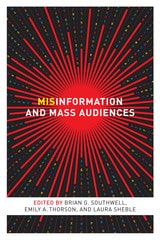
Misinformation and Mass Audiences
Edited by Brian G. Southwell, Emily A. Thorson, and Laura Sheble
University of Texas Press, 2018
Lies and inaccurate information are as old as humanity, but never before have they been so easy to spread. Each moment of every day, the Internet and broadcast media purvey misinformation, either deliberately or accidentally, to a mass audience on subjects ranging from politics to consumer goods to science and medicine, among many others. Because misinformation now has the potential to affect behavior on a massive scale, it is urgently important to understand how it works and what can be done to mitigate its harmful effects.
Misinformation and Mass Audiences brings together evidence and ideas from communication research, public health, psychology, political science, environmental studies, and information science to investigate what constitutes misinformation, how it spreads, and how best to counter it. The expert contributors cover such topics as whether and to what extent audiences consciously notice misinformation, the possibilities for audience deception, the ethics of satire in journalism and public affairs programming, the diffusion of rumors, the role of Internet search behavior, and the evolving efforts to counteract misinformation, such as fact-checking programs. The first comprehensive social science volume exploring the prevalence and consequences of, and remedies for, misinformation as a mass communication phenomenon, Misinformation and Mass Audiences will be a crucial resource for students and faculty researching misinformation, policymakers grappling with questions of regulation and prevention, and anyone concerned about this troubling, yet perhaps unavoidable, dimension of current media systems.
News Parade
The American Newsreel and the World as SpectacleJoseph Clark
University of Minnesota Press, 2020
A fascinating look at the United States’ conflicted relationship with news and the media, through the lens of the newsreel
When weekly newsreels launched in the early twentieth century, they offered the U.S. public the first weekly record of events that symbolized “indisputable evidence” of the news. In News Parade, Joseph Clark examines the history of the newsreel and how it changed the way Americans saw the world. He combines an examination of the newsreel’s methods of production, distribution, and reception with an analysis of its representational strategies to understand the newsreel’s place in the history of twentieth-century American culture and film history.
Clark focuses on the sound newsreel of the 1930s and 1940s, arguing that it represents a crucial moment in the development of a spectacular society where media representations of reality became more fully integrated into commodity culture. Using several case studies, including the newsreel’s coverage of Charles Lindbergh’s transatlantic flight and the Sino–Japanese War, News Parade shows how news film transformed the relationship between its audience and current events, as well as the social and political consequences of these changes. It pays particular attention to how discourses of race and gender worked together with the rhetoric of speed, mobility, and authority to establish the power and privilege of newsreel spectatorship.
In the age of fake news and the profound changes to journalism brought on by the internet, News Parade demonstrates how new technologies and media reshaped the American public’s relationship with the news in the 1930s—a history that can help us to better understand the transformations happening today.
No Innocent Bystanders
Performance Art and AudienceFrazer Ward
Dartmouth College Press, 2012
Postcinematic Vision
The Coevolution of Moving-Image Media and the SpectatorRoger F. Cook
University of Minnesota Press, 2020
A study of how film has continually intervened in our sense of perception, with far-ranging insights into the current state of lived experience
How has cinema transformed our senses, and how does it continue to do so? Positing film as a stage in the long coevolution of human consciousness and visual technology, Postcinematic Vision offer a fresh perspective on the history of film while providing startling new insights into the so-called divide between cinematic and digital media.
Starting with the argument that film viewing has long altered neural circuitry in our brains, Roger F. Cook proceeds to reevaluate film’s origins, as well as its merger with digital imaging in the 1990s. His animating argument is that film has continually altered the relation between media and human perception, challenging the visual nature of modern culture in favor of a more unified, pan-sensual way of perceiving. Through this approach, he makes original contributions to our understanding of how mediation is altering lived experience.
Along the way, Cook provides important reevaluations of well-known figures such as Franz Kafka, closely reading cinematic passages in the great author’s work; he reassesses the conventional wisdom that Marshall McLuhan was a technological determinist; and he lodges an original new reading of The Matrix. Full of provocative and far-reaching ideas, Postcinematic Vision is a powerful work that helps us see old concepts anew while providing new ideas for future investigation.
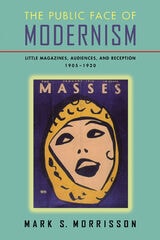
Public Face Of Modernism
Little Magazines, Audiences, And Reception, 1905-1920Mark S. Morrisson
University of Wisconsin Press, 2000
The phenomenal successes of new advertising agencies and mass market publishers did elicit what Morrisson calls a "crisis of publicity" for some modernists and for many concerned citizens in both countries. But, as Morrisson demonstrates, the vast influence of these industries on consumers also had a profound and largely overlooked effect upon many modernist authors, artists, and others. By exploring the publicity and audience reception of several of the most important modernist magazines of the period, The Public Face of Modernism shows how modernists, far from lamenting the destruction of meaningful art and public culture by the new mass market, actually displayed optimism about the power of mass-market technologies and strategies to transform and rejuvenate contemporary culture—and, above all, to restore a public function to art.
This reconstruction of the "public face of modernism" offers surprising new perceptions about the class, gender, racial, and even generational tensions within the public culture of the early part of the century, and provides a rare insight into the actual audiences for modernist magazines of the period. Moreover, in new readings of works by James Joyce, George Bernard Shaw, Wyndham Lewis, Ford Madox Ford, T. S. Eliot, William Carlos Williams, and many others, Morrisson shows that these contexts also had an impact on the techniques and concerns of the literature itself.
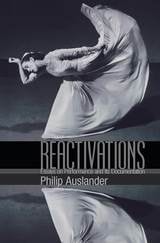
Reactivations
Essays on Performance and Its DocumentationPhilip Auslander
University of Michigan Press, 2018
performance from its documentation? What is the value of performance documentation?
The book treats performance documentation as a specific discursive use of media that arose in the middle of the 20th century alongside such forms of performance as the Happening and that is different, both discursively and as a practice, from traditional theater and dance photography. Philip Auslander explores the phenomenal relationship between the spectator who experiences the performance from the document and the document itself. The document is not merely a secondary iteration of the original event but a vehicle that gives us meaningful access to the performance itself as an artistic work.
Rhetorical Refusals
Defying Audiences' ExpectationsJohn Schilb
Southern Illinois University Press, 2007
The first book to explore rhetorical refusals—instances in which speakers and writers deliberately flout the conventions of rhetoric and defy their audiences’ expectations— Rhetorical Refusals: Defying Audiences’ Expectations challenges the reader to view these acts of academic rebellion as worthy of deeper analysis than they are commonly accorded, as rhetorical refusals can simultaneously reveal unspoken assumptions behind the very conventions they challenge, while also presenting new rhetorical strategies.
Through a series of case studies, John Schilb demonstrates the deeper meanings contained within rhetorical refusals: when dance critic Arlene Croce refused to see a production that she wrote about; when historian Deborah Lipstadt declined to debate Holocaust deniers; when President Bill Clinton denied a grand jury answers to their questions; and when Frederick Douglass refused to praise Abraham Lincoln unequivocally. Each of these unexpected strategies revealed issues of much greater importance than the subjects at hand. By carefully laying out an underlying framework with which to evaluate these acts, Schilb shows that they can variously point to the undue privilege of authority; the ownership of truth; the illusory divide between public and private lives; and the subjectivity of honor.
According to Schilb, rhetorical refusals have the potential to help political discourse become more inventive. To demonstrate this potential, Schilb looks at some notable cases in which invitations have led to unexpected results: comedian Stephen Colbert’s brazen performance at the White House Press Association dinner; poet Sharon Olds’s refusal to attend the White House Book Fair, and activist Cindy Sheehan’s display of an anti-war message at the 2006 State of the Union Address.
Rhetorical Refusals explores rhetorical theories in accessible language without sacrificing complexity and nuance, revealing the unspoken implications of unexpected deviations from rhetorical norms for classic political concepts like free debate and national memory. With case studies taken from art, politics, literature, and history, this book will appeal to scholars and students of English, communication studies, and history.
Siren Songs
Gender, Audiences, and Narrators in the OdysseyLillian Eileen Doherty
University of Michigan Press, 1995
Siren Songs synthesizes audience-oriented and narratological approaches, and examines the relationships among three kinds of audiences: internal, implied, and actual. The author prefaces her own reading of the Odyssey with an analysis of the issues posed by the earlier feminist readings on which she builds. Should the Odyssey be read as a "closed" text, that is, as one whose meaning is highly determined, or as an "open" text whose contradictions and ambiguities undercut its overt meanings?
Siren Songs presents a feminist critique of the Odyssey in an accessible manner aimed at a more general audience. All Greek is translated, and critical terminology is clearly defined.
Lillian Eileen Doherty is Associate Professor of Classics, University of Maryland, College Park.
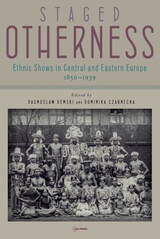
Staged Otherness
Ethnic Shows in Central and Eastern Europe, 1850–1939Dagnoslaw Demski
Central European University Press, 2022
The cultural phenomenon of exhibiting non-European people in front of the European audiences in the 19th and 20th century was concentrated in the metropolises in the western part of the continent. Nevertheless, traveling ethnic troupes and temporary exhibitions of non-European humans took place also in territories located to the east of the Oder river and Austria. The contributors to this edited volume present practices of ethnographic shows in Russia, Poland, Czechia, Slovenia, Hungary, Germany, Romania, and Austria and discuss the reactions of local audiences. The essays offer critical arguments to rethink narratives of cultural encounters in the context of ethnic shows. By demonstrating the many ways in which the western models and customs were reshaped, developed, and contested in Central and Eastern European contexts, the authors argue that the dominant way of characterizing these performances as “human zoos” is too narrow.
The contributors had to tackle the difficult task of finding traces other than faint copies of official press releases by the tour organizers. The original source material was drawn from local archives, museums, and newspapers of the discussed period. A unique feature of the volume is the rich amount of images that complement every single case study of ethnic shows.
The Audience Experience
A Critical Analysis of Audiences in the Performing ArtsEdited by Jennifer Radbourne, Hilary Glow, and Katya Johanson
Intellect Books, 2013
Watching While Black Rebooted!
The Television and Digitality of Black AudiencesBeretta E. Smith-Shomade
Rutgers University Press, 2024
Chapters rethink such historically significant programs as Roots and Underground, such seemingly innocuous programs as Soul Food, and such contemporary and culturally complicated programs as Being Mary Jane and Atlanta. The book makes a case for the centrality of these programs while always recognizing the racial dynamics that continue to shape Black representation on the small screen. Painting a decidedly introspective portrait across forty years of Black television, Watching While Black Rebooted sheds much-needed light on under examined demographics, broadens common audience considerations, and gives deference to the preferences of audiences and producers of Black-targeted programming.
Watching While Black
Centering the Television of Black AudiencesSmith-Shomade, Beretta E
Rutgers University Press, 2013
2013 Choice Outstanding Academic Title
Television scholarship has substantially ignored programming aimed at Black audiences despite a few sweeping histories and critiques. In this volume, the first of its kind, contributors examine the televisual diversity, complexity, and cultural imperatives manifest in programming directed at a Black and marginalized audience.
Watching While Black considers its subject from an entirely new angle in an attempt to understand the lives, motivations, distinctions, kindred lines, and individuality of various Black groups and suggest what television might be like if such diversity permeated beyond specialized enclaves. It looks at the macro structures of ownership, producing, casting, and advertising that all inform production, and then delves into television programming crafted to appeal to black audiences—historic and contemporary, domestic and worldwide.
Chapters rethink such historically significant programs as Roots and Black Journal, such seemingly innocuous programs as Fat Albert and bro’Town, and such contemporary and culturally complicated programs as Noah’s Arc, Treme, and The Boondocks. The book makes a case for the centrality of these programs while always recognizing the racial dynamics that continue to shape Black representation on the small screen. Painting a decidedly introspective portrait across forty years of Black television, Watching While Black sheds much-needed light on under-examined demographics, broadens common audience considerations, and gives deference to the the preferences of audiences and producers of Black-targeted programming.
Writing Himself Into History
Oscar Micheaux, His Silent Films, and His AudiencesBowser, Pearl
Rutgers University Press, 2000
Winner of the 2001 Kraszna-Krausz Moving Image Book Awards | Winner of the Theatre Library Association Award
Writing Himself Into History is an eagerly anticipated analysis of the career and artistry surrounding the legendary Black filmmaker Oscar Micheaux. With the exception of Spike Lee, Micheaux is the most famous—and prolific—African American film director. Between 1918 and 1948 he made more than 40 “race pictures,” movies made for and about African Americans. A man of immense creativity, he also wrote seven novels.
Pearl Bowser and Louise Spence concentrate here on the first decade of Micheaux’s career, when Micheaux produced and directed more than twenty silent features and built a reputation as a controversial and maverick entrepreneur. Placing his work firmly within his social and cultural milieu, they also examine Micheaeux’s family and life. The authors provide a close textual analysis of his surviving films (including The Symbol of the Unconquered, Within Our Gates, and Body and Soul), and highlight the rivalry between studios, dilemmas of assimilation versus separatism, gender issues, and class. In Search of Oscar Micheaux also analyzes Micheaux’s career as a novelist in relation to his work as a filmmaker.
This is a much-awaited book that is especially timely as interest in Micheaux’s work increases.