Results by title
14 books match the query 'Auschwitz (Concentration camp)'
A Jewish Kapo in Auschwitz
History, Memory, and the Politics of SurvivalTuvia Friling
Brandeis University Press, 2014
Auschwitz, Poland, and the Politics of Commemoration, 1945–1979
Jonathan Huener
Ohio University Press, 2003
Few places in the world carry as heavy a burden of history as Auschwitz. Recognized and remembered as the most prominent site of Nazi crimes, Auschwitz has had tremendous symbolic weight in the postwar world.
Auschwitz, Poland, and the Politics of Commemoration is a history of the Auschwitz memorial site in the years of the Polish People’s Republic. Since 1945, Auschwitz has functioned as a memorial and museum. Its monuments, exhibitions, and public spaces have attracted politicians, pilgrims, and countless participants in public demonstrations and commemorative events.
Jonathan Huener’s study begins with the liberation of the camp and traces the history of the State Museum at Auschwitz from its origins immediately after the war until the 1980s, analyzing the landscape, exhibitions, and public events at the site.
Based on extensive research and illustrated with archival photographs, Auschwitz, Poland, and the Politics of Commemoration accounts for the development and durability of a Polish commemorative idiom at Auschwitz. Emphasis on Polish national “martyrdom” at Auschwitz, neglect of the Shoah as the most prominent element of the camp’s history, political instrumentalization of the grounds and exhibitions—these were some of the more controversial aspects of the camp’s postwar landscape.
Professor Huener locates these and other public manifestations of memory at Auschwitz in the broad scope of Polish history, in the specific context of postwar Polish politics and culture, and against the background of Polish-Jewish relations. Auschwitz, Poland, and the Politics of Commemoration will be of interest to scholars, students, and general readers of the history of modern Poland and the Holocaust.
Birkenau, The Camp Of Death
Marco Nahon
University of Alabama Press, 1989
Charlotte Delbo
A Life ReclaimedGhislaine Dunant, Translated by Kathryn M. Lachman
University of Massachusetts Press, 2021
Ghislaine Dunant's unforgettable biography of Delbo, La vie retrouvée (2016), captivated French readers and was awarded the Prix Femina. Now translated into English for the first time, Charlotte Delbo: A Life Reclaimed depicts Delbo's lifelong battles as a working-class woman, as a survivor, as a leftist who broke from the Communist Party, and most of all, as a writer whose words compelled others to see.
Days and Memory
Charlotte Delbo
Northwestern University Press, 2001
This definitive translation is by Delbo's close friend, the author and theater critic Rosette Lamont, an expert on the works of Ionesco and Beckett. Lamont wrote that Delbo was, like Beckett, "a minimalist of infinite pain, a voice of conscience."
Medallions
Zofia Nalkowska
Northwestern University Press, 2000
Considered a masterpiece of antifascist world literature, Medallions stands as the culmination of Nalkowska's literary style, a style the Polish writer Witold Gombrowicz once described as "the iron capital of her art and one of the very few exportables in our national literature." More than mere historical record, Medallions offers the reader startling immediacy, the repetition of an event as it persists in the testimonial present, in the scars on the consciousness and conscience of individuals.
Music of Another World
Szymon Laks
Northwestern University Press, 2000
Screening Auschwitz
Wanda Jakubowska's The Last Stage and the Politics of CommemorationMarek Haltof
Northwestern University Press, 2018
Screening Auschwitz examines the classic Polish Holocaust film The Last Stage (Ostatni etap), directed by the Auschwitz survivor Wanda Jakubowska (1907–1998). Released in 1948, The Last Stage was a pioneering work and the first narrative film to portray the Nazi concentration and extermination camp complex of Auschwitz-Birkenau. Marek Haltof’s fascinating book offers English-speaking readers a wealth of new materials, mostly from original Polish sources obtained through extensive archival research.
With its powerful dramatization of the camp experience, The Last Stage established several quasi-documentary themes easily discernible in later film narratives of the Shoah: dark, realistic images of the camp, a passionate moral appeal, and clear divisions between victims and perpetrators. Jakubowska’s film introduced images that are now archetypal—for example, morning and evening roll calls on the Appelplatz, the arrival of transport trains at Birkenau, the separation of families upon arrival, and tracking shots over the belongings left behind by those who were gassed. These and other images are taken up by a number of subsequent American films, including George Stevens’s The Diary of Anne Frank (1959), Alan Pakula’s Sophie’s Choice (1982), and Steven Spielberg’s Schindler’s List (1993).
Haltof discusses the unusual circumstances that surrounded the film's production on location at Auschwitz-Birkenau and summarizes critical debates surrounding the film’s release. The book offers much of interest to film historians and readers interested in the Holocaust.
Seed of Sarah
Memoirs of a SurvivorJudith Magyar Isaacson
University of Illinois Press, 1990
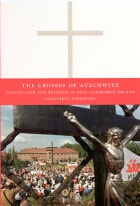
The Crosses of Auschwitz
Nationalism and Religion in Post-Communist PolandGeneviève Zubrzycki
University of Chicago Press, 2006
In the summer and fall of 1998, ultranationalist Polish Catholics erected hundreds of crosses outside Auschwitz, setting off a fierce debate that pitted Catholics and Jews against one another. While this controversy had ramifications that extended well beyond Poland’s borders, Geneviève Zubrzycki sees it as a particularly crucial moment in the development of post-Communist Poland’s statehood and its changing relationship to Catholicism.
In The Crosses of Auschwitz, Zubrzycki skillfully demonstrates how this episode crystallized latent social conflicts regarding the significance of Catholicism in defining “Polishness” and the role of anti-Semitism in the construction of a new Polish identity. Since the fall of Communism, the binding that has held Polish identity and Catholicism together has begun to erode, creating unease among ultranationalists. Within their construction of Polish identity also exists pride in the Polish people’s long history of suffering. For the ultranationalists, then, the crosses at Auschwitz were not only symbols of their ethno-Catholic vision, but also an attempt to lay claim to what they perceived was a Jewish monopoly over martyrdom.
This gripping account of the emotional and aesthetic aspects of the scene of the crosses at Auschwitz offers profound insights into what Polishness is today and what it may become.
The Holocaust Odyssey of Daniel Bennahmias, Sonderkommando
Rebecca Fromer
University of Alabama Press, 1993
A poignant reminder of the ways enslaved Jews and others were forced to destroy their families and fellow prisoners.
The Holocaust Odyssey of Daniel Bennahmias, Sonderkommando presents the extraordinary testimony of Daniel Bennahmias, a Greek Jew whose life was forever altered by the Holocaust. Deported to Auschwitz-Birkenau as a teenager, Bennahmias was separated from his family and forced into the Sonderkommando, the prisoner unit compelled to work in the crematoria and gas chamber complex. Through painstaking collaboration with survivor and author Rebecca Fromer, this powerful narrative documents his struggle to endure unimaginable brutality while preserving his humanity. Bennahmias's account sheds rare light on the inner workings of Auschwitz, the Sonderkommando revolt, the death marches, and the difficult path toward liberation and recovery. More than a historical record, the book is a testament to courage, memory, and resilience in the face of systematic dehumanization. An essential contribution to Holocaust literature, it preserves the voice of a survivor whose experiences deepen our understanding of one of history's darkest chapters.
The Holocaust as Culture
Imre Kertész
Seagull Books, 2011
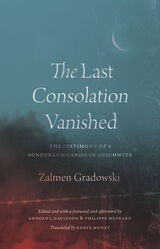
The Last Consolation Vanished
The Testimony of a Sonderkommando in AuschwitzZalmen Gradowski
University of Chicago Press, 2022
On October 7, 1944, a group of Jewish prisoners in Auschwitz obtained explosives and rebelled against their Nazi murderers. It was a desperate uprising that was defeated by the end of the day. More than four hundred prisoners were killed. Filling a gap in history, The Last Consolation Vanished is the first complete English translation and critical edition of one prisoner’s powerful account of life and death in Auschwitz, written in Yiddish and buried in the ashes near Crematorium III.
Zalmen Gradowski was in the Sonderkommando (special squad) at Auschwitz, a Jewish prisoner given the unthinkable task of ushering Jewish deportees into the gas chambers, removing their bodies, salvaging any valuables, transporting their corpses to the crematoria, and destroying all evidence of their murders. Sonderkommandos were forcibly recruited by SS soldiers; when they discovered the horror of their assignment, some of them committed suicide or tried to induce the SS to kill them. Despite their impossible situation, many Sonderkommandos chose to resist in two interlaced ways: planning an uprising and testifying. Gradowski did both, by helping to lead a rebellion and by documenting his experiences. Within 120 scrawled notebook pages, his accounts describe the process of the Holocaust, the relentless brutality of the Nazi regime, the assassination of Czech Jews, the relationships among the community of men forced to assist in this nightmare, and the unbearable separation and death of entire families, including his own. Amid daily unimaginable atrocities, he somehow wrote pages that were literary, sometimes even lyrical—hidden where and when one would least expect to find them.
The October 7th rebellion was completely crushed and Gradowski was killed in the process, but his testimony lives on. His extraordinary and moving account, accompanied by a foreword and afterword by Philippe Mesnard and Arnold I. Davidson, is a voice speaking to us from the past on behalf of millions who were silenced. Their story must be shared.
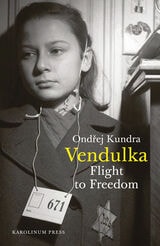
Vendulka
Flight to FreedomOndrej Kundra
Karolinum Press, 2021
Famed Czech photographer Jan Lukas snapped an offhand portrait of twelve-year-old Vendulka Vogl in March 1943. A friend of the Vogls, Lukas was saying goodbye to the family, who were soon to leave Prague for a concentration camp. The photograph almost didn’t see the light of day—Lukas knew that if the Nazis found it on him, he could wind up in the camps as well—but the image was eventually developed and came to symbolize the Holocaust and humanize its victims. Seventy years after this famous picture was taken, investigative journalist Ondřej Kundra discovered that, despite all odds, Vendulka Vogl had survived the camps of Terezín, Auschwitz, and Christianstadt, and was in fact still alive and living in the United States. Kundra persuaded her to tell the remarkable story surrounding the photograph: her survival, her later decision to flee the Communist regime for America, and how she later reconnected with Jan Lukas, maintaining a lifelong friendship.
Vogl’s thrillingly moving story, Kundra’s sharp and engaging writing, and Lukas’s striking photography all combine to make Vendulka an inspiring investigation into the horrors of totalitarianism and the redemptive beauty of friendship.