Results by title
4 books match the query 'Auteur theory (Motion pictures)'

Beyond Auteurism
New Directions in Authorial Film Practices in France, Italy and Spain since the 1980sRosanna Maule
Intellect Books, 2008
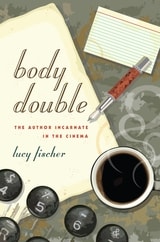
Body Double
The Author Incarnate in the CinemaLucy Fischer
Rutgers University Press, 2013
Body Double explores the myriad ways that film artists have represented the creative process. In this highly innovative work, Lucy Fischer draws on a neglected element of auteur studies to show that filmmakers frequently raise questions about the paradoxes of authorship by portraying the onscreen writer. Dealing with such varied topics as the icon of the typewriter, the case of the writer/director, the authoress, and the omnipresent infirm author, she probes the ways in which films can tell a plausible story while contemplating the conditions and theories of their making.
By examining many forms of cinema, from Hollywood and the international art cinema to the avant-garde, Fischer considers the gender, age, and mental or physical health of fictionalized writers; the dramatized interaction between artists and their audiences and critics; and the formal play of written words and nonverbal images.
By analyzing such movies as Adaptation,Diary of a Country Priest, Naked Lunch, American Splendor, and Irezumi, Fischer tracks the parallels between film author and character, looking not for the creative figure who stands outside the text, but for the one who stands within it as corporeal presence and alter-ego.
Directed By Allen Smithee
Jeremy Braddock
University of Minnesota Press, 2001
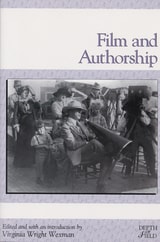
Film and Authorship
Wexman, Virginia W
Rutgers University Press, 2003
During the 1960s, when cinema first entered the academy as a serious object of study, the primary focus was on auteurism, or on films authorship. Burgeoning cinema studies courses demonstrated how directors were the authors of work that undermined (or succeeded in spite of) all the constraints that Hollywood threw at them. New critical methods were introduced as the field matured, and studies of the author/director, for the most part, were considered obsolete.
Virginia Wright Wexman has pulled together some of the freshest writing available on the topic of film authorship. Spanning approaches including poststructuralism, feminism, queer theory, postcolonialism, and cultural studies, the contributors ask, what does auteurship look like today in light of all these developments? The contents of the volume are divided into three major sections: Theoretical Statements, Historical and Institutional Contexts, and Case Studies. Wexmans comprehensive introduction contextualizes the selections and summarizes the scholarly methods through which auteurism has been addressed in the past; it also provides a sketch of the history of media authorship. An extensive bibliography rounds off the volume.