Results by title

11 books match the query 'Authority in literature'
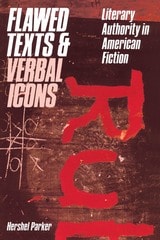
cover of Flawed Texts and Verbal Icons: Literary Authority and American Fiction

Flawed Texts and Verbal Icons

Literary Authority and American Fiction

Hershel Parker

Northwestern University Press, 1984
An evaluation of the importance of textual criticism in evaluation of important literary works, based on his study of important American literary works by authors such as James, Crane, and Mailer.
[more]
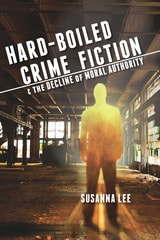
cover of Hard-Boiled Crime Fiction and the Decline of Moral Authority

Hard-Boiled Crime Fiction and the Decline of Moral Authority

Susanna Lee

The Ohio State University Press, 2016

The cynical but kind-hearted detective is the soul of the classic hard-boiled story, that chronicle of world-weary urban pessimism. In Hard-Boiled Crime Fiction and the Decline of Moral Authority, Susanna Lee argues that this fiction functions as a measure for individual responsibility in the modern world and that it demonstrates the enduring status of individual conscience across a variety of cultural crises. In this major rethinking of the hard-boiled genre, Lee suggests that, whether in Los Angeles, New York, or Paris, the hard-boiled detective is the guardian of individual moral authority and the embodiment of ideals in a corrupt environment.
Lee traces the history of the hard-boiled detective through the twentieth century and on both sides of the Atlantic (France and the United States), tying the idea of morality to the character model in nuanced, multifaceted ways. When the heroic model devolves, the very conceptual validity of individual moral authority can seem to devolve as well. Hard-Boiled Crime Fiction and the Decline of Moral Authority charts the evolution of that character model of the hard-boiled hero, the mid-century deterioration of his exemplarity, and twenty-first-century endeavors to resuscitate the accountable hero. The history of hard-boiled crime fiction tells nothing less than the story of individual autonomy and accountability in modern Western culture.
 
[more]
cover of Loser Sons: Politics and Authority

Loser Sons

Politics and Authority

Avital Ronell

University of Illinois Press, 2013
There are sons who grow up unhappily believing that no matter what they do, they cannot please their fathers. Often unable to shed their sense of lifelong failure, either they give up and suffer in a permanent sulk, or they try with all their might to prove they are worth something after all. These are the "loser sons," a group of historical men as varied as President George W. Bush, Osama bin Laden, and Mohammed Atta. Their names quickly illustrate that not only are their problems serious, but they also make serious problems for others, expanding to whole nations. When God is conceived and inculcated as an angry and impossible-to-please father, the problems can last for generations.
 
In Loser Sons, Avital Ronell draws on current philosophy, literary history, and political events to confront the grim fact that divested boys become terrifying men. This would be old news if the problem didn't recur so often with such disastrous consequences. Looking beyond our current moment, she interrogates the problems of authority, paternal fantasy, and childhood as they have been explored and exemplified by Franz Kafka, Goethe's Faust, Benjamin Franklin, Jean-François Lyotard, Hannah Arendt, Alexandre Kojève, and Immanuel Kant.
 
Brilliantly weaving these threads into a polyvocal discourse, Ronell shows how, with their arrays of powerful symbols, ideologies of all sorts perpetuate the theme that while childhood represents innocence, adulthood entails responsible cruelty. The need for suffering--preferably somebody else's--has become a widespread assumption, not only justifying abuses of authority, but justifying authority itself. 
 
Shockingly honest, Loser Sons recognizes that focusing on the spectacular catastrophes of modernity might make writer and reader feel they're engaged in something important, while in fact what they are engaged in is still only spectacle. To understand the implications of her insights, Ronell addresses them directly to her readers, challenging them to think through their own notions of authority and their responses to it.
[more]
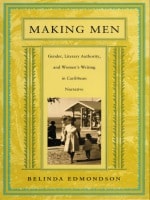
cover of Making Men: Gender, Literary Authority, and Women’s Writing in Caribbean Narrative

Making Men

Gender, Literary Authority, and Women’s Writing in Caribbean Narrative

Belinda Edmondson

Duke University Press, 1998

Colonialism left an indelible mark on writers from the Caribbean. Many of the mid-century male writers, on the eve of independence, looked to England for their models. The current generation of authors, many of whom are women, have increasingly looked—and relocated—to the United States. Incorporating postcolonial theory, West Indian literature, feminist theory, and African American literary criticism, Making Men carves out a particular relationship between the Caribbean canon—as represented by C. L. R. James and V. S. Naipaul, among others—and contemporary Caribbean women writers such as Jean Rhys, and Jamaica Kincaid, Paule Marshall, and Michelle Cliff, who now live in the United States.

Discussing the canonical Caribbean narrative as it reflects national identity under the domination of English cultural authority, Belinda Edmondson focuses particularly on the pervasive influence of Victorian sensibilities in the structuring of twentieth-century national identity. She shows that issues of race and English constructions of masculinity not only are central to West Indian identity but also connect Caribbean authorship to the English literary tradition. This perspective on the origins of West Indian literary nationalism then informs Edmondson’s search for female subjectivity in current literature by West Indian women immigrants in America. Making Men compares the intellectual exile of men with the economic migration of women, linking the canonical male tradition to the writing of modern West Indian women and exploring how the latter write within and against the historical male paradigm in the continuing process of national definition.
With theoretical claims that invite new discourse on English, Caribbean, and American ideas of exile, migration, race, gender identity, and literary authority, Making Men will be informative reading for those involved with postcolonial theory, African American and women’s studies, and Caribbean literature.
[more]
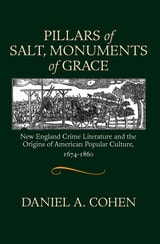
cover of Pillars of Salt, Monuments of Grace: New England Crime Literature and the Origins of American Popular Culture, 1674-1860

Pillars of Salt, Monuments of Grace

New England Crime Literature and the Origins of American Popular Culture, 1674-1860

Daniel A. Cohen

University of Massachusetts Press, 2006
In this innovative study, Daniel A. Cohen explores a major cultural shift embodied in hundreds of early New England crime publications. Tracing the declining authority of Puritan ministers, he shows how the arbiters of an increasingly pluralistic literary marketplace gradually supplanted pious execution sermons with last-speech broadsides, gallows verses, criminal autobiographies, trial reports, newspaper stories, and romantic docudramas. Pillars of Salt, Monuments of Grace probes the forgotten origins of our modern mass media's preoccupation with crime and punishment.
[more]
cover of Reconstituting Authority: American Fiction in the Province of the Law, 1880-1920

Reconstituting Authority

American Fiction in the Province of the Law, 1880-1920

William E. Moddelmog

University of Iowa Press, 2000

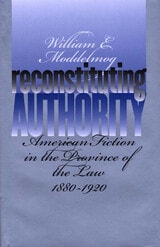
In Reconstituting Authority, William Moddelmog explores the ways in which American law and literature converged in the late nineteenth and early twentieth centuries. Through close readings of significant texts from the era, he reveals not only how novelists invoked specific legal principles and ideals in their fictions but also how they sought to reconceptualize the boundaries of law and literature in ways that transformed previous versions of both legal and literary authority.
Moddelmog does not assume a sharp distinction between literary and legal institutions and practices but shows how writers imagined the two fields as engaged in the same cultural process. He argues that because the law was instrumental in setting the terms by which concepts such as race, gender, nationhood, ownership, and citizenship were defined in the nineteenth century, authors challenging those definitions had to engage the law on its own terrain: to place their work in a dialogue with the law by telling stories that were already authorized (though perhaps suppressed) by legal institutions.
The first half of the book is devoted in separate chapters to William Dean Howells, Helen Hunt Jackson, and Pauline Hopkins. The focus shifts from large theoretical concerns to questions of contract and native sovereignty, to issues of African American citizenship and racial entitlement. In each case the discussion is rooted in a larger consideration of the rule (or misrule) of law.
The second half of the book turns from the rule of law to the issue of property, specifically the Lockean version of the self that tied identity to legal conceptions of property and economic value. In separate discussions of Charles Chesnutt, Edith Wharton, and Theodore Dreiser, Reconstituting Authority reveals authors as closely engaged with those changing perspectives on property and identity, in ways that challenged the racial, gendered, and economic consequences of America's possessive individualism.
[more]
cover of Recovered Legacies: Authority And Identity In Early Asian Amer Lit

Recovered Legacies

Authority And Identity In Early Asian Amer Lit

edited by Keith Lawrence and Floyd Cheung

Temple University Press, 2005
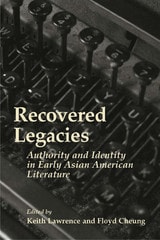
Recovered Legacies: Authority and Identity in Early Asian American Literature employs contemporary and traditional readings of representative works in prose, poetry, and drama to suggest new ways of understanding and appreciating the critically fertile but underexamined body of Asian American writing from the late 1800s to the early 1960s. The essays in this volume engage this corpus—composed of multiple genres from different periods and by authors of different ethnicities—with a strong awareness of historical context and a keen sensitivity to literary form. As a collection, Recovered Legacies re-establishes the rich and diverse literary heritage of Asian America and argues persuasively for the significance of these works to the American literary canon.
[more]
cover of Scripting the Nation: Court Poetry and the Authority of History in Late Medieval Scotland

Scripting the Nation

Court Poetry and the Authority of History in Late Medieval Scotland

Katherine H. Terrell

The Ohio State University Press, 2021
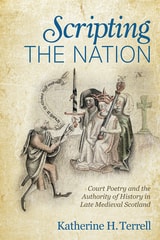
Scripting the Nation is the first book to set the poets of Scottish King James IV’s court—William Dunbar, Walter Kennedy, and Gavin Douglas—in an extended dialogue with Latin and vernacular traditions of historiography. In the fourteenth and fifteenth centuries, Latin chroniclers such as John of Fordun and Walter Bower argued for their nation’s status, using genealogically based myths of origin that linked Scotland to ancient centers of power. As vernacular histories grew more Anglophobic and quarrels rooted in the past continued to influence Anglo-Scottish diplomacy, Dunbar, Kennedy, and Douglas took up a national discourse that responded to English myths and an English poetic tradition exemplified by Geoffrey Chaucer. Terrell’s elegant study examines how these Scottish writers marked out a distinct realm of Scottish cultural and poetic achievement, appropriating and subverting English literary models in ways that reveal the interplay between literary and historical authority in the scripting of nationhood.
[more]
cover of Tales Out of School: Gender, Longing, and the Teacher in Fiction and Film

Tales Out of School

Gender, Longing, and the Teacher in Fiction and Film

Jo Keroes

Southern Illinois University Press, 1999

Jo Keroes's scope is wide: she examines the teacher as represented in fiction and film in works ranging from the twelfth-century letters of Abelard and Heloise to contemporary films such as Dangerous Minds and Educating Rita. And from the twelfth through the twentieth century, Keroes shows, the teaching encounter is essentially erotic.

Tracing the roots of eros from cultural as well as psychological perspectives, Keroes defines erotic in terms broader than the merely sexual. She analyzes ways in which teachers serve as convenient figures on whom to map conflicts about gender, power, and desire. To show how portrayals of men and women differ, she examines pairs of texts, using a film or a novel with a woman protagonist (Up the Down Staircase, for example) as counterpoint to one featuring a male teacher (Blackboard Jungle) or The Prime of Miss Jean Brodie balanced against Dead Poets Society.

The portrayals of teachers, like all images a culture presents of itself, reveal much about our private and social selves. Keroes points out authentic accounts of authoritative women teachers who are admired and respected by colleagues and students alike. Real teachers differ from the stereotypes we see in fiction and film, however. Male teachers are often portrayed as heroes in film and fallibly human in fiction, whereas women in either genre are likely to be monstrous or muddled and are virtually never women of color. Among other things, Keroes demonstrates, the tension between reality and representation reveals society's ambivalence about power in the hands of women.
[more]
cover of The Appropriated Voice: Narrative Authority in Conrad, Forster, and Woolf

The Appropriated Voice

Narrative Authority in Conrad, Forster, and Woolf

Bette London

University of Michigan Press, 1990
The Appropriated Voice: Narrative Authority in Conrad, Forster, and Woolf reassesses questions of voice in three central modernist texts: Heart of Darkness, A Passage to India, and To the Lighthouse. Representing voice as the site of a struggle articulated on a number of fronts, Bette London challenges traditional assumptions about voice as a reliable marker of individuality, originality, self-identity, and aesthetic autonomy—assumptions reinforced in the recent reconstructions of modernism in postmodernism’s discourses.Drawing upon narrative theory, cultural criticism, and cultural ethnography, as well as feminist theory, London provides a sophisticated critique of the conventional categories at work in both traditional and revisionist criticism. Her method reveals the narrative and cultural appropriations through which modernism speaks, and produces what might be called modernism’s other ideology: its performance of its own political and aesthetic complicities; its display of its own second-handedness.The book is a contribution to contemporary theoretical debates as well as to the scholarship pertaining to Conrad, Forster, and Woolf.
[more]
cover of The Subject of Elizabeth: Authority, Gender, and Representation

The Subject of Elizabeth

Authority, Gender, and Representation

Louis Montrose

University of Chicago Press, 2006

As a woman wielding public authority, Elizabeth I embodied a paradox at the very center of sixteenth-century patriarchal English society. Louis Montrose’s long-awaited book, The Subject of Elizabeth, illuminates the ways in which the Queen and her subjects variously exploited or obfuscated this contradiction.

Montrose offers a masterful account of the texts, pictures, and performances in which the Queen was represented to her people, to her court, to foreign powers, and to Elizabeth herself. Retrieving this “Elizabethan imaginary” in all its richness and fascination, Montrose presents a sweeping new account of Elizabethan political culture.  Along the way, he explores the representation of Elizabeth within the traditions of Tudor dynastic portraiture; explains the symbolic manipulation of Elizabeth’s body by both supporters and enemies of her regime; and considers how Elizabeth’s advancing age provided new occasions for misogynistic subversions of her royal charisma.  

This book, the remarkable product of two decades of study by one of our most respected Renaissance scholars, will be welcomed by all historians, literary scholars, and art historians of the period.
[more]