Results by title
4 books match the query 'Authors, Exiled'
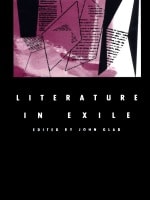
Literature in Exile
John Glad, ed.
Duke University Press, 1990
The volume includes writers whose origins lie in Central Europe, South Africa, Israel, Cuba, Chile, Somalia, and Turkey. Through their testimony of the creative process in exile, we gain insight into the forces which affect the creative process as a whole.
Contributors. William Gass, Yury Miloslavsky, Jan Vladislav, Jiri Grusa, Guillermo Cabrera Infante, Horst Bienek, Edward Limonov, Nedim Gursel, Nuruddin Farah, Jaroslav Vejvoda, Anton Shammas, Joseph Brodsky, Wojciech Karpinski, Thomas Venclova, Yuri Druzhnikov

Performing Exile
Foreign BodiesEdited by Judith Rudakoff
Intellect Books, 2017
In a world where exiled populations continue to grow, the role of art to document and engage with these experiences will continue to be essential, and this diverse book offers an important model for understanding the rich body of work being created today.
A PDF version of this book is available for free in open access via the OAPEN Library platform, www.oapen.org It has been made available under a Creative Commons Attribution 4.0 International Public License and is part of Knowledge Unlatched.

The Ethics of Autobiography
Replacing the Subject in Modern SpainAngel G. Loureiro
Vanderbilt University Press, 2000
To address this oversight, Loureiro draws from his own experiences as well as from a wide range of previous theoretical works on autobiography, especially from the writings of Emmanuel Levinas, who believed that the self does not begin as a self-positing consciousness but as a response to an address from the other. On this basis, Loureiro then brilliantly traces the complex interplays between the political, discursive, rhetorical, and ethical dimensions of autobiography.
After laying out these theoretical foundations, Loureiro puts them to work in analyzing four of the most fascinating autobiographies written by Spanish exiles: The Life of Joseph Blanco White, who lived from 1775 to 1841, Memoria de la Melancolia by Maria Teresa Leon (1904-1988), Coto vedado and En los reinos de taifa by Juan Goytisolo (born 1931), and Literature or Life by Jorge Semprun (born 1923). The lives of these authors, all of whom were exiled for political reasons, were disrupted by some of the most crucial events in Spain's tortuous road to modernity and democracy.
The book closes with a discussion of why there have been so few critical examinations of autobiographies written in modern Spain. Loureiro proposes that, even in today's Spain, stifling social and political forces smother ethical responsibility, which is an essential ingredient in creating autobiographies that dare to be more than a humdrum inventory of personal recollections. Only in exile have Spanish authors seemed able to find the conditions to write their lives in a truly responsible manner. This answer to a call that grounds the subject in an other is ultimately the only form of truth available in autobiography.
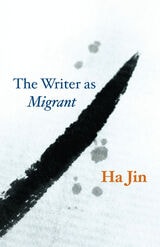
The Writer as Migrant
Ha Jin
University of Chicago Press, 2008
Consisting of three interconnected essays, The Writer as Migrant sets Ha Jin’s own work and life alongside those of other literary exiles, creating a conversation across cultures and between eras. He employs the cases of Alexander Solzhenitsyn and Chinese novelist Lin Yutang to illustrate the obligation a writer feels to the land of their birth, while Joseph Conrad and Vladimir Nabokov—who, like Ha Jin, adopted English for their writing—are enlisted to explore a migrant author’s conscious choice of a literary language. A final essay draws on V. S. Naipaul and Milan Kundera to consider the ways in which our era of perpetual change forces a migrant writer to reconceptualize the very idea of home. Throughout, Jin brings other celebrated writers into the conversation as well, including W. G. Sebald, C. P. Cavafy, and Salman Rushdie—refracting and refining the very idea of a literature of migration.
Simultaneously a reflection on a crucial theme and a fascinating glimpse at the writers who compose Ha Jin’s mental library, The Writer as Migrant is a work of passionately engaged criticism, one rooted in departures but feeling like a new arrival.