Results by title

17 books match the query 'Automobiles'
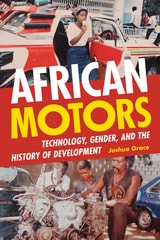
cover of African Motors: Technology, Gender, and the History of Development

African Motors

Technology, Gender, and the History of Development

Joshua Grace

Duke University Press, 2021
In African Motors, Joshua Grace examines how Tanzanian drivers, mechanics, and passengers reconstituted the automobile into a uniquely African form between the late 1800s and the early 2000s. Drawing on hundreds of oral histories, extensive archival research, and his ethnographic fieldwork as an apprentice in Dar es Salaam's network of garages, Grace counters the pervasive narratives that Africa is incompatible with technology and that the African use of cars is merely an appropriation of technology created elsewhere. Although automobiles were invented in Europe and introduced as part of colonial rule, Grace shows how Tanzanians transformed them, increasingly associating their own car use with maendeleo, the Kiswahili word for progress or development. Focusing on the formation of masculinities based in automotive cultures, Grace also outlines the process through which African men remade themselves and their communities by adapting technological objects and systems for local purposes. Ultimately, African Motors is an African-centered story of development featuring everyday examples of Africans forging both individual and collective cultures of social and technological wellbeing through movement, making, and repair.
[more]
cover of Automobile and American Culture

Automobile and American Culture

David L. Lewis and Laurence Goldstein, Editors

University of Michigan Press, 1983
The Automobile and American Culture, edited by David L. Lewis and Laurence Goldstein, offers a sweeping exploration of the automobile’s impact on American society. Integrating both scholarly and popular approaches, this landmark anthology brings together essays, memoirs, fiction, poetry, and graphics to describe the profound and multifaceted impact of one of the twentieth century’s most fascinating inventions on American life. Now in its revised and expanded form, the collection provides an even closer look at the past, present, and future of America’s automobile revolution.With contributions from acclaimed writers, artists, musicians, and scholars, this volume examines the automobile’s influence on every corner of American society—the city and the farm, fashion and art, domestic life, popular culture, youth, gender, sexuality, and the evolving American psyche. Iconic figures such as Chuck Berry, Carl Sandburg, and Bruce Springsteen appear alongside incisive academic analysis, underscoring the car’s central place in both creative imagination and lived experience.Organized thematically, The Automobile and American Culture explores how the automobile not only transformed the physical landscape and economy, but also became a powerful cultural symbol—one both praised and critiqued as it shaped the nation’s identity, values, and dreams. From the industry’s Michigan roots to roadside Americana and critiques of modern car culture, this anthology stands as the definitive reference for anyone seeking to understand the enduring love affair between Americans and their cars, and the way this relationship continues to influence society today.
[more]
cover of Automobiles and the Future: Competition, Cooperation, and Change

Automobiles and the Future

Competition, Cooperation, and Change

Robert E. Cole, Editor

University of Michigan Press, 1983
At the time of the U.S.-Japan auto conferences in March 1983, the hoped-for economic recovery as manifested in auto sales had revealed itself quite modestly. Three months later, the indicators were more robust and certainly long overdue for those whose livelihood depends on the health of the industry--some of whom are university professors.
With Japanese import restrictions in place until March 1984 and drastically reduced break-even points for domestic manufactures, rising consumer demand holds great promise for the industry. The rapidly rising stock prices of the auto-makers captures well the sense of heightened optimism, as do the various forecasts for improved profits.
While the news is certainly welcome, it nevertheless should be greeted with caution. As Mr. Perkins noted at the conference, "we have a tendency to forget things very quickly. If we have a boom market this year, there is a good chance that a lot of things we learned will be forgotten."
To put the matter differently and more bluntly, with growing prosperity there is the risk that management will fall back into old habits, making impossible the achievement of sustained quality and productivity improvement. Similarly, the commitment to develop cooperative relations with workers and suppliers will weaken. The union will be under membership pressure to retrieve concessions rather than to take the longer-term view. This longer-term view recognizes that "up-front increases" and adherence to existing work rules increasingly come at the sacrifice of future job security. Government policymakers will turn their attention away from the industry. This may not mean a great deal given how weakly focused their attentions has been during the last three years and how mixed and contradictory government auto policies have been for over a decade.
[more]
cover of Autophobia: Love and Hate in the Automotive Age

Autophobia

Love and Hate in the Automotive Age

Brian Ladd

University of Chicago Press, 2008
Cars are the scourge of civilization, responsible for everything from suburban sprawl and urban decay to environmental devastation and rampant climate change—not to mention our slavish dependence on foreign oil from dubious sources abroad. Add the astonishing price in human lives that we pay for our automobility—some thirty million people were killed in car accidents during the twentieth century—plus the countless number of hours we waste in gridlock traffic commuting to work, running errands, picking up our kids, and searching for parking, and one can’t help but ask: Haven’t we had enough already? After a century behind the wheel, could we be reaching the end of the automotive age?
 
From the Model T to the SUV, Autophobia reveals that our vexed relationship with the automobile is nothing new—in fact, debates over whether cars are forces of good or evil in our world have raged for over a century now, ever since the automobile was invented. According to Brian Ladd, this love and hate relationship we share with our cars is the defining quality of the automotive age. And everyone has an opinion about them, from the industry shills, oil barons, and radical libertarians who offer cars blithe paeans and deny their ill effects, to the technophobes, treehuggers, and killjoys who curse cars, ignoring the very real freedoms and benefits they provide us. Focusing in particular on our world’s cities, and spanning settings as varied as belle epoque Paris, Nazi Germany, postwar London, Los Angeles, New York, and the smoggy Shanghai of today, Ladd explores this love and hate relationship throughout, acknowledging adherents and detractors of the automobile alike.
 
Eisenhower, Hitler, Jan and Dean, J. G. Ballard, Ralph Nader, OPEC, and, of course, cars, all come into play in this wide-ranging but remarkably wry and pithy book. A dazzling display of erudition, Autophobia is cultural commentary at its most compelling, history at its most searching—and a surprising page-turner.
[more]
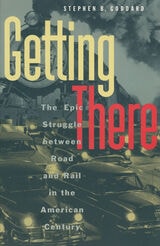
cover of Getting There: The Epic Struggle between Road and Rail in the American Century

Getting There

The Epic Struggle between Road and Rail in the American Century

Stephen B. Goddard

University of Chicago Press, 1996

"A readable and concise overview of how U.S. transportation came to its present pass. . . . Goddard is at his best when recounting the complex and interesting history of what has come to be called 'the highway lobby.'. . . An excellent book for the general reader with an interest in getting around."—Larry Fish, Philadelphia Inquirer

"This is a riveting story: of mighty railroads hamstrung almost overnight by government bureaucrats; of road interests led by General Motors Corp. conspiring in city after city to destroy efficient trolley systems . . . and of freeways that are far from free."—Bill Laitner, Detroit Free Press

"The combination of forces and fates that turned America into a giant parking lot from sea to shining sea is the subject of Stephen B. Goddard's lively pop history. . . . As Mr. Goddard ably points out, road-building and the creation of car-dependent suburbs have become ends in themselves."—James Howard Kunstler, Wall Street Journal

"The strength of Goddard's book is that he understands the complexities of manipulating public opinion to influence legislatures."—David Young, Chicago Tribune

"[Goddard's] book is a deft and easily read history of how transportation has shaped the nation and its economy, and ultimately, how a federation of truck and car interests drastically tilted national policies. . . . For many reasons this is an exceptionally important work."—Jim Dwyer, New York Newsday
[more]
cover of Hitting the Brakes: Engineering Design and the Production of Knowledge

Hitting the Brakes

Engineering Design and the Production of Knowledge

Ann Johnson

Duke University Press, 2009

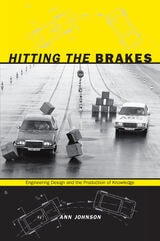
In Hitting the Brakes, Ann Johnson illuminates the complex social, historical, and cultural dynamics of engineering design, in which knowledge communities come together to produce new products and knowledge. Using the development of antilock braking systems for passenger cars as a case study, Johnson shows that the path to invention is neither linear nor top-down, but highly complicated and unpredictable. Individuals, corporations, university research centers, and government organizations informally coalesce around a design problem that is continually refined and redefined as paths of development are proposed and discarded, participants come and go, and information circulates within the knowledge community. Detours, dead ends, and failures feed back into the developmental process, so that the end design represents the convergence of multiple, diverse streams of knowledge.

The development of antilock braking systems (ABS) provides an ideal case study for examining the process of engineering design because it presented an array of common difficulties faced by engineers in research and development. ABS did not develop predictably. Research and development took place in both the public and private sectors and involved individuals working in different disciplines, languages, institutions, and corporations. Johnson traces ABS development from its first patents in the 1930s to the successful 1978 market introduction of integrated ABS by Daimler and Bosch. She examines how a knowledge community first formed around understanding the phenomenon of skidding, before it turned its attention to building instruments to measure, model, and prevent cars’ wheels from locking up. While corporations’ accounts of ABS development often present a simple linear story, Hitting the Brakes describes the full social and cognitive complexity and context of engineering design.
[more]
cover of Lowrider Space: Aesthetics and Politics of Mexican American Custom Cars

Lowrider Space

Aesthetics and Politics of Mexican American Custom Cars

By Ben Chappell

University of Texas Press, 2012
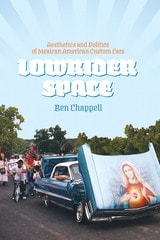
Aren’t lowriders always gangbangers? And, don’t they always hold high status in their neighborhoods? Contrary to both stereotypes, the people who build and drive lowrider cars perform diverse roles while mobilizing a distinctive aesthetic that is sometimes an act of resistance and sometimes of belonging. A fresh application of critical ethnographic methods, Lowrider Space looks beyond media portrayals, high-profile show cars, and famous cruising scenes to bring readers a realistic tour of the “ordinary” lowriders who turn streetscapes into stages on which dynamic identities can be performed.Drawing on firsthand participation in everyday practices of car clubs and cruising in Austin, Texas, Ben Chappell challenges histories of erasure, containment, and class immobility to emphasize the politics of presence evidenced in lowrider custom car style. Sketching out a partially personal map of the lowrider presence in Texas’s capital city, Chappell also explores the interior and exterior adornment of the cars (including the use of images of women’s bodies) and the intersecting production of personal and social space. As he moves through a second-hand economy to procure parts necessary for his own lowrider vehicle, on “service sector” wages, themes of materiality and physical labor intersect with questions of identity, ultimately demonstrating how spaces get made in the process of customizing one’s self.
[more]
cover of Machines of Youth: America’s Car Obsession

Machines of Youth

America’s Car Obsession

Gary S. Cross

University of Chicago Press, 2018

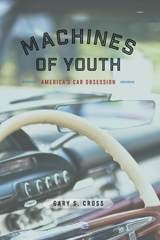
For American teenagers, getting a driver’s license has long been a watershed moment, separating teens from their childish pasts as they accelerate toward the sweet, sweet freedom of their futures. With driver’s license in hand, teens are on the road to buying and driving(and maybe even crashing) their first car, a machine which is home to many a teenage ritual—being picked up for a first date, “parking” at a scenic overlook, or blasting the radio with a gaggle of friends in tow. So important is this car ride into adulthood that automobile culture has become a stand-in, a shortcut to what millions of Americans remember about their coming of age.

Machines of Youth traces the rise, and more recently the fall, of car culture among American teens. In this book, Gary S. Cross details how an automobile obsession drove teen peer culture from the 1920s to the 1980s, seducing budding adults with privacy, freedom, mobility, and spontaneity.   Cross shows how the automobile redefined relationships between parents and teenage children, becoming a rite of passage, producing new courtship rituals, and fueling the growth of numerous car subcultures. Yet for teenagers today the lure of the automobile as a transition to adulthood is in decline.Tinkerers are now sidelined by the advent of digital engine technology and premolded body construction, while the attention of teenagers has been captured by iPhones, video games, and other digital technology. And adults have become less tolerant of teens on the road, restricting both cruising and access to drivers’ licenses. 

Cars are certainly not going out of style, Cross acknowledges, but how upcoming generations use them may be changing. He finds that while vibrant enthusiasm for them lives on, cars may no longer be at the center of how American youth define themselves. But, for generations of Americans, the modern teen experience was inextricably linked to this particularly American icon.
 
[more]
cover of Mobility without Mayhem: Safety, Cars, and Citizenship

Mobility without Mayhem

Safety, Cars, and Citizenship

Jeremy Packer

Duke University Press, 2007

While Americans prize the ability to get behind the wheel and hit the open road, they have not always agreed on what constitutes safe, decorous driving or who is capable of it. Mobility without Mayhem is a lively cultural history of America’s fear of and fascination with driving, from the mid-twentieth century to the present. Jeremy Packer analyzes how driving has been understood by experts, imagined by citizens, regulated by traffic laws, governed through education and propaganda, and represented in films, television, magazines, and newspapers. Whether considering motorcycles as symbols of rebellion and angst, or the role of CB radio in regulating driving and in truckers’ evasions of those regulations, Packer shows that ideas about safe versus risky driving often have had less to do with real dangers than with drivers’ identities.

Packer focuses on cultural figures that have been singled out as particularly dangerous. Women drivers, hot-rodders, bikers, hitchhikers, truckers, those who “drive while black,” and road ragers have all been targets of fear. As Packer debunks claims about the dangers posed by each figure, he exposes biases against marginalized populations, anxieties about social change, and commercial and political desires to profit by fomenting fear. Certain populations have been labeled as dangerous or deviant, he argues, to legitimize monitoring and regulation and, ultimately, to curtail access to automotive mobility. Packer reveals how the boundary between personal freedom and social constraint is continually renegotiated in discussions about safe, proper driving.
[more]
cover of Postcolonial Automobility: Car Culture in West Africa

Postcolonial Automobility

Car Culture in West Africa

Lindsey B. Green-Simms

University of Minnesota Press, 2015

For more than a century cars have symbolized autonomous, unfettered mobility and an increasingly global experience. And yet, they are often used differently outside the centers of global capitalism. This pioneering book considers how, through the lens of the automobile, we can assess the pleasures, dangers, and limits of global modernity in West Africa. Through new and provocative readings of famous plays, novels, and films, as well as recent popular videos, Postcolonial Automobility reveals the surprising ways in which automobility in the region is, at once, an everyday practice, an ethos, a fantasy of autonomy, and an affective activity intimately tied to modern social life. 

Lindsey B. Green-Simms begins with the history of motorization in West Africa from the colonial era to the decolonizing decades after World War II, and addresses the tragedy of car accidents through a close reading of Wole Soyinka’s 1965 postindependence play The Road. Shifting to screen media, she discusses Ousmane Sembene’s Xala and Jean-Pierre Bekolo’s Quartier Mozart and reviews popular, low-budget Nollywood films. Finally, Green-Simms considers how feminist texts rewrite and work in dialogue with the male-centered films and novels where the car stands in for patriarchal power and capitalist achievement.

Providing a unique perspective on technology in Africa—one refusing to be confined to narratives of either underdevelopment or inevitable progress—and covering a broad range of interdisciplinary material, Postcolonial Automobility will appeal not only to scholars and students of African literature and cinema but also to those in postcolonial and globalization studies.
[more]
cover of Republic of Drivers: A Cultural History of Automobility in America

Republic of Drivers

A Cultural History of Automobility in America

Cotten Seiler

University of Chicago Press, 2008

Rising gas prices, sprawl and congestion, global warming, even obesity—driving is a factor in many of the most contentious issues of our time. So how did we get here? How did automobile use become so vital to the identity of Americans? Republic of Drivers looks back at the period between 1895 and 1961—from the founding of the first automobile factory in America to the creation of the Interstate Highway System—to find out how driving evolved into a crucial symbol of freedom and agency.
            Cotten Seiler combs through a vast number of historical, social scientific, philosophical, and literary sources to illustrate the importance of driving to modern American conceptions of the self and the social and political order. He finds that as the figure of the driver blurred into the figure of the citizen, automobility became a powerful resource for women, African Americans, and others seeking entry into the public sphere. And yet, he argues, the individualistic but anonymous act of driving has also monopolized our thinking about freedom and democracy, discouraging the crafting of a more sustainable way of life. As our fantasies of the open road turn into fears of a looming energy crisis, Seiler shows us just how we ended up a republic of drivers—and where we might be headed.

[more]
cover of Roadrunner: A Song by Jonathan Richman and the Modern Lovers

Roadrunner

A Song by Jonathan Richman and the Modern Lovers

Joshua Clover

Duke University Press, 2021

Jonathan Richman and the Modern Lovers' 1972 song “Roadrunner” captures the freedom and wonder of cruising down the highway late at night with the radio on. Although the song circles Boston's beltway, its significance reaches far beyond Richman's deceptively simple declarations of love for modern moonlight, the made world, and rock & roll. In Roadrunner, cultural theorist and poet Joshua Clover charts both the song's emotional power and its elaborate history, tracing its place in popular music from Chuck Berry to M.I.A. He also locates “Roadrunner” at the intersection of car culture, industrialization, consumption, mobility, and politics. Like the song itself, Clover tells a story about a particular time and place—the American era that rock & roll signifies—that becomes a story about love and the modern world.
[more]
cover of Sensors, Actuators, and Their Interfaces: A multidisciplinary introduction

Sensors, Actuators, and Their Interfaces

A multidisciplinary introduction

Nathan Ida

The Institution of Engineering and Technology, 2020
Sensors and actuators are used daily in countless applications to ensure more accurate and reliable workflows and safer environments. Many students and young engineers with engineering and science backgrounds often come prepared with circuits and programming skills but have little knowledge of sensors and sensing strategies and their interfacing.
[more]
cover of Sensors, Actuators, and their Interfaces: A multidisciplinary introduction

Sensors, Actuators, and their Interfaces

A multidisciplinary introduction

Nathan Ida

The Institution of Engineering and Technology, 2014
As sensors and actuators are normally not (and have not been) treated in academic curricula as a subject in its own right; many students and current professionals often find themselves limited in their knowledge and dealing with topics and issues based on material they may have never encountered. Until now.
[more]
cover of The Cultural Life of the Automobile: Roads to Modernity

The Cultural Life of the Automobile

Roads to Modernity

By Guillermo Giucci

University of Texas Press, 2012

From its invention in Europe at the end of the nineteenth century, the automobile crisscrossed the world, completely took over the cities, and became a feature of daily life. Considered basic to the American lifestyle, the car reflected individualism, pragmatism, comfort, and above all modernity. In Latin America, it served as a symbol of distinction, similar to jewelry or fine clothing. In The Cultural Life of the Automobile, Guillermo Giucci focuses on the automobile as an instrument of social change through its “kinetic modernity” and as an embodiment of the tremendous social impact of technology on cultural life.

Material culture—how certain objects generate a wide array of cultural responses—has been the focus of much scholarly discussion in recent years. The automobile wrought major changes and inspired images in language, literature, and popular culture. Focusing primarily on Latin America but also covering the United States, Europe, Asia, and Africa, Giucci examines how the automobile was variously adapted by different cultures and how its use shaped and changed social and economic relationships within them. At the same time, he shows how the “automobilization” of society became an essential support for the development of modern individualism, and the automobile its clearest material manifestation.
[more]
cover of The Electric Vehicle and the Burden of History

The Electric Vehicle and the Burden of History

Kirsch, David A

Rutgers University Press, 2000

In the late 1890s, at the dawn of the automobile era, steam, gasoline, and electric cars all competed to become the dominant automotive technology. By the early 1900s, the battle was over and internal combustion had won. Was the electric car ever a viable competitor? What characteristics of late nineteenth-century American society led to the choice of internal combustion over its steam and electric competitors? And might not other factors, under slightly differing initial conditions, have led to the adoption of one of the other motive powers as the technological standard for the American automobile?

David A. Kirsch examines the relationship of technology, society, and environment to choice, policy, and outcome in the history of American transportation. He takes the history of the Electric Vehicle Company as a starting point for a vision of an “alternative” automotive system in which gasoline and electric vehicles would have each been used to supply different kinds of transport services. Kirsch examines both the support—and lack thereof—for electric vehicles by the electric utility industry. Turning to the history of the electric truck, he explores the demise of the idea that different forms of transportation technology might coexist, each in its own distinct sphere of service.

A main argument throughout Kirsch’s book is that technological superiority cannot be determined devoid of social context. In the case of the automobile, technological superiority ultimately was located in the hearts and minds of engineers, consumers and drivers; it was not programmed inexorably into the chemical bonds of a gallon of refined petroleum. Finally, Kirsch connects the historic choice of internal combustion over electricity to current debates about the social and environmental impacts of the automobile, the introduction of new hybrid vehicles, and the continuing evolution of the American transportation system.
[more]
cover of Welcome 2 Houston: Hip Hop Heritage in Hustle Town

Welcome 2 Houston

Hip Hop Heritage in Hustle Town

Langston Collin Wilkins

University of Illinois Press, 2023

Langston Collin Wilkins returns to the city where he grew up to illuminate the complex relationship between place, identity, and music in Houston’s hip hop culture. Interviews with local rap artists, producers, and managers inform an exploration of how artists, audiences, music, and place interact to create a heritage that musicians negotiate in a variety of ways. Street-based musicians, avant-garde underground rappers, and Christian artists offer candid views of the scene while Wilkins delves into related aspects like slab, the area’s hip hop-related car culture. What emerges is a portrait of a dynamic reciprocal process where an artist, having identified with and embodied a social space, reproduces that space in a performance even as the performance reconstructs the social space.

A vivid journey through a southern hip hop bastion, Welcome 2 Houston offers readers an inside look at a unique musical culture.

[more]