Results by title
4 books match the query 'Autonomy (Philosophy)'
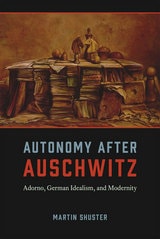
Autonomy After Auschwitz
Adorno, German Idealism, and ModernityMartin Shuster
University of Chicago Press, 2014
Shuster uncovers dangers in the notion of autonomy as it was originally conceived by Kant. Putting Adorno into dialogue with a range of European philosophers, notably Kant, Hegel, Horkheimer, and Habermas—as well as with a variety of contemporary Anglo-American thinkers such as Richard Rorty, Stanley Cavell, John McDowell, and Robert Pippin—he illuminates Adorno’s important revisions to this fraught concept and how his different understanding of autonomous agency, fully articulated, might open up new and positive social and political possibilities. Altogether, Autonomy after Auschwitz is a meditation on modern evil and human agency, one that demonstrates the tremendous ethical stakes at the heart of philosophy.
Can Virtue Make Us Happy?
The Art of Living and MoralityOtfried Hoffe
Northwestern University Press, 2010
Can one be happy and free, and nonetheless be moral? This question occurs at the core of daily life and is, as well, a question as old as philosophy itself. In Can Virtue Make Us Happy? The Art of Living and Morality, Otfried Höffe, one of Europe’s most well-known philosophers, offers a far-reaching and foundational work in philosophical ethics.
As long as one understands "happiness" purely as a feeling of subjective well-being, Höffe argues, there is at best only an accidental unity between it and morality. However, if one means by "happiness" the quality of doing well in the sense of one’s own successful existence, then one must include actions that undoubtedly have a moral character and are named virtues. He uses clear and general language to present what one understands by "happiness" and "freedom" while illuminating the blind alleys in the history of philosophy as well as the difficulties raised by the issues themselves. What has priority: good ends or right action? Is freedom always anarchy? Is it possible to think of a freedom enhanced by morality? Is "morality" only a pretty word for stupidity? Does humanity have a good or a bad character? Is there such a thing as evil? Höffe offers us enlightened philosophical reflection and foundational orientation but no simple formulas; this is precisely what is at stake because anyone who wishes to live a self-determined life rejects any and all formulas.
The Law of Love
From Autonomy to CommunionStephen F. Brett, SSJ
University of Scranton Press, 2010
With an interdisciplinary combination of philosophy, theology, and family law, The Law of Love explores the impact of secular conceptions of autonomy on sexuality and family. Drawing from the thought of Aristotle, Cicero, Augustine, Aquinas, and the modern theologian Servais Pinckaers, Stephen F. Brett argues that the divorce of freedom from virtue has caused cultural relativism, and that a potent and healthy mix of temperance, chastity, and modesty is the antidote. Styled accessibly and quite cleverly with a broader audience in mind, The Law of Love will appeal to intellectuals of all faiths who are interested in facing the ambiguities and problems of contemporary life in a secularized society.
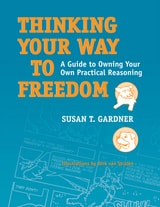
Thinking Your Way to Freedom
A Guide to Owning Your Own Practical ReasoningSusan T. Gardner
Temple University Press, 2009
Thinking Your Way to Freedom is a critical-thinking textbook with a difference. Rather than focusing exclusively on improving college students’ academic achievement, Susan Gardner seeks to dramatically change how students think through issues that are important in their lives beyond school. Gardner created 66 original and entertaining comic strips—featuring her dogs, Diva and Ben—that add a light touch as they encourage intellectual and personal autonomy. Through a clear step-by-step method of practical reasoning, students are taught how to think impartially and how to neutralize invisible biases that limit their freedom of thought and action. With the help of Diva and Ben, readers learn to evaluate the strengths of arguments and to recognize fallacies, all the while avoiding the paralyzing effects of relativism.
Thinking Your Way to Freedom includes the writing of short essays so that students can improve their critical thinking and writing at the same time. A Teacher’s Manual for this book will be available online.