Results by title
25 books match the query 'Avant - Garde'
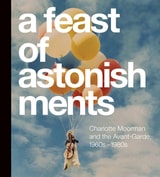
A Feast of Astonishments
Charlotte Moorman and the Avant-Garde, 1960s-1980sEdited by Lisa Graziose Corrin and Corrine Granof
Northwestern University Press, 2015
Charlotte Moorman was a bold, barrier-breaking musician and performance artist and a tireless champion of experimental art, whose avant-garde festivals in New York City brought new art forms to a broad public. To date, recognition of Moorman has been limited mostly to her collaborations with other artists, including composer John Cage and pioneering multimedia artist Nam June Paik, and to her 1967 performance of Paik’s "Opera Sextronique," for which she became known as the "topless cellist" after being arrested on indecency charges. A Feast of Astonishments looks deeper to portray Moorman as a leading international figure in her own right.
With more than 150 color images and essays by art historians, curators, and musicologists, this catalog will offer a fresh perspective and complement an exhibition that opens at Northwestern University’s Mary and Leigh Block Museum of Art in January 2016 before traveling to New York University’s Grey Art Gallery in Manhattan and the Museum der Moderne in Salzburg, Austria. The exhibition will feature original sculptures, photographs, video, props and costumes, annotated music scores, archival materials, film clips, and audio recordings, many drawn from the Charlotte Moorman Archive at the Charles Deering McCormick Library of Special Collections, Northwestern University Library. The exhibition is a partnership between the Block Museum and the Northwestern University Libraries.
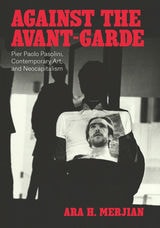
Against the Avant-Garde
Pier Paolo Pasolini, Contemporary Art, and NeocapitalismAra H. Merjian
University of Chicago Press, 2020

Antidiets of the Avant-Garde
From Futurist Cooking to Eat ArtCecilia Novero
University of Minnesota Press, 2009
Discussing an aspect of the European avant-garde that has often been neglected-its relationship to the embodied experience of food, its sensation, and its consumption-Cecilia Novero exposes the surprisingly key roles that food plays in the theoretical foundations and material aesthetics of a broad stratum of works ranging from the Italian Futurist Cookbook to the magazine Dada, Walter Benjamin's writings on eating and cooking, Daniel Spoerri's Eat Art, and the French New Realists.
Starting from the premise that avant-garde art involves the questioning of bourgeois aesthetics, Novero demonstrates that avant-garde artists, writers, and performers have produced an oppositional aesthetics of indigestible art. Through the rhetoric of incorporation and consumption and the use of material ingredients in their work, she shows, avant-garde artists active in the 1920s and 1930s as well as the neo-avant-garde movements engaged critically with consumer culture, memory, and history.
Attention to food in avant-garde aesthetics, Novero asserts, reveals how these works are rooted in a complex temporality that associates memory and consumption with dynamics of change.
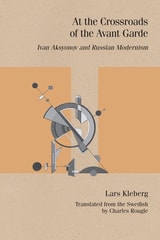
At the Crossroads of the Avant-Garde
Ivan Aksyonov and Russian ModernismLars Kleberg, Charles Rougle
Northwestern University Press, 2026
This kaleidoscopic biography offers readers a compelling microhistory of a revolutionary moment in art and politics through its portrait of an enigmatic but influential figure: Ivan Aksyonov authored the first book-length study about Pablo Picasso, translated Elizabethan drama, and was a literary adviser to Vsevolod Meyerhold, as well as a teacher of Sergei Eisenstein in Meyerhold’s institute and an important critic, before dying in 1935. Lars Kleberg traces Aksyonov’s influences, interlocutors, and creative output in multiple genres and media to bring a complicated and fascinating character back to life. Kleberg invites us to reconsider the avant-garde and to understand the political and artistic ferment of the revolutionary era and its aftermath in new, deeper ways.
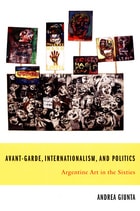
Avant-Garde, Internationalism, and Politics
Argentine Art in the SixtiesAndrea Giunta
Duke University Press, 2007
The renowned Argentine art historian and critic Andrea Giunta analyzes projects specifically designed to internationalize Argentina’s art and avant-garde during the 1960s: the importation of exhibitions of contemporary international art, the sending of Argentine artists abroad to study, the organization of prize competitions involving prestigious international art critics, and the export of exhibitions of Argentine art to Europe and the United States. She looks at the conditions that made these projects possible—not least the Alliance for Progress, a U.S. program of “exchange” and “cooperation” meant to prevent the spread of communism through Latin America in the wake of the Cuban Revolution—as well as the strategies formulated to promote them. She describes the influence of Romero Brest, prominent art critic, supporter of abstract art, and director of the Centro de Artes Visuales del Instituto Tocuato Di Tella (an experimental art center in Buenos Aires); various group programs such as Nueva Figuración and Arte Destructivo; and individual artists including Antonio Berni, Alberto Greco, León Ferrari, Marta Minujin, and Luis Felipe Noé. Giunta’s rich narrative illuminates the contentious postwar relationships between art and politics, Latin America and the United States, and local identity and global recognition.
Beyond the Sovereign Self
Aesthetic Autonomy from the Avant-Garde to Socially Engaged ArtGrant H. Kester
Duke University Press, 2024
Distant Early Warning
Marshall McLuhan and the Transformation of the Avant-GardeAlex Kitnick
University of Chicago Press, 2021
Kitnick builds the story of McLuhan’s entanglement with artists by carefully drawing out the connections among McLuhan, his theories, and the artists themselves. The story is packed with big names: Marcel Duchamp, Niki de Saint Phalle, Jasper Johns, Andy Warhol, Nam June Paik, and others. Kitnick masterfully weaves this history with McLuhan’s own words and his provocative ideas about what art is and what artists should do, revealing McLuhan’s influence on the avant-garde through the confluence of art and theory. The illuminating result sheds light on new aspects of McLuhan, showing him not just as a theorist, or an influencer, but as a richly multifaceted figure who, among his many other accolades, affected multiple generations of artists and their works. The book finishes with Kitnick overlaying McLuhan’s ethos onto the state of contemporary and post-internet art. This final channeling of McLuhan is a swift and beautiful analysis, with a personal touch, of art’s recent transgressions and what its future may hold.

Franklin Furnace and the Spirit of the Avant-Garde
A History of the FutureToni Sant
Intellect Books, 2011
Franklin Furnace is a renowned New York–based artsorganization whose mission is to preserve, document, and present works of avant-garde art by emerging artists—particularly those whose works may be vulnerable due to institutional neglect or politically unpopular content. Over more than thirty years, Franklin Furnace has exhibited works by hundreds of avant-garde artists, some of whom—Laurie Anderson, Vito Acconci, Karen Finley, Guillermo Gómez-Peña, Jenny Holzer, and the Blue Man Group, to name a few—are now established names in contemporary art.
Here, for the first time, is a comprehensive history of this remarkable organization from its conception to the present. Organized around the major art genres that emerged in the second half of the twentieth century, this book intersperses first-person narratives with readings by artists and scholars on issues critical to the organization's success as well as Franklin Furnace's many contributions to avant-garde art.
In Senghor's Shadow
Art, Politics, and the Avant-Garde in Senegal, 1960–1995Elizabeth Harney
Duke University Press, 2004
Heavily illustrated with nearly one hundred images, including some in color, In Senghor’s Shadow surveys the work of a range of Senegalese artists, including painters, muralists, sculptors, and performance-based groups—from those who worked at the height of Senghor’s patronage system to those who graduated from art school in the early 1990s. Harney reveals how, in the 1970s, avant-gardists contested Negritude beliefs by breaking out of established artistic forms. During the 1980s and 1990s, artists such as Moustapha Dimé, Germaine Anta Gaye, and Kan-Si engaged with avant-garde methods and local artistic forms to challenge both Senghor’s legacy and the broader art world’s understandings of cultural syncretism. Ultimately, Harney’s work illuminates the production and reception of modern Senegalese art within the global arena.
Making Theory/Constructing Art
On the Authority of the Avant-GardeDaniel Herwitz
University of Chicago Press, 1993
Spurred by the theoretical claims of Arthur Danto, a leader in the philosophy of the avant-garde, Herwitz reexamines the art and theory of major figures in the avant-garde movement including John Cage, Jean-François Lyotard, Jean Baudrillard, and Andy Warhol.
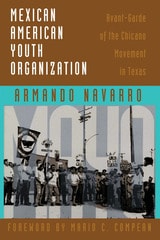
Mexican American Youth Organization
Avant-Garde of the Chicano Movement in TexasBy Armando Navarro
University of Texas Press, 1995
Among the protest movements of the 1960s, the Mexican American Youth Organization (MAYO) emerged as one of the principal Chicano organizations seeking social change. By the time MAYO evolved into the Raza Unida Party (RUP) in 1972, its influence had spread far beyond its Crystal City, Texas, origins. Its members precipitated some thirty-nine school walkouts, demonstrated against the Vietnam War, and confronted church and governmental bodies on numerous occasions.
Armando Navarro here offers the first comprehensive assessment of MAYO's history, politics, leadership, ideology, strategies and tactics, and activist program. Interviews with many MAYO and RUP organizers and members, as well as first-hand knowledge drawn from his own participation in meetings, presentations, and rallies, enrich the text.
This wealth of material yields the first reliable history of this extremely vocal and visible catalyst of the Chicano Movement. The book will add significantly to our understanding of Sixties protest movements and the social and political conditions that gave them birth.
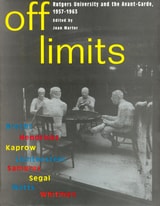
Off Limits
Rutgers University and the Avant-Garde, 1957-1963Marter, Joan
Rutgers University Press, 1999
Off Limits is the first examination of the Rutgers group, artists who came together on the Rutgers University, New Brunswick campus during the 1950s and revolutionized art practices and pedagogy. Based on interviews with artists, critics, and dealers from the period, the book connects the initiation of major trends such as Happenings, Pop Art, and Fluxus to the faculty, students, art curriculum, and events at the university. It is the first book to look not only at the work of individual artists, but to consider how interactions between these artists influenced their groundbreaking work.
Rutgers was clearly the place to be for experimental artists during the late 1950s and early 1960s. Allan Kaprow’s first Happening was presented at Rutgers. Roy Lichtenstein’s first Pop paintings, George Segal’s earliest figurative tableaux, Lucas Samaras’s radical exploration of media, and proto-Fluxus events by Robert Watts and George Brecht all took place on and around the campus. The innovative group rejected Abstract Expressionism for art based on the immediate experience of urban and industrial life, creating startling new artforms which remain startling and provocative.
Led by the theoretical writings and art practice of Kaprow, the group created a New Art—art beyond the limits of the conventional and predictable, even beyond accepted notions of progressive trends. Lichtenstein recalls in an interview, “Kaprow showed us that art didn’t have to look like art.” Along with Lichtenstein, Kaprow, Segal, and Watts taught at Rutgers and challenged one another to take art “Off Limits” — beyond the limits of the conventional, the predictable — even beyond the progressive, as defined by Abstract Expressionist gesturalism. Their art incorporated the gritty environs, the technological, the everyday, making art radical, outrageous, disturbing, and humorous.
Scenes of the Avant-Garde
Networks, Temporalities and Transformational PowerEdited by Katharina Tchelidze, Julian Volz, and Beate Söntgen
Diaphanes, 2026
The history of the avant-garde, told in a series of non-linear tableaus.
This volume understands “avant-garde” as a constellation of moments, emphasizing its plural developments and its crucial interventionist role in culture and politics. Challenging the narrative of a linear avant-garde, the book sheds light on local scenes shaped by their distance from artistic practices and sociocultural conditions of their time. Scenes of the Avant-Garde brings together papers from a conference held in Tbilisi on the occasion of the centenary of the Futurist and Dadaist group H2SO4 (1924).
The contributions explore networks, relationships, and collaborations in artistic interventions. What transformational power lies in these practices? What are the gendered, social, and spatial structures, within which artistic groups test and create forms of community? And what can we learn from these overlooked or differently read stories?
The book offers new insights into avant-garde histories, drawing on case studies from countries such as Georgia, Algeria, India, Poland, Czechoslovakia, France, and the United Kingdom.
Stubborn Poetries
Poetic Facticity and the Avant-GardePeter Quartermain
University of Alabama Press, 2013
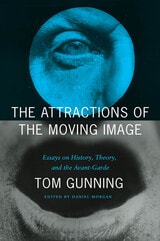
The Attractions of the Moving Image
Essays on History, Theory, and the Avant-GardeTom Gunning
University of Chicago Press, 2025
Tom Gunning is the author of multiple books and nearly two hundred essays that have defined the field of cinema and media studies. His works have transformed our understanding of early cinema and the American avant-garde and reset the terms of many central debates in film and media history and theory. His 1986 essay “The Cinema of Attractions” is among the most cited essays on film ever published. Gunning’s writings articulate a distinctive and powerful model for thinking about cinema’s history and likely future, addressing the full range of moving-image media, from film to still photography to digital media. His discussions draw on stage melodrama and magic lantern shows, as well as criminology, world’s fairs, and Spiritualism, surveying the medium as a cultural phenomenon informed by the industrial and information ages, psychiatry, urban experience, discourses on art and aesthetics, and more.
This collection brings together twenty-six essays that showcase the depth and range of Gunning’s scholarship, including four that have never before been published. Together, they solidify Gunning’s place as a scholar who has transformed the way generations of scholars, archivists, critics, and artists think about cinema.
The Avant-Garde and the Popular in Modern China
Tian Han and the Intersection of Performance and PoliticsLiang Luo
University of Michigan Press, 2014
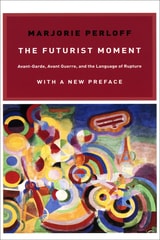
The Futurist Moment
Avant-Garde, Avant Guerre, and the Language of Rupture, with a New PrefaceMarjorie Perloff
University of Chicago Press, 2004
The Historicity of Experience
Modernity, the Avant-Garde, and the EventKrysztof Ziarek
Northwestern University Press, 2001
The four poets Ziarek considers—Gertrude Stein, Velimir Khlebnikov, Miron Biaoszewski, and Susan Howe—demonstrate the broad reach of and variety of forms taken by the avant-garde revision of experience and aesthetics. Moreover, this quartet illustrates how the main operative concepts and strategies of the avant-garde underpinned the practices of canonical writers. A profound philosophical meditation on language, modernity, and the everyday, The Historicity of Experience offers a fundamental reconceptualization of the avant-garde in relation to experience.

The Old Guard and the Avant-Garde
Modernism in Chicago, 1910-1940Edited by Sue Ann Prince
University of Chicago Press, 1990
"This is fresh and fascinating research about the ups and downs of modernism in Chicago, a city where art students reportedly once hung Matisse in effigy. Regional studies like this one broaden our understanding of how the art world has worked outside of New York and gives depth to a story we know too narrowly. Applause all the way around."—Wanda M. Corn, Stanford University
The Sovereign Self
Aesthetic Autonomy from the Enlightenment to the Avant-GardeGrant H. Kester
Duke University Press, 2023
The Transformation of the Avant-Garde
The New York Art World, 1940-1985Diana Crane
University of Chicago Press, 1989
Crane's account is built around discussions of seven styles: Abstract Expressionism in the forties; Pop art and Minimalism in the sixties; Figurative painting, Photorealism, and Pattern painting in the early seventies; and Neo-Expressionism in the early eighties. Demonstrating that the New York art world moved toward increasing acceptance of dominant American cultural trends, Crane offers a fascinating look not only at the intricacies of New York's artistic inner circle but also at the sociology of work and professions, the economics of culture markets such as "dealing art," and the sociology of culture.

Theory Of The Avant-Garde
Peter Burger
University of Minnesota Press, 1984
Travels with Mina Loy
Navigating the Avant-GardeSuzanne W. Churchill, Linda A. Kinnahan, and Susan Rosenbaum
Lever Press, 2026
Artist and writer Mina Loy (1882-1966) traversed continents, participated in Futurism, Dada, and Surrealism, and depicted poetic and painterly vistas ranging from lunar landscapes to the gritty streets of the Bowery. Travels with Mina Loy: Navigating the Avant-Garde, a companion text to the award-winning, multi-authored web resource Mina Loy: Navigating the Avant-Garde, offers an illustrated tour of Mina Loy’s long and varied career, contextualized with in-depth explorations of key places that shaped her life and work. Shedding new light on Loy's poetic responses to Italy, her theatrical explorations in New York City, and her forays into the museums of Paris and New York, the book brings in newly discovered and critically overlooked Loy works, as well as fresh timelines and surveys of the critical corpus on her creative output. This essential guidebook to Mina Loy charts her migrations across geography, movements among artistic circles and people, and transit across arts to illuminate her evolving aesthetics, politics, and artistic commitments.
Wireless Dada
Telegraphic Poetics in the Avant-GardeKurt Beals
Northwestern University Press, 2020
Wireless Dada: Telegraphic Poetics in the Avant-Garde demonstrates that the poetics of the Dada movement was profoundly influenced by the telegraph and the technological and social transformations that it brought about in the nineteenth and early twentieth centuries. While telegraphy’s impact on Italian Futurism and German Expressionism is widely acknowledged, its formative role in Dada poetics has been largely neglected. Drawing on media history and theory, avant-garde studies, and German literary studies, Kurt Beals shows how the telegraph and the cultural discourses that surrounded it shaped the radical works of this seminal avant-garde movement. The “nonsense” strain in Dada is frequently seen as a response to the senseless violence of the First World War. Beals argues that it was not just the war that turned Dada poetry into a jumble of senseless signals—it was also the wireless.
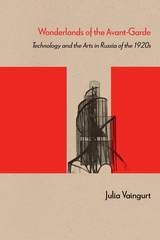
Wonderlands of the Avant-Garde
Technology and the Arts in Russia of the 1920sJulia Vaingurt
Northwestern University Press, 2013
In postrevolutionary Russia, as the Soviet government pursued rapid industrialization, avant-garde artists declared their intent to serve the nascent state and to transform life in accordance with their aesthetic designs. Despite their utilitarian intentions, however, most avant-gardists rarely created works regarded as practical instruments of societal transformation. Exploring this paradox, Vaingurt claims that the artists’ fusion of technology and aesthetics prevented their creations from being fully conscripted into the arsenal of political hegemony. The purposes of avant-garde technologies, she contends, are contemplative rather than constructive. Looking at Meyerhold’s theater, Tatlin’s and Khlebnikov’s architectural designs, Mayakovsky’s writings, and other works from the period, Vaingurt offers an innovative reading of an exceptionally complex moment in the formation of Soviet culture.