Results by title

5 books match the query 'Avilez, GerShun'
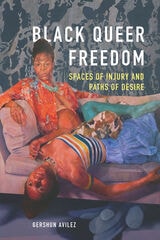
cover of Black Queer Freedom: Spaces of Injury and Paths of Desire

Black Queer Freedom

Spaces of Injury and Paths of Desire

GerShun Avilez

University of Illinois Press, 2020

Whether engaged in same-sex desire or gender nonconformity, black queer individuals live with being perceived as a threat while simultaneously being subjected to the threat of physical, psychological, and socioeconomical injury. Attending to and challenging threats has become a defining element in queer black artists’ work throughout the black diaspora. GerShun Avilez analyzes the work of diasporic artists who, denied government protections, have used art to create spaces for justice. He first focuses on how the state seeks to inhibit the movement of black queer bodies through public spaces, whether on the street or across borders. From there, he pivots to institutional spaces—specifically prisons and hospitals—and the ways such places seek to expose queer bodies in order to control them. Throughout, he reveals how desire and art open routes to black queer freedom when policy, the law, racism, and homophobia threaten physical safety, civil rights, and social mobility.
[more]
cover of Black Wellness: Health Beyond Outcomes

Black Wellness

Health Beyond Outcomes

GerShun Avilez

University of Minnesota Press, 2027

Revealing how contemporary Black creatives explore personal and collective wellness within anti-Black societies

Black Wellness tracks how Black artists, writers, poets, and other cultural producers explore Black health as feeling good while attending to underlying physical and mental exhaustion resulting from racism, homophobia, and sexism. Considering depictions of and discourse about pain, HIV/AIDS, Covid-19, cancer, and diabetes, GerShun Avilez moves beyond pathologies of Black illness and the outcome-motivated medical field to delineate the nature of Black wellness as the basis for artistic experiments, envisioning manifold expressions of health.

Responding to the history and impact of racial health disparities, Avilez locates a complex interplay between pain and care, stigma and pleasure, self-management and blame, and isolation and contact. In Black Wellness, he delves into innovative literary writing and digital projects: poetry by Danez Smith, Claudia Rankine, and Bettina Judd; personal reflections by Zadie Smith, Audre Lorde, and Yohanes Godanna Gatiso; novels by Toni Cade Bambara and Masande Ntshanga; and video, theatrical, and multimedia projects by Faithe Daye, Seth E. Davis, and Robbie McCauley.

Reading and thinking across borders to analyze African diasporic artists originating from the United States, Jamaica, South Africa, Ethiopia, and the United Kingdom, Avilez highlights how interconnected histories of racialization, minoritization, and colonization contextualize the lived experiences of Black wellness and illness. By deemphasizing—but not discounting—health outcomes, Black Wellness argues that cultural acts of envisioning and communicating Black health are always double pronged, simultaneously attending to states of debility and vitality in Black bodies.

Retail e-book files for this title are screen-reader friendly.

[more]
cover of Radical Aesthetics and Modern Black Nationalism

Radical Aesthetics and Modern Black Nationalism

GerShun Avilez

University of Illinois Press, 2016

Radical Aesthetics and Modern Black Nationalism explores the long-overlooked links between black nationalist activism and the renaissance of artistic experimentation emerging from recent African American literature, visual art, and film. GerShun Avilez charts a new genealogy of contemporary African American artistic production that illuminates how questions of gender and sexuality guided artistic experimentation in the Black Arts Movement from the mid-1960s to the mid-1970s. As Avilez shows, the artistic production of the Black Arts era provides a set of critical methodologies and paradigms rooted in the disidentification with black nationalist discourses. Avilez's close readings study how this emerging subjectivity, termed aesthetic radicalism, critiqued nationalist rhetoric in the past. It also continues to offer novel means for expressing black intimacy and embodiment via experimental works of art and innovative artistic methods.

A bold addition to an advancing field, Radical Aesthetics and Modern Black Nationalism rewrites recent black cultural production even as it uncovers unexpected ways of locating black radicalism.

[more]
cover of Tarell Alvin McCraney: Theater, Performance, and Collaboration

Tarell Alvin McCraney

Theater, Performance, and Collaboration

Edited by Sharrell D. Luckett, David Román, and Isaiah Matthew Wooden

Northwestern University Press, 2020

This is the first book to dedicate scholarly attention to the work of Tarell Alvin McCraney, one of the most significant writers and theater-makers of the twenty-first century. Featuring essays, interviews, and commentaries by scholars and artists who span generations, geographies, and areas of interest, the volume examines McCraney’s theatrical imagination, his singular writerly voice, his incisive cultural critiques, his stylistic and formal creativity, and his distinct personal and professional trajectories.
 
Contributors consider McCraney’s innovations as a playwright, adapter, director, performer, teacher, and collaborator, bringing fresh and diverse perspectives to their observations and analyses. In so doing, they expand and enrich the conversations on his much-celebrated and deeply resonant body of work, which includes the plays Choir Boy, Head of Passes, Ms. Blakk for President, The Breach, Wig Out!, and the critically acclaimed trilogy The Brother/Sister Plays: In the Red and Brown Water, The Brothers Size, and Marcus; Or the Secret of Sweet, as well as the Oscar Award–winning film Moonlight, which was based on his play In Moonlight Black Boys Look Blue.

 
[more]
cover of The Psychic Hold of Slavery: Legacies in American Expressive Culture

The Psychic Hold of Slavery

Legacies in American Expressive Culture

Soyica Diggs Colbert, Robert J. Patterson, and Aida Levy-Hussen

Rutgers University Press, 2016

What would it mean to “get over slavery”? Is such a thing possible? Is it even desirable? Should we perceive the psychic hold of slavery as a set of mental manacles that hold us back from imagining a postracist America? Or could the psychic hold of slavery be understood as a tool, helping us get a grip on the systemic racial inequalities and restricted liberties that persist in the present day?   
 
Featuring original essays from an array of established and emerging scholars in the interdisciplinary field of African American studies, The Psychic Hold of Slavery offers a nuanced dialogue upon these questions. With a painful awareness that our understanding of the past informs our understanding of the present—and vice versa—the contributors place slavery’s historical legacies in conversation with twenty-first-century manifestations of antiblack violence, dehumanization, and social death.   
 
Through an exploration of film, drama, fiction, performance art, graphic novels, and philosophical discourse, this volume considers how artists grapple with questions of representation, as they ask whether slavery can ever be accurately depicted, trace the scars that slavery has left on a traumatized body politic, or debate how to best convey that black lives matter. The Psychic Hold of Slavery thus raises provocative questions about how we behold the historically distinct event of African diasporic enslavement and how we might hold off the transhistorical force of antiblack domination.
 
[more]