Results by title
3 books match the query 'Aztec calendar'

Aztec Science
The Genetic Origin of Maize, Pollination, and Plant Sexuality Recorded in ArtHelen Burgos-Ellis
University Press of Colorado, 2026
Supported with ample iconographic, ethnohistoric, etymological, and scientific evidence, Aztec Science is a groundbreaking endeavor introducing a new and radical approach to the study of Aztec art. It demonstrates that the Indigenous peoples of ancient Mesoamerica recorded scientific information about plants in their material culture. The detailed analysis of plant imagery in Aztec art, including in manuscripts such as the Codex Borgia, reveals that the cultural importance of maize and other plants was closely linked to scientific concepts that were well known in central Mexico centuries before they were subsequently “discovered” in Europe.
For the Nahua, Helen Burgos-Ellis argues, maize’s significance went far beyond economic value and religious importance. In Nahua art, references to maize, grass, and Quetzalcoatl reflect historic and scientifically relevant information. These images and glyphs, when studied against the ethnohistoric and scientific record of central Mexicans’ vast knowledge of plants, indicate that the Nahua understood key concepts about the maize plant, including its genetic origin from a common grass, pollination process, life cycle, and sexual reproduction. Consequently, the cultural significance of maize for the Nahuas was deeply intertwined with scientific understanding.
Aztec Science is a radical departure from bulk of the scholarship on the Codex Borgia, which has primarily been understood to contain calendrical and ritual information rather than botanical content, and is of significant interest to Pre-Columbianists and students and scholars of ethnohistory, Indigenous history and culture, traditional ecological knowledge, art history, and the history of science and botany.
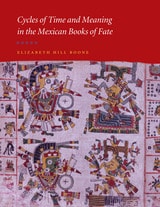
Cycles of Time and Meaning in the Mexican Books of Fate
By Elizabeth Hill Boone
University of Texas Press, 2007
In communities throughout precontact Mesoamerica, calendar priests and diviners relied on pictographic almanacs to predict the fate of newborns, to guide people in choosing marriage partners and auspicious wedding dates, to know when to plant and harvest crops, and to be successful in many of life's activities. As the Spanish colonized Mesoamerica in the sixteenth century, they made a determined effort to destroy these books, in which the Aztec and neighboring peoples recorded their understanding of the invisible world of the sacred calendar and the cosmic forces and supernaturals that adhered to time. Today, only a few of these divinatory codices survive. Visually complex, esoteric, and strikingly beautiful, painted books such as the famous Codex Borgia and Codex Borbonicus still serve as portals into the ancient Mexican calendrical systems and the cycles of time and meaning they encode.
In this comprehensive study, Elizabeth Hill Boone analyzes the entire extant corpus of Mexican divinatory codices and offers a masterful explanation of the genre as a whole. She introduces the sacred, divinatory calendar and the calendar priests and diviners who owned and used the books. Boone then explains the graphic vocabulary of the calendar and its prophetic forces and describes the organizing principles that structure the codices. She shows how they form almanacs that either offer general purpose guidance or focus topically on specific aspects of life, such as birth, marriage, agriculture and rain, travel, and the forces of the planet Venus. Boone also tackles two major areas of controversy—the great narrative passage in the Codex Borgia, which she freshly interprets as a cosmic narrative of creation, and the disputed origins of the codices, which, she argues, grew out of a single religious and divinatory system.
Time, History, and Belief in Aztec and Colonial Mexico
By Ross Hassig
University of Texas Press, 2001
Based on their enormously complex calendars that recorded cycles of many kinds, the Aztecs and other ancient Mesoamerican civilizations are generally believed to have had a cyclical, rather than linear, conception of time and history. This boldly revisionist book challenges that understanding. Ross Hassig offers convincing evidence that for the Aztecs time was predominantly linear, that it was manipulated by the state as a means of controlling a dispersed tribute empire, and that the Conquest cut off state control and severed the unity of the calendar, leaving only the lesser cycles. From these, he asserts, we have inadequately reconstructed the pre-Columbian calendar and so misunderstood the Aztec conception of time and history.
Hassig first presents the traditional explanation of the Aztec calendrical system and its ideological functions and then marshals contrary evidence to argue that the Aztec elite deliberately used calendars and timekeeping to achieve practical political ends. He further traces how the Conquest played out in the temporal realm as Spanish conceptions of time partially displaced the Aztec ones. His findings promise to revolutionize our understanding of how the Aztecs and other Mesoamerican societies conceived of time and history.