Results by title
3 books match the query 'Babbitt, Irving'
Democracy and Imperialism
Irving Babbitt and Warlike DemocraciesWilliam S. Smith
University of Michigan Press, 2019
Following costly U.S. engagement in two wars in the Middle East, questions about the appropriateness of American military interventions dominate foreign policy debates. Is an interventionist foreign policy compatible with the American constitutional tradition?
This book examines critic Irving Babbitt’s (1865–1933) unique contribution to understanding the quality of foreign policy leadership in a democracy. Babbitt explored how a democratic nation’s foreign policy is a product of the moral and cultural tendencies of the nation’s leaders, arguing that the substitution of expansive, sentimental Romanticism for the religious and ethical traditions of the West would lead to imperialism.
The United States’ move away from the restraint and order of sound constitutionalism to involve itself in the affairs of other nations will inevitably cause a clash with the “civilizational” regions that have emerged in recent decades. Democracy and Imperialism uses the question of soul types to address issues of foreign policy leadership, and discusses the leadership qualities that are necessary for sound foreign policy.
Humanism as Realism
Three Essays Concerning the Thought of Paul Elmer More and Irving BabbittLisa Fretschel
St. Augustine's Press, 2023
"This is a protreptic book. Its main goal is to encourage people to undertake independent studies or more generally, simply to think independently. If we want to think for ourselves, and not like preprogrammed humanoids, we can’t do so in a vacuum. We have to lean on something. In the Author’s view, the more than century-old writings of Paul Elmer More and Irving Babbitt are perfectly suited to the role of such a support for us, living in the here and now. They make it possible for us to dig ourselves out from underneath the heaps of opinions, “principles” or “theories” that allegedly can’t be rejected, that we’re obliged to follow, but that have a paralyzing and dumbing-down effect on us, making our lives from the
outset seems like the dream of a childish old man."
––Taken from the Preface by Pawel Armada
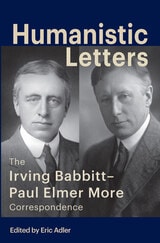
Humanistic Letters
The Irving Babbitt-Paul Elmer More CorrespondenceEric Adler
University of Missouri Press, 2023