Results by title
3 books match the query 'Bacevich, Andrew J.'
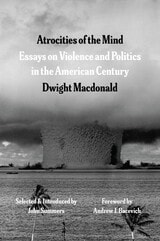
Atrocities of the Mind
Essays on Violence and Politics in the American CenturyDwight Macdonald
University of Chicago Press, 2026
An essential collection of Dwight Macdonald’s prophetic essays on politics, art, and violence in twentieth-century America.
What does extreme violence do to human values? Does the concept of collective guilt make sense in assessing responsibility for genocide? Has modern mechanized society forever destroyed the possibility of peaceful resistance through art and civil disobedience? Atrocities of the Mind presents anew Dwight Macdonald, one of America’s foremost literary journalists and political activists, grappling with the hard questions of his time—and ours.
In this collection, Macdonald writes about major events—the Holocaust, the atomic bombing of Hiroshima, Gandhi’s assassination, the Vietnam War, and social phenomena such as mass shootings, campus protests, and police brutality—with clear-sighted and buoyant prose. He writes incisively about the cinema of Alfred Hitchcock and Roman Polanski, praises Dorothy Day’s pacifism, and reports circulating an antiwar petition in the White House Rose Garden. And not without effect: his essay “Our Invisible Poor” is said to have spurred the Johnson administration’s War on Poverty.
Norman Mailer memorably called Macdonald “a man with whom one might seldom agree but could never disrespect because he always told the truth as he saw the truth—a man therefore of the most incorruptible integrity.” In our America, reeling from political violence, Macdonald’s truth-telling reminds us how we got here and who we might still become.
Raritan on War
An AnthologyJackson Lears
Rutgers University Press, 2025
Raritan on War collects some of the finest writing on that troubling subject published in Raritan Quarterly between 2003 and 2022. The editors, Jackson Lears and Karen Parker Lears, have selected work that typifies Raritan's wide-ranging sensibility, focusing on a topic that is aesthetically rich, intellectually challenging, and morally disturbing. Ultimately, Raritan on War reveals the power of art and reflection to sustain humane ways of being in the world, even amid constant global violence.
Contributors: C. Felix Amerasinghe; Andrew J. Bacevich; Victoria De Grazia; Tamas Dobozy; David Ferry; M. Fortuna; Cai Guo-Qiang; Emma Dodge Hanson; Jochen Hellbeck; Karl Kirchwey; Ray Klimek; Peter LaBier; Patrick Lawrence; d. mark levitt; Michael Miller; Lyle Jeremy Rubin; Elizabeth D. Samet; Sherod Santos; Robert Westbrook
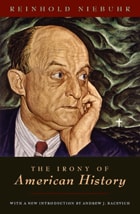
The Irony of American History
Reinhold Niebuhr
University of Chicago Press, 2008
“The supreme American theologian of the twentieth century.”—Arthur Schlesinger Jr., New York Times
“Niebuhr is important for the left today precisely because he warned about America’s tendency—including the left’s tendency—to do bad things in the name of idealism. His thought offers a much better understanding of where the Bush administration went wrong in Iraq.”—Kevin Mattson, The Good Society
“Irony provides the master key to understanding the myths and delusions that underpin American statecraft. . . . The most important book ever written on US foreign policy.”—Andrew J. Bacevich, from the Introduction