Results by title
5 books match the query 'Bachmann, Ingeborg'
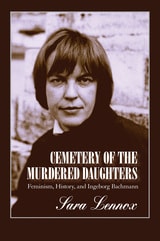
Cemetery of the Murdered Daughters
Feminism, History, and Ingeborg BachmannSara Lennox
University of Massachusetts Press, 2006
Although Austrian writer Ingeborg Bachmann (1926–1973) is widely regarded as one of the most important twentieth-century authors writing in German, her novels and stories have sometimes been viewed narrowly as portraits of women as victims. In this innovative study, Sara Lennox provides a much broader perspective on Bachmann's work, at the same time undertaking an experiment in feminist methodology. Lennox examines Bachmann's poetry and prose in historical context, arguing that the varied feminist interpretations of her writings are the result of shifts in theoretical emphases over a period of more than three decades. Lennox then places her own essays on Bachmann in similar perspective, showing how each piece reflects the historical moment in which it was written. Making use of recent interdisciplinary approaches—Foucauldian theories of sexuality, post-colonial theory, materialist feminism—she explores the extent to which each of her earlier readings was shaped by the methods employed, the questions asked, and the political issues that seemed most germane at the time. Out of this analysis comes a new understanding of the significance of Bachmann's work and new insight into the theory and practice of feminist criticism.
Correspondence
Paul Celan and Ingeborg Bachmann
Seagull Books, 2019
Collected here for the first time in English are their letters written between 1948 and 1961. Their correspondence forms a moving testimony of the discourse of love in the age after Auschwitz, with all the symptomatic disturbances and crises caused by their conflicting backgrounds and their hard-to-reconcile designs for living—as a woman, as a man, as writers. In addition to the almost 200 letters, the volume includes an important exchange between Bachmann and Gisèle Celan-Lestrange, who married Celan in 1951, as well as the letters between Paul Celan and Swiss writer Max Frisch.
“Scarcely more breathlessly and desperately can two lovers ever have struggled for words. Little known among German literary historians, the relationship between these two poets amounts to one of the most dramatic and momentous occurrences in German literature.”—FAZ, on the German edition
The Book of Franza and Requiem for Fanny Goldmann
Ingeborg Bachmann, translated from the German by Peter Filkins
Northwestern University Press, 2010
War Diary
Ingeborg Bachmann
Seagull Books, 2011
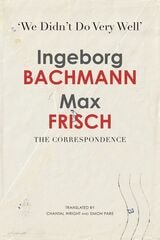
‘We Didn’t Do Very Well’
The CorrespondenceIngeborg Bachmann and Max Frisch
Seagull Books, 2026
The fraught and generative relationship between two postwar literary giants—revealed through a series of letters published for the first time in English.
Ingeborg Bachmann (1926–1973) stands among the most vital voices of postwar German literature—an acclaimed poet and prose writer who also reshaped radio drama and opera. In 1958, a letter of admiration from the Swiss novelist Max Frisch (1911–1991), written after hearing Bachmann’s radio play The Good God of Manhattan, led to a meeting in Paris and the beginning of an intense, volatile love affair that would forever leave a mark on both their lives and work. Presented here for the first time in English, 299 letters written between 1958 and 1973 trace the arc of that relationship: long separations, the strain of two writers attempting to share a life, creative rivalry, sexual jealousy, and gendered tensions sharpened by a fifteen-year age gap. The correspondence ranges from everyday logistics to raw psychological insight, from passion and longing to bitterness, silence, and regret. The later letters, written as Bachmann’s health declined, expand to include friends, relatives, and key literary figures. First published in German in 2022, this correspondence overturned long-held myths about the two writers, revealing mutual influence, negotiated freedom, and a struggle to reconcile incompatible needs. Intimate and revelatory, these letters illuminate the fragile intersection of love, power, and creativity.