Results by title
5 books match the query 'Bad'

A Bad and Stupid Girl
Jean McGarry
University of Michigan Press, 2006
Brought together by chance, the girls soon become partners in a struggle to find their way in a world where neither Esther’s brains nor Siri’s beauty is enough. Never having been forced to work hard at anything, Siri must rely on Esther to teach her to learn and attend class. But as Siri wakes from her dream world to discover the life of the mind, Esther begins shedding her rational bonds to explore the mysteries of the soul. For both, some of the most devastating lessons in the attainment of worldly knowledge come from love.
Deadpan funny and bittersweet, A Bad and Stupid Girl is above all else a moving portrait of two friends helping each other to uncover the potential splendor of their lives.
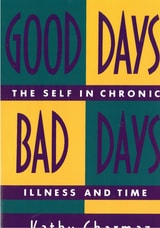
Good Days, Bad Days
The Self and Chronic Illness in TimeKathy C Charmaz
Rutgers University Press, 1993
Illness provides a mirror that allows sufferers to see themselves and to become more introspective. As they struggle for control over illness and control over time, they also struggle to control the central images of the self. For example, the chronically ill may situate their self-concepts in the past, present, or future. Charmaz examines under what conditions they situate their self-concepts in each of those timeframes. People may say they live one day at a time. They may bracket certain experiences, such as a heart attack, as timemarkers or turning points in the past. Or they may look ahead to recovering their health. Or ahead to death.
Charmaz artfully combines near jargon-free analysis with moving stories about how people have experienced illness, usually told in the sufferers' own words. She enters the world of the chronically ill, and brings us into it.
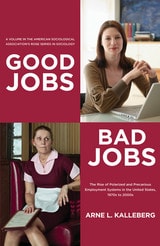
Good Jobs, Bad Jobs
The Rise of Polarized and Precarious Employment Systems in the United States, 1970s-2000sArne L. Kalleberg
Russell Sage Foundation, 2011
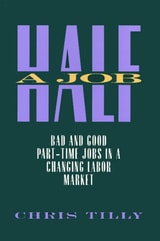
Half A Job
Bad and Good Part-Time Jobs in a Changing Labor MarketChris Tilly
Temple University Press, 1996
Over 20 million people are working part-time in the United States, more than six million of them involuntarily. Both Time and Fortune magazines have run recent cover stories about this constrained faction of the workforce, who tend to earn on average 40 percent less than full-time workers. Addressing this disturbing trend, Chris Tilly presents a current, in-depth analysis of how U.S. businesses use part-time employment, and why they are using it more and more.
Worker demand for part-time jobs peaked more than twenty years ago, but employers' desires for cheap labor and schedule flexibility have continued to drive the long-term growth of part-time jobs. Tilly argues that this growth is a reaction to the expanding trade and service industries, which, by their nature, depend on part-time workers. Examining the nature and purposes of the different types of part-time employment, he explores the roots of part-time jobs in the organization of work, and the inadequacies of existing public policies on part-time employment.
Using not only statistical analysis but over eighty interviews with employers in the retail and insurance industries, Tilly suggests new approaches to providing flexibility without insecurity.
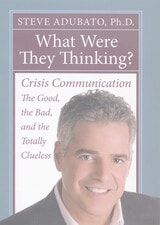
What Were They Thinking?
Crisis Communication: The Good, the Bad, and the Totally CluelessSteve Adubato, Ph.D.
Rutgers University Press, 2008
Nationally recognized communication coach and four-time Emmy Awardûwinning broadcaster Steve Adubato has been teaching, writing, and thinking about comm¡unication, leadership, and crisis communication for nearly two decades. In What Were They Thinking? Adubato examines twenty-two controversial and complex public relations and media mishaps, many of which were played out in public. Among cases and people discussed are:
- The Johnson & Johnson Tylenol scare: Perhaps the best crisis management ever
- Don Imus: Sometimes saying "sorry" is too little too late
- Former Attorney General Alberto Gonzales: Authority does not put you above questioning
- Bill O'Reilly: Know when to stop defending yourself and save face
- Former EPA Administrator Christie Whitman: Proof that your written words can come back to haunt you
- Hurricane Katrina: A natural disaster that led to a larger governmental disaster
- The Catholic Church's pedophilia scandal: Denial won't get rid of the skeletons in your closet
Arranged in short chapters detailing each case individually, the book provides a brief history of the topics and answers the questions: Who got it right? Who got it wrong? What can the rest of us learn from them?