Results by title
2 books match the query 'Baer, Andrew S.'
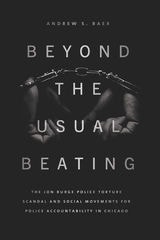
Beyond the Usual Beating
The Jon Burge Police Torture Scandal and Social Movements for Police Accountability in ChicagoAndrew S. Baer
University of Chicago Press, 2020
A story of institutionalized police brutality and how Chicago's public outcry led to long-lasting criminal justice reforms.
The malign and long-lasting influence of Chicago police commander Jon Burge cannot be overestimated, particularly as fresh examples of local and national criminal-justice abuse continue to surface with dismaying frequency. Burge’s decades-long tenure on the Chicago police force was marked by racist and barbaric interrogation methods, including psychological torture, burnings, and mock executions—techniques that went far “beyond the usual beating.” After being exposed in 1989, he became a symbol of police brutality and the unequal treatment of nonwhite people, and the persistent outcry against him led to reforms such as the abolition of the death penalty in Illinois.
But Burge hardly developed or operated in a vacuum, as Andrew S. Baer explores to stark effect here. He identifies the darkness of the Burge era as a product of local social forces, arising from a specific milieu beyond the nationwide racialized reactionary fever of the 1960s and 1970s. Similarly, the popular resistance movements that rallied in his wake actually predated Burge’s exposure but cohered with unexpected power due to the galvanizing focus on his crimes and abuses. For more than thirty years, a shifting coalition including torture survivors, their families, civil rights attorneys, and journalists helped to corroborate allegations of violence, free the wrongfully convicted, have Burge fired and incarcerated, and win passage of a municipal reparations package, among other victories. Beyond the Usual Beating reveals that though the Burge scandal underscores the relationship between personal bigotry and structural racism in the criminal justice system, it also shows how ordinary people held perpetrators accountable in the face of intransigent local power.
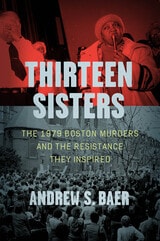
Thirteen Sisters
The 1979 Boston Murders and the Resistance They InspiredAndrew S. Baer
University of Chicago Press, 2027
The murder of thirteen women and girls in 1979 and the social movement they launched.
In four terrifying months in 1979, thirteen women and girls—twelve Black, one white—were murdered in Boston. All were found in or near Roxbury, a predominantly Black neighborhood in a city famously beset by racial strife and division. Fears of a serial killer spread within Black communities. But the authorities wouldn’t hear of it: these were just ordinary, everyday murders of unimportant people, killed by men they knew. The police said Black residents had nothing to fear—and the media implied that white people could safely ignore the carnage.
Yet Black feminists refused to accept the murders of Black women and girls. The real serial killers, they argued, were chronic racism, sexism, poverty, and domestic violence, including violence committed by Black men. Something had to be done.
Thirteen Sisters tells the gripping stories of the women who died—their lives, their brutal deaths, the attempts to solve them—and the renowned Combahee River Collective, whose activism in the wake of the murders brought national attention to the overlapping oppressions that made Black women and girls so vulnerable to violence. Historian Andrew S. Baer interviews family members and activists to introduce readers to the victims as complete people and investigate the events surrounding their deaths, unspooling a fast-paced and urgent narrative about crime, race, and marginalization. Baer also pays tribute to the Black feminists who saw the social roots of this violence and called for radical change, demands that remain all too relevant today.
Riveting, enraging, and humane, Thirteen Sisters is an indictment of the neglectful institutions that have failed Black women and a testament to the activists who transformed how we understand systemic oppression.