Results by title
2 books match the query 'Bagenstos, Samuel R.'
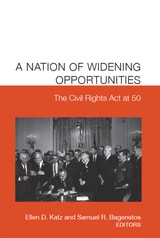
A Nation of Widening Opportunities
The Civil Rights Act at 50Ellen D. Katz and Samuel R. Bagenstos, editors
Michigan Publishing Services, 2015
“Sing for the Pro-Palestinian Student Activists.” A Commencement Speech and the Fight to Protect the Freedom of Expression
Rebekah Modrak
Disobedience Press, 2026
Sing for the pro-Palestinian student activists who have, over these past two years, opened our hearts to the injustice and inhumanity of Israel’s war in Gaza.
This single sentence, concluding a brief commencement address by the University of Michigan’s Faculty Senate Chair, ignited a controversy that simmered for weeks. Professor Derek Peterson had praised the work of female, Jewish, and Black activists who had fought for inclusion, ending with a shoutout to students who protested the university’s financial ties to Israel’s war on Gaza.
Hours later, U-M President Domenico Grasso publicly apologized, calling the remarks “hurtful and insensitive.” Peterson faced a barrage of threatening hate mail, alongside demands that he be fired and the university defunded. Conversely, a chorus of passionate dissent argued that a college education should equip students for, not shield them from, sharp controversies.
This volume collects commentary from students, alumni, labor organizers, and faculty. Most, but not all, defend Peterson’s right to say what he said, reflecting on questions of academic freedom, repressive notions of what is “appropriate,” the institution’s traditions of moral courage, the danger of assuming a monolithic “Jewish community,” and the Palestine exception to free speech.