Results by title
6 books match the query 'Baghdad'
Baghdad, Adieu
Selected Poems of Memory and ExileSalah Al Hamdani
Seagull Books, 2018
This landmark collection gathers thirty-five years of his writings, from his first volume in Arabic, Memory of Embers, to his latest collection, written originally in French, For You I Dream. It offers English-language readers their first substantial overview of Al Hamdani’s work, fired by the fight against injustice and shot through with longing for the home to which he can never return.
Baghdad, Mon Amour
Selected Writings of Salah Al HamdaniSalah Al Hamdani
Northwestern University Press, 2008
Baghdadi Judeo-Arabic
An Introductory TextAssaf Bar-Moshe
University College London, 2024
This textbook is dedicated to spoken Baghdadi Judeo-Arabic—the native tongue spoken by the Jews of Baghdad and other towns of Southern Iraq—and is designed to guide beginners to an advanced level of speaking. It focuses on common expressions, introduces Baghdad’s historic Jewish culture, and guides readers through sample texts, key vocabulary, grammar points, and exercises, as well as particular topics, such as greetings, family, shopping, and cuisine.
Ghost Riders of Baghdad
Soldiers, Civilians, and the Myth of the SurgeDaniel A. Sjursen
University Press of New England, 2015
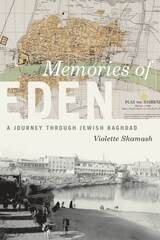
Memories of Eden
A Journey Through Jewish BaghdadViolette Shamash
Northwestern University Press, 2010
According to legend, the Garden of Eden was located in Iraq, and for millennia, Jews resided peacefully in metropolitan Baghdad. Memories of Eden: A Journey Through Jewish Baghdad reconstructs the last years of the oldest Jewish Diaspora community in the world through the recollections of Violette Shamash, a Jewish woman who was born in Baghdad in 1912, sent to her daughter Mira Rocca and son-in-law, the British journalist Tony Rocca. The result is a deeply textured memoir—an intimate portrait of an individual life, yet revealing of the complex dynamics of the Middle East in the twentieth century.
Toward the end of her long life, Violette Shamash began writing letters, notes, and essays and sending them to the Roccas. The resulting book begins near the end of Ottoman rule and runs through the British Mandate, the emergence of an independent Iraq, and the start of dictatorial government. Shamash clearly loved the world in which she grew up but is altogether honest in her depiction of the transformation of attitudes toward Baghdad’s Jewish population. Shamash’s world is finally shattered by the Farhud, the name given to the massacre of hundreds of Iraqi Jews over three days in 1941. An event that has received very slight historical coverage, the Farhud is further described and placed in context in a concluding essay by Tony Rocca.
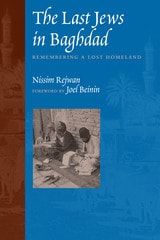
The Last Jews in Baghdad
Remembering a Lost HomelandBy Nissim Rejwan
University of Texas Press, 2004
Once upon a time, Baghdad was home to a flourishing Jewish community. More than a third of the city's people were Jews, and Jewish customs and holidays helped set the pattern of Baghdad's cultural and commercial life. On the city's streets and in the bazaars, Jews, Muslims, and Christians—all native-born Iraqis—intermingled, speaking virtually the same colloquial Arabic and sharing a common sense of national identity. And then, almost overnight it seemed, the state of Israel was born, and lines were drawn between Jews and Arabs. Over the next couple of years, nearly the entire Jewish population of Baghdad fled their Iraqi homeland, never to return.
In this beautifully written memoir, Nissim Rejwan recalls the lost Jewish community of Baghdad, in which he was a child and young man from the 1920s through 1951. He paints a minutely detailed picture of growing up in a barely middle-class family, dealing with a motley assortment of neighbors and landlords, struggling through the local schools, and finally discovering the pleasures of self-education and sexual awakening. Rejwan intertwines his personal story with the story of the cultural renaissance that was flowering in Baghdad during the years of his young manhood, describing how his work as a bookshop manager and a staff writer for the Iraq Times brought him friendships with many of the country's leading intellectual and literary figures. He rounds off his story by remembering how the political and cultural upheavals that accompanied the founding of Israel, as well as broad hints sent back by the first arrivals in the new state, left him with a deep ambivalence as he bid a last farewell to a homeland that had become hostile to its native Jews.