Results by title

4 books match the query 'Bahia (Brazil : State)'
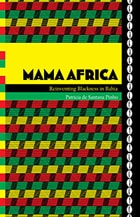
cover of Mama Africa: Reinventing Blackness in Bahia

Mama Africa

Reinventing Blackness in Bahia

Patricia de Santana Pinho

Duke University Press, 2010

Often called the “most African” part of Brazil, the northeastern state of Bahia has the country’s largest Afro-descendant population and a black culture renowned for its vibrancy. In Mama Africa, Patricia de Santana Pinho examines the meanings of Africa in Bahian constructions of blackness. Combining insights from anthropology, sociology, and cultural studies, Pinho considers how Afro-Bahian cultural groups, known as blocos afro, conceive of Africanness, blackness, and themselves in relation to both. Mama Africa is a translated, updated, and expanded edition of an award-winning book published in Brazil in 2004. Central to the book, and to Bahian constructions of blackness, is what Pinho calls “the myth of Mama Africa,” the idea that Africa exists as a nurturing spirit inside every black person.

Pinho explores how Bahian cultural production influences and is influenced by black diasporic cultures and the idealization of Africa—to the extent that Bahia draws African American tourists wanting to learn about their heritage. Analyzing the conceptions of blackness produced by the blocos afro, she describes how Africa is re-inscribed on the body through clothes, hairstyles, and jewelry; once demeaned, blackness is reclaimed as a source of beauty and pride. Turning to the body’s interior, Pinho explains that the myth of Mama Africa implies that black appearances have corresponding black essences. Musical and dance abilities are seen as naturally belonging to black people, and these traits are often believed to be transmitted by blood. Pinho argues that such essentialized ideas of blackness render black culture increasingly vulnerable to exploitation by the state and commercial interests. She contends that the myth of Mama Africa, while informing oppositional black identities, overlaps with a constraining notion of Bahianness promoted by the government and the tourist industry.
[more]
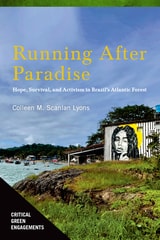
cover of Running After Paradise: Hope, Survival, and Activism in Brazil's Atlantic Forest

Running After Paradise

Hope, Survival, and Activism in Brazil's Atlantic Forest

Colleen M. Scanlan Lyons

University of Arizona Press, 2022

Brazil’s Atlantic Forest is a paradise to many. In Southern Bahia, surfers, billionaires, travelers, and hippies mingle with environmentalists, family farmers, quilombolas (descendants of formerly enslaved people), and nativos, or “locals.” Each of these groups has connections to the unique environment, culture, and character of this region as their home, their source of a livelihood, or perhaps their vacation escape. And while sometimes these connections converge—other times they clash.

The pressures on this tropical forest are palpable. So are people’s responses to these pressures. What was once the state’s economic mainstay, cacao production, is only now beginning to make a comeback after a disease decimated the crops of large and small farmers alike. Tourism, another economic hope, is susceptible to economic crises and pandemics. And the threat of a massive state-led infrastructure project involving mining, a railroad, and an international port has loomed over the region for well over a decade.

Southern Bahia is at a crossroads: develop a sustainable, forest-based economy or run the risk of losing the identity and soul of this place forevermore. Through the lives of environmentalists, farmers, quilombolas, and nativos—people who are in and of this place—this book brings alive the people who are grappling with this dilemma.

Anthropologist Colleen M. Scanlan Lyons brings the eye of a storyteller to present this complex struggle, weaving in her own challenges of balancing family and fieldwork alongside the stories of the people who live in this dynamic region. Intertwined tales, friendships, and hope emerge as people both struggle to sustain their lives in a biodiversity hotspot and strive to create their paradise.
 
[more]
cover of Sex Tourism in Bahia: Ambiguous Entanglements

Sex Tourism in Bahia

Ambiguous Entanglements

Erica Lorraine Williams

University of Illinois Press, 2013
For nearly a decade, Brazil has surpassed Thailand as the world's premier sex tourism destination. As the first full-length ethnography of sex tourism in Brazil, this pioneering study treats sex tourism as a complex and multidimensional phenomenon that involves a range of activities and erotic connections, from sex work to romantic transnational relationships. Erica Lorraine Williams explores sex tourism in the Brazilian state of Bahia from the perspectives of foreign tourists, tourism industry workers, sex workers who engage in liaisons with foreigners, and Afro-Brazilian men and women who contend with foreigners' stereotypical assumptions about their licentiousness. She shows how the Bahian state strategically exploits the touristic desire for exotic culture by appropriating an eroticized blackness and commodifying the Afro-Brazilian culture in order to sell Bahia to foreign travelers.

[more]
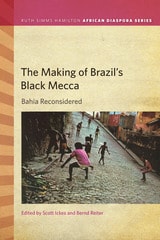
cover of The Making of Brazil's Black Mecca: Bahia Reconsidered

The Making of Brazil's Black Mecca

Bahia Reconsidered

Scott Ickes

Michigan State University Press, 2018

One of the few interdisciplinary volumes on Bahia available, The Making of Brazil’s Black Mecca: Bahia Reconsidered contains contributions covering a wide chronological and topical range by scholars whose work has made important contributions to the field of Bahian studies over the last two decades. The authors interrogate and problematize the idea of Bahia as a Black Mecca, or a haven where Brazilians of African descent can embrace their cultural and spiritual African heritage without fear of discrimination. In the first section, leading historians create a century-long historical narrative of the emergence of these discourses, their limitations, and their inability to effect meaningful structural change. The chapters by social scientists in the second section present critical reflections and insights, some provocative, on deficiencies and problematic biases built into current research paradigms on blackness in Bahia. As a whole the text provides a series of insights into the ways that inequality has been structured in Bahia since the final days of slavery.
 
[more]