Results by title
5 books match the query 'Bailey, Hugh C.'
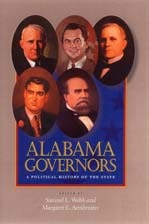
Alabama Governors
A Political History of the StateSamuel L. Webb
University of Alabama Press, 2001
The story of Alabama's governors has been often bizarre, occasionally inspiring, but never dull. Several of the state's early governors fought duels; one killed his wife's lover. A Reconstruction era-governor barricaded himself in his administrative office and refused to give it up when voters failed to reelect him. A 20th-century governor, an alumnus of Yale, married his first cousin and served as an officer in the Ku Klux Klan.
This collection of biographical essays, written by 34 noted historians and political scientists, chronicles the foibles and idiosyncrasies, in and out of office, of those who have served as the state's highest elected official. It also describes their courage; their meaningful policy initiatives; their accomplishments and failures; the complex factors that led to their actions or inaction; and the enormous consequences of their choices on the state's behalf.
Taken together, the essays provide a unified history of the state, with its recurring themes of race, federal-state relations, economic development, taxation, and education. Alabama Governors is certain to become an invaluable resource for teachers, students, librarians, journalists, and anyone interested in the colorful history and politics of the state.

Alabama Governors
A Political History of the StateSamuel L. Webb
University of Alabama Press, 2014
An entirely revised and updated edition of the best-selling 2001 original guide to the leaders, politics, and personalities that shaped Alabama's history.
This collection of biographical essays, written by thirty-four noted historians and political scientists, chronicles the times, careers, challenges, leadership, and legacies of the fifty-seven men and one woman who have served as the state's highest elected official. The book is organized chronologically into six sections that cover Alabama’s years as a US territory and its early statehood, the 1840s through the Civil War and Reconstruction, the late nineteenth-century Bourbon era, twentieth-century progressive and wartime governors, the Civil Rights era and George Wallace’s period of influence, and recent chief executives in the post-Wallace era.
The political careers of these fifty-eight individuals reflect the story of Alabama itself. Taken together, these essays provide a unified history of the state, with its recurring themes of race, federal-state relations, tensions between north and south Alabama, economic development, taxation, and education.
Alabama Governors expertly delineates the decisions and challenges of the chief executives, their policy initiatives, their accomplishments and failures, and the lasting impact of their terms. The book also includes the true and sometimes scandalous anecdotes that pepper Alabama’s storied history. Several of the state's early governors fought duels; one killed his wife's lover. A Reconstruction era-governor barricaded himself in his office and refused to give it up when voters failed to reelect him. A twentieth-century governor, an alumnus of Yale, served as an officer in the Ku Klux Klan.
This entirely updated and revised edition includes enlarged and enhanced images of each governor. Alabama Governors is certain to become a valuable resource for teachers, students, librarians, journalists, and anyone interested in the colorful history of Alabama politics.

Edgar Gardner Murphy
Gentle ProgressiveHugh C. Bailey
University of Alabama Press, 2002
The definitive biography of a visionary reformer who sought to guide the South into the modern age.
Edgar Gardner Murphy: Gentle Progressive by Hugh C. Bailey is the definitive biography of one of the most influential reform-minded leaders of the New South. Focusing on the life and public career of Edgar Gardner Murphy, an Episcopal clergyman, author, and social reform advocate, the book explores his efforts to promote education, civic responsibility, racial moderation, child welfare reform, and economic modernization during the Progressive Era. Bailey presents a nuanced portrait of a man whose ideas helped shape public discourse in the South at a time of profound social and political change.
Drawing on extensive research, Bailey examines Murphy's leadership in regional reform movements and his attempts to reconcile traditional Southern values with the demands of a modernizing society. The biography places Murphy within the broader context of Progressive Era America, illuminating the challenges reformers faced as they sought to address issues of poverty, education, labor, and governance while navigating the complex realities of race relations in the post-Reconstruction South.
Both scholarly and accessible, this volume highlights Murphy's achievements, limitations, and enduring legacy as a public intellectual and advocate for change. It offers valuable insight into the development of Southern Progressivism and remains an important resource for understanding the social, religious, and political evolution of the modern South.
Hinton Rowan Helper
Abolitionist and RacistHugh C. Bailey
University of Alabama Press, 1965
The compelling biography of a man whose opposition to slavery was matched only by the contradictions that defined his life.
Hinton Rowan Helper: Abolitionist and Racist by Hugh C. Bailey is a compelling scholarly biography of one of the most controversial and contradictory figures in nineteenth-century American history. Born in North Carolina and raised in the slaveholding South, Hinton Rowan Helper emerged as one of the era's most outspoken critics of slavery, arguing that the institution harmed the economic prospects of nonslaveholding white Southerners and hindered regional development. Yet despite his vigorous opposition to slavery, Helper also espoused deeply racist views, creating a paradox that has long challenged historians seeking to understand his place in American history.
Drawing on extensive research, Bailey examines Helper's career as an antislavery activist, political propagandist, reformer, and public intellectual while exploring the social, economic, and political forces that shaped his worldview. The biography traces Helper's influence on sectional tensions before the Civil War, his connections to the emerging Republican movement, and his later involvement in a variety of ambitious political and economic ventures.
More than a biography, this book offers a revealing study of the complexities of race, reform, and ideology in antebellum America. It remains an essential resource for understanding the contradictions that characterized both Helper and the broader society in which he lived.
John Williams Walker
A Study in the Political, Social, and Cultural Life of the Old SouthwestHugh C. Bailey
University of Alabama Press, 1964
The definitive biography of the statesman who helped shape Alabama and the American frontier.
A biography of Alabama’s first Senator, this book is also the fascinating story of Southern frontier life as portrayed in contemporary letters and documents. When Madison County, Alabama, was still wilderness, Walker trekked across the mountains from Georgia with his bride, Matilda Pope, his slaves, and all his household possessions, to build a plantation near Huntsville. Here he began his extraordinary political career: member of the first territorial legislature; speaker of the house in the second; U.S. territorial judge; president of Alabama’s Constitutional Convention; and when statehood was won, first U.S. Senator.
Though his term in the Senate was cut short by illness, resignation, and death, in the four years he served, he met head-on the most controversial issues of his day—the Missouri Compromise, acquisition of Florida, and land relief legislation. It was in land relief that he made his most significant contribution, for he fathered the 1821 Land Law upon which new public-lands legislation for a decade thereafter was based. His own state wildly acclaimed him upon its passage; other frontier states had good reason to make him the public hero he became. But a year later, at 40, he was dead of tuberculosis.