Results by title
2 books match the query 'Bajío Region (Mexico)'
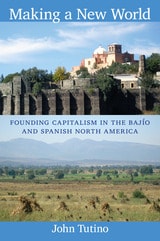
Making a New World
Founding Capitalism in the Bajío and Spanish North AmericaJohn Tutino
Duke University Press, 2011
Making a New World is a major rethinking of the role of the Americas in early world trade, the rise of capitalism, and the conflicts that reconfigured global power around 1800. At its center is the Bajío, a fertile basin extending across the modern-day Mexican states of Guanajuato and Querétaro, northwest of Mexico City. The Bajío became part of a new world in the 1530s, when Mesoamerican Otomís and Franciscan friars built Querétaro, a town that quickly thrived on agriculture and trade. Settlement accelerated as regional silver mines began to flourish in the 1550s. Silver tied the Bajío to Europe and China; it stimulated the development of an unprecedented commercial, patriarchal, Catholic society. A frontier extended north across vast expanses settled by people of European, Amerindian, and African ancestry. As mining, cloth making, and irrigated cultivation increased, inequities deepened and religious debates escalated. Analyzing the political economy, social relations, and cultural conflicts that animated the Bajío and Spanish North America from 1500 to 1800, John Tutino depicts an engine of global capitalism and the tensions that would lead to its collapse into revolution in 1810.
[more]
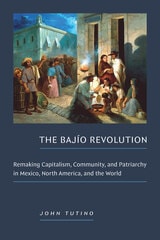
The Bajío Revolution
Remaking Capitalism, Community, and Patriarchy in Mexico, North America, and the WorldJohn Tutino
Duke University Press, 2025
In The Bajío Revolution, John Tutino examines how popular insurgents reshaped Mexico, the United States, and global capitalism during the nineteenth century. After detailing New Spain’s silver-driven wealth, Tutino shows how the Bajío insurgency of 1810–20 broke silver flows and Asian trades, opening markets to industrial cloth made in England from cotton made by enslaved hands in the US South—while Bajío women claimed pivotal roles making maize to sustain families and guerrilla bands. As Mexico gained independence in 1821, mining remained broken while family growers held strong. Then, in the 1830s, a new silver-industrial capitalism fed by family maize makers rose in the Bajío. Women still led rural families and took on mill labor; one woman became Mexico’s leading silver capitalist. Facing that competition, in the 1840s the United States invaded to claim Texas for cotton and slavery and California for gold. The new Mexican capitalism carried on until the United States mobilized gold taken in war to join a global gold standard in the 1870s—blocking Mexico’s independent route to capitalism.
[more]