Results by title

9 books match the query 'Baker, David'
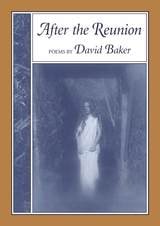
cover of After the Reunion: Poems

After the Reunion

Poems

David Baker

University of Arkansas Press, 1994
After the Reunion is an intensely lyrical collection of love poems and elegies from “the most expansive and moving poet to come out of the American Midwest since James Wright,” as Marilyn Hacker has described him. In these quiet, powerful, and eloquent poems, David Baker explores the kinship of love to loss, discovering that each is an inevitable component of the other. The final movement of the book is a unification of these two modes and becomes a celebration of continuities, kinships, and renewals.
[more]
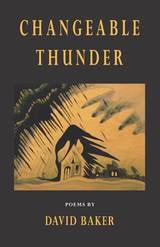
cover of Changeable Thunder: Poems

Changeable Thunder

Poems

David Baker

University of Arkansas Press, 2001
Changeable Thunder marks David Baker's emergence as a major contemporary poet. To his abiding sense of the Midwest—its politics, people, and landscapes—Baker adds a powerful historical dimension, with poems ranging from Puritan New England to the modern subway. Of particular note are poems on the works of other writers, as he reanimates Shelley's letters, Samuel Sewall's diaries, and Walt Whitman's novel. With brilliant technique, dazzling formal variety, and moving intimacy, Baker's poems explore personal illness, erotic and familial passion, artistic creation, and the constant work and changing weather of one man's life.
[more]
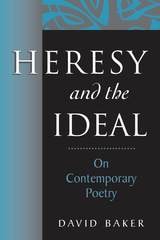
cover of Heresy and the Ideal: On Contemporary Poetry

Heresy and the Ideal

On Contemporary Poetry

David Baker

University of Arkansas Press, 2000
Heresy and the Ideal is a powerful collection of essays and essay-reviews which David Baker wrote and published throughout the 1990s. He thoroughly discusses the work of more than fifty contemporary poets, including T. R. Hummer, Miller Williams, Albert Goldbarth, Jane Kenyon, Galway Kinnell, Charles Simic, Ted Kooser, David Wojahn, Alice Fulton, Louise Glück, and Charles Wright. He takes as his models some of the great critical books of the past three decades, especially Richard Howard's masterpiece, Alone with America, and Helen Vendler's Part of Nature, Part of Us, as well as other works by Laurence Lieberman, Majorie Perloff, Carol Muske, and Mary Kinzie. At its center, Heresy and the Ideal is based on Baker's sense of Romantic poetics, especially on how contemporary poets have applied, altered, or rejected certain Romantic principles. He uses the Romantic trope to measure the tension between passion and reason and between the problems of literary transcendence and the obligations of social engagement. The result is a welcome variety of enlightening, practical criticism devoid of exclusionary jargon and based on persistent attention to an individual poem or book of poems. Utilizing the essay-review, Baker considers each poet's purposes and achievements. He blends the strategies of explanation, analysis, and evaluation, clarifying each poet's work instead of complaining or condemning. Heresy and the Ideal addresses a wide and diverse range of contemporary poetry and should take a deserved place both as a critical introduction to the work of many important poets and as a work that documents and explores the shape of poetry at the end of the millennium.
[more]
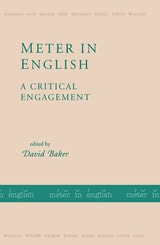
cover of Meter in English: A Critical Engagement

Meter in English

A Critical Engagement

David Baker

University of Arkansas Press, 1997
Renowned poets and experts in metrics respond to Robert Wallace's pivotal essay which clarifies and simplifies methods of studying poetry. Former United States Poet Laureate Robert Hass has called Wallace's essay a paradigm shift in our understanding of English prosody.
[more]
cover of Musical Landscapes in Color: Conversations with Black American Composers

Musical Landscapes in Color

Conversations with Black American Composers

William C. Banfield

University of Illinois Press, 2023

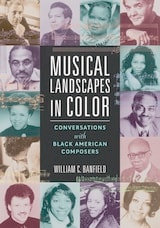
Now available in paperback, William C. Banfield’s acclaimed collection of interviews delves into the lives and work of forty-one Black composers. Each of the profiled artists offers a candid self-portrait that explores areas from training and compositional techniques to working in a exclusive canon that has existed for a very long time. At the same time, Banfield draws on sociology, Western concepts of art and taste, and vernacular musical forms like blues and jazz to provide a frame for the artists’ achievements and help to illuminate the ongoing progress and struggles against industry barriers. Expanded illustrations and a new preface by the author provide invaluable added context, making this new edition an essential companion for anyone interested in Black composers or contemporary classical music.

Composers featured: Michael Abels, H. Leslie Adams, Lettie Beckon Alston, Thomas J. Anderson, Dwight Andrews, Regina Harris Baiocchi, David Baker, William C. Banfield, Ysaye Maria Barnwell, Billy Childs, Noel DaCosta, Anthony Davis, George Duke, Leslie Dunner, Donal Fox, Adolphus Hailstork, Jester Hairston, Herbie Hancock, Jonathan Holland, Anthony Kelley, Wendell Logan, Bobby McFerrin, Dorothy Rudd Moore, Jeffrey Mumford, Gary Powell Nash, Stephen Newby, Coleridge-Taylor Perkinson, Michael Powell, Patrice Rushen, George Russell, Kevin Scott, Evelyn Simpson-Curenton, Hale Smith, Billy Taylor, Frederick C. Tillis, George Walker, James Kimo Williams, Julius Williams, Tony Williams, Olly Wilson, and Michael Woods

[more]
cover of Show Me Your Environment: Essays on Poetry, Poets, and Poems

Show Me Your Environment

Essays on Poetry, Poets, and Poems

David Baker

University of Michigan Press, 2014

In Show Me Your Environment, a penetrating yet personable collection of critical essays, David Baker explores how a poem works, how a poet thinks, and how the art of poetry has evolved—and is still evolving as a highly diverse, spacious, and inclusive art form. The opening essays offer contemplations on the “environment” of poetry from thoughts on physical places and regions as well as the inner aesthetic environment. Next, Baker looks at the highly distinctive achievements and styles of poets ranging from George Herbert and Emily Dickinson through poets writing today. Finally, he takes joy in reading individual poems—from the canonical to the contemporary; simply and closely.

[more]
cover of Sweet Home, Saturday Night: Poems

Sweet Home, Saturday Night

Poems

David Baker

University of Arkansas Press, 1991

"This music of Place, with all its varied and subtle emotional range, is what this book so marvelously captures. . . ." --Linda Pastan
[more]
cover of Talk Poetry: Poems and Interviews with Nine American Poets

Talk Poetry

Poems and Interviews with Nine American Poets

David Baker

University of Arkansas Press, 2012

What is more direct and intimate than one-to-one conversation? Here two forces in American poetry, the Kenyon Review and the University of Arkansas Press, bring together discussions between one of America's leading poets and editors, David Baker, and nine of the most exciting poets of our day. The poets, who represent a wide array of vocations and aesthetic positions, open up about their writing processes, their reading and education, their hopes for and discontents with the contemporary scene, and much more, treating readers to a view of the range and capacity of contemporary American poetry.
[more]
cover of The Truth about Small Towns: Poems

The Truth about Small Towns

Poems

David Baker

University of Arkansas Press, 1998

Winner of the 1998 Ohioana Poetry Award

Skilled at both extended narratives and intense, intimate lyrics, David Baker combines his talents in his fifth collection of poems. Working in syllabics, sonnets, couplets, and free verse, Baker can write unflinchingly about love, illness, madness, and perseverance.

His small towns are the burgs of the Midwest, where there is a constant tension between a future that’s coming and a past that may never vanish. The grocer on the corner now carries mango chutney, and the city council must decide—Wendy’s or wetlands.

From these rural towns, Baker evokes lovers, mothers and fathers, highway workmen, hospital patients, and the long dead. He spots the inner struggles of everyday living, as in these lines from “The Women”: “there comes a rubbing of hands, and not as in cleaning. / As when something’s put away, but it won’t stay down.”

Regional in the best sense, Baker’s poems capture the universal human commerce of love and conflict enduring under the water towers and storefronts of America’s heartland.

[more]