Results by title
11 books match the query 'Bakhtin, M. M.'
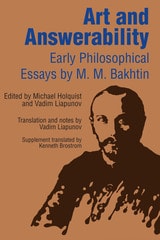
Art and Answerability
Early Philosophical EssaysBy M. M. Bakhtin
University of Texas Press, 1990
Art and Answerability contains three of Mikhail Bakhtin's early essays from the years following the Russian Revolution, when Bakhtin and other intellectuals eagerly participated in the debates, lectures, demonstrations, and manifesto writing of the period. Because they predate works that have already been translated, these essays—"Art and Answerability," "Author and Hero in Aesthetic Activity," and "The Problem of Content, Material, and Form in Verbal Art"—are essential to a comprehensive understanding of Bakhtin's later works. A superb introduction by Michael Holquist sets out the major themes and concerns of the three essays and identifies their place in the canon of Bakhtin's work and in intellectual history. The introduction, together with Vadim Liapunov's scholarly gloss, makes these essays accessible to students as well as scholars.
Bakhtin and Religion
A Feeling for FaithSusan M. Felch and Paul J. Contino
Northwestern University Press, 2001
These essays provide an overview of Bakhtin's attitude toward religion in general and Russian Orthodoxy in particular, addressing topics ranging from how Bakhtin's religious ideas informed his linguistic and aesthetic theories to the idea of love in his secular and religious thought and to the religious component of Bakhtin's theory of laughter.
Bakhtin and the Classics
R. Bracht Branham
Northwestern University Press, 2001
The authors, eminent classicists and distinguished critics of Bakhtin, put Bakhtin into dialogue with the classics--and classicists into dialogue with Bakhtin. Each essay offers a critical account of an important aspect of Bakhtin's thought and examines the value of his approach in the context of literary or cultural history. Beginning with an overview of Bakhtin's notion of carnival laughter, perhaps his central critical concept, the volume explores Bakhtin's thought and writing in relation to Homer's epic verse. Catullus's lyric poetry, ancient Roman novels, and Greek philosophy from Aristotle's theory of narrative to the work of Antiphon the Sophist. The results are of interest and importance to Bakhtinians, theorists, and classicists.
Bakhtin in Contexts
Across the DisciplinesAmy Mandelker
Northwestern University Press, 1995
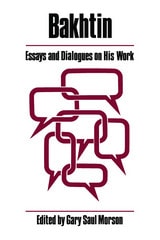
Bakhtin
Essays and Dialogues on His WorkEdited by Gary Saul Morson
University of Chicago Press, 1986
A groundbreaking collection of essays on the influential critic and philosopher
Mikhail Bakhtin (1895-1975) was a Russian philosopher and literary critic whose influence on a wide range of intellectual fields has only grown since his death, with his emphasis on dialogue and suspicion of systems having particularly resonance in literary studies and linguistics. This collection of essays, all originally published in the the journal Critical Inquiry, explores his literary and linguistic theory and its implications for theory in general and critical practice.
In addition to the critical essays, this book includes previously untranslated excerpts from Bakhtin's essays and notebooks.
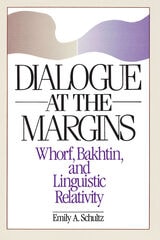
Dialogue at the Margins
Whorf, Bakhtin, and Linguistic RelativityEmily A. Schultz
University of Wisconsin Press, 1990
The “linguistic relativity principle” of pioneering American linguist Benjamin Whorf has been a focus of controversy among scholars of language for half a century. Many claim that this principle amounts to Whorf’s assertion that language determines thought and culture, while others vigorously reject such a claim. Emily Schultz rereads Whorf in terms of Russian theorist Mikhail Bakhtin, and argues that the Whorfian controversy is rooted in the polyphonic character of his best known texts. By combining Whorfian and Bakhtinian insights concerning variation within and across languages, Schultz offers a new dialogic interpretation of linguistic relativity that has profound implications for students and scholars of anthropology, linguistics, cognitive psychology, philosophy of language, and literary and art criticism.
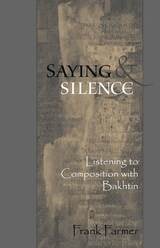
Saying And Silence
Frank Farmer
Utah State University Press, 2001
Frank Farmer has contributed important essays to the study of Bakhtin in composition, and in Saying and Silence he gathers some of those, along with several new essays, into a single volume. Scholars who specialize in Bakhtin will find this work engaging, but equally Farmer wants to explicate and apply Bakhtin for readers whose focus is teaching or some other nonspecialist dimension of writing scholarship.
Farmer explores the relationship between the meaningful word and the meaningful pause, between saying and silence, especially as the relationship emerges in our classrooms, our disciplinary conversations, and encounters with publics beyond the academy. Each of his chapters here addresses some aspect of how we and our students, colleagues, and critics have our say and speak our piece, often under conditions where silence is the institutionally sanctioned and preferred alternative. He has enlisted a number of Bakhtinian ideas (the superaddressee, outsideness, voice in dialogue) to help in the project of interpreting the silences we hear, naming the silences we do not hear, and of encouraging all silences to speak in ways that are freely chosen, not enforced.
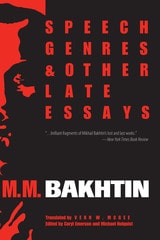
Speech Genres and Other Late Essays
By M.M. Bakhtin
University of Texas Press, 1986
Speech Genres and Other Late Essays presents six short works from Bakhtin's Esthetics of Creative Discourse, published in Moscow in 1979. This is the last of Bakhtin's extant manuscripts published in the Soviet Union. All but one of these essays (the one on the Bildungsroman) were written in Bakhtin's later years and thus they bear the stamp of a thinker who has accumulated a huge storehouse of factual material, to which he has devoted a lifetime of analysis, reflection, and reconsideration.
Testimony after Catastrophe
Narrating the Traumas of Political ViolenceStevan Weine
Northwestern University Press, 2006
A deeply involving, compassionate, occasionally confrontational blend of practical hands-on experience and dialogic theory, emerging from the author's decade-long work in Europe and Chicago with survivors of the Balkan wars, this book is committed to the proposition that efforts to use testimony to address the consequences of political violence can be strengthened--though by no means guaranteed--if they are based on a fuller acknowledgment of the personal and ethical elements embodied in the narrative essence of testimony. These elements are what Testimony after Catastrophe seeks to reveal.
The Dialogic Imagination
Four EssaysBy M. M. Bakhtin
University of Texas Press, 1982
These essays reveal Mikhail Bakhtin (1895-1975)—known in the West largely through his studies of Rabelais and Dostoevsky—as a philosopher of language, a cultural historian, and a major theoretician of the novel. The Dialogic Imagination presents, in superb English translation, four selections from Voprosy literatury i estetiki (Problems of literature and esthetics), published in Moscow in 1975. The volume also contains a lengthy introduction to Bakhtin and his thought and a glossary of terminology.
Bakhtin uses the category "novel" in a highly idiosyncratic way, claiming for it vastly larger territory than has been traditionally accepted. For him, the novel is not so much a genre as it is a force, "novelness," which he discusses in "From the Prehistory of Novelistic Discourse." Two essays, "Epic and Novel" and "Forms of Time and of the Chronotope in the Novel," deal with literary history in Bakhtin's own unorthodox way. In the final essay, he discusses literature and language in general, which he sees as stratified, constantly changing systems of subgenres, dialects, and fragmented "languages" in battle with one another.
Toward a Philosophy of the Act
By M. M. Bakhtin
University of Texas Press, 1993
Rescued in 1972 from a storeroom in which rats and seeping water had severely damaged the fifty-year-old manuscript, this text is the earliest major work (1919-1921) of the great Russian philosopher M. M. Bakhtin. Toward a Philosophy of the Act contains the first occurrences of themes that occupied Bakhtin throughout his long career. The topics of authoring, responsibility, self and other, the moral significance of "outsideness," participatory thinking, the implications for the individual subject of having "no-alibi in existence," the difference between the world as experienced in actions and the world as represented in discourse—all are broached here in the heat of discovery. This is the "heart of the heart" of Bakhtin, the center of the dialogue between being and language, the world and mind, "the given" and "the created" that forms the core of Bakhtin's distinctive dialogism.
A special feature of this work is Bakhtin's struggle with the philosophy of Immanuel Kant. Put very simply, this text is an attempt to go beyond Kant's formulation of the ethical imperative. mci will be important for scholars across the humanities as they grapple with the increasingly vexed relationship between aesthetics and ethics.