Results by title
6 books match the query 'Balakian, Peter'
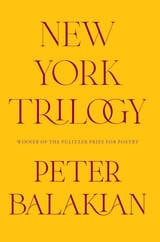
New York Trilogy
Peter Balakian
University of Chicago Press, 2025
An American long poem in three sections by Pulitzer Prize-winning poet Peter Balakian that moves between decades of tumultuous life in New York City and explosive parts of the Middle East.
In an inventive, elliptical language, New York Trilogy explores one man’s journey from the late 1960s to the twenty-first century, as he moves through a series of experiences centered in New York City and the surrounding New Jersey Palisades. Throughout this long poem in three parts, the protagonist’s life is impacted by historical events including the Armenian Genocide, the bombing of Hiroshima, the Vietnam War, the AIDS epidemic, the attacks of September 11th, the US war in Iraq, and the climate crisis.
Comprised of three multi-sequence poems originally included in Peter Balakian’s collections No Sign, Ozone Journal, and Ziggurat, the sections of New York Trilogy come together to form a poetry that embraces interior and aesthetic experiences, celebrates human intimacy, and bears witness to history. The historical power and psychological depth of Balakian’s work expands on the tradition of the American long poem with a lyrical narrative that weaves intimate personal moments into the vastness of shared history.
[more]
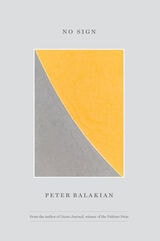
No Sign
Peter Balakian
University of Chicago Press, 2022
New poetry collection from Peter Balakian, author of Ozone Journal, winner of the Pulitzer Prize.
In these poems, Peter Balakian wrestles with national and global cultural and political realities, including challenges for the human species amid planetary transmutation and the impact of mass violence on the self and culture. At the collection’s heart is “No Sign,” another in Balakian’s series of long-form poems, following “A-Train/Ziggurat/Elegy” and “Ozone Journal,” which appeared in his previous two collections. In this dialogical multi-sectioned poem, an estranged couple encounters each other, after years, on the cliffs of the New Jersey Palisades. The dialogue that ensues reveals the evolution of a kaleidoscopic memory spanning decades, reflecting on the geological history of Earth and the climate crisis, the film Hiroshima Mon Amour, the Vietnam War, a visionary encounter with the George Washington Bridge, and the enduring power of love..
Whether meditating on the sensuality of fruits and vegetables, the COVID-19 pandemic, the trauma and memory of the Armenian genocide, James Baldwin in France, or Arshile Gorky in New York City, Balakian’s layered, elliptical language, wired phrases, and shifting tempos engage both life’s harshness and beauty and define his inventive and distinctive style.
[more]
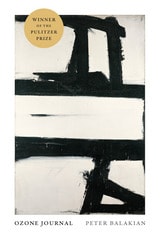
Ozone Journal
Peter Balakian
University of Chicago Press, 2015
WINNER OF THE PULITZER PRIZE
from "Ozone Journal"
Bach’s cantata in B-flat minor in the cassette,
we lounged under the greenhouse-sky, the UVBs hacking
at the acids and oxides and then I could hear the difference
between an oboe and a bassoon
at the river’s edge under cover—
trees breathed in our respiration;
there was something on the other side of the river,
something both of us were itching toward—
radical bonds were broken, history became science.
We were never the same.
The title poem of Peter Balakian's Ozone Journal is a sequence of fifty-four short sections, each a poem in itself, recounting the speaker's memory of excavating the bones of Armenian genocide victims in the Syrian desert with a crew of television journalists in 2009. These memories spark others—the dissolution of his marriage, his life as a young single parent in Manhattan in the nineties, visits and conversations with a cousin dying of AIDS—creating a montage that has the feel of history as lived experience. Bookending this sequence are shorter lyrics that span times and locations, from Nairobi to the Native American villages of New Mexico. In the dynamic, sensual language of these poems, we are reminded that the history of atrocity, trauma, and forgetting is both global and ancient; but we are reminded, too, of the beauty and richness of culture and the resilience of love.
[more]
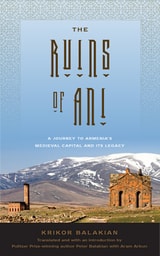
The Ruins of Ani
A Journey to Armenia's Medieval Capital and its LegacyKrikor Balakian
Rutgers University Press, 2019
Winner of the 2019 Dr. Sona Aronian Book Prize for Excellence in Armenian Studies (NAASR)
From the tenth to the thirteenth centuries, the city of Ani was the jewel of the Armenian kingdom, renowned far and wide for its magnificent buildings. Known as the city of 1001 churches, Ani was a center for artistic innovation, and its architecture is a potential missing link between Byzantine and Gothic styles. By the fifteenth century, Ani was virtually abandoned, its stunning buildings left to crumble. Yet its ruins have remained a symbol of cultural accomplishment that looms large in the Armenian imagination.
The Ruins of Ani is a unique combination of history, art criticism, and travel memoir that takes readers on a thousand-year journey in search of past splendors. Today, Ani is a popular tourist site in Turkey, but the city has been falsified in its presentation by the Turkish government in order to erase Armenian history in the wake of the Armenian Genocide. This timely publication also raises questions about the preservation of major historic monuments in the face of post atrocity campaigns of cultural erasure.
Originally written by young priest Krikor Balakian in 1910, just a few years before the Armenian genocide, this book offers a powerful and poignant counterpart to Balakian’s acclaimed genocide memoir Armenian Golgotha. This new translation by the author’s great-nephew, Pulitzer Prize-winning poet Peter Balakian, eloquently renders the book’s vivid descriptions and lyrical prose into English. Including a new introduction that explores Ani’s continued relevance in the twenty-first century, The Ruins of Ani will give readers a new appreciation for this lost city’s status as a pinnacle of both Armenian civilization and human achievement.
[more]
Vise and Shadow
Essays on the Lyric Imagination, Poetry, Art, and CulturePeter Balakian
University of Chicago Press, 2015
Peter Balakian is a renowned poet, scholar, and memoirist; but his work as an essayist often prefigures and illuminates all three. "I think of vise and shadow as two dimensions of the lyric (literary and visual) imagination," he writes in the preface to this collection, which brings together essayistic writings produced over the course of twenty-five years. Vise, "as in grabbing and holding with pressure," but also in the sense of the vise-grip of the imagination, which can yield both clarity and knowledge. Consider the vise-grip of some of the poems of our best lyric poets, how language might be put under pressure "as carbon might be put under pressure to create a diamond." And shadow, the second half of the title: both as noun, "the shaded or darker portion of the picture or view or perspective," "partial illumination and partial darkness"; and as verb, to shadow, "to trail secretly as an inseparable companion" or a "force that follows something with fidelity; to cast a dark light on something—a person, an event, an object, a form in nature."
Vise and Shadow draws into conversation such disparate figures as W. B. Yeats, Hart Crane, Joan Didion, Primo Levi, Robert Rauschenberg, Bob Dylan, Elia Kazan, and Arshile Gorky, revealing how the lyric imagination of these artists grips experience, "shadows history," and "casts its own type of illumination," creating one of the deepest kinds of human knowledge and sober truth. In these elegantly written essays, Balakian offers a fresh way to think about the power of poetry, art, and the lyrical imagination as well as history, trauma, and memory.
Vise and Shadow draws into conversation such disparate figures as W. B. Yeats, Hart Crane, Joan Didion, Primo Levi, Robert Rauschenberg, Bob Dylan, Elia Kazan, and Arshile Gorky, revealing how the lyric imagination of these artists grips experience, "shadows history," and "casts its own type of illumination," creating one of the deepest kinds of human knowledge and sober truth. In these elegantly written essays, Balakian offers a fresh way to think about the power of poetry, art, and the lyrical imagination as well as history, trauma, and memory.
[more]
Ziggurat
Peter Balakian
University of Chicago Press, 2010
In his first book of poems since his highly acclaimed June-tree, Peter Balakian continues to define himself as one of the most distinctive voices of his generation. Exploring history, self, and imagination, as well as his ongoing concerns with catastrophe and trauma, many of Balakian’s new poems wrestle with the aftermath and reverberations of 9/11.
Whether reliving the building of the World Trade Towers in the inventive forty-three-section poem that anchors the book, walking the ruins of the Bosnian National Library in Sarajevo, meditating on Andy Warhol’s silk screens, or considering the confluence of music, language, and memory, Balakian continues his meditations on history, as well as on the harshness and beauty of contemporary life, that his readers have enjoyed over the years. In sensual, layered, and sometimes elliptical language, Balakian in Ziggurat explores absence, war, love, and art in a new age of American uncertainty.
[more]