Results by title

11 books match the query 'Balance of power'
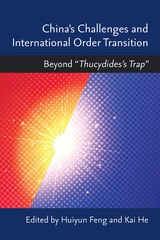
cover of China’s Challenges and International Order Transition: Beyond “Thucydides's Trap”

China’s Challenges and International Order Transition

Beyond “Thucydides's Trap”

Edited by Huiyun Feng and Kai He

University of Michigan Press, 2020

China’s Challenges and International Order Transition introduces an integrated conceptual framework of “international order” categorized by three levels (power, rules, and norms) and three issue-areas (security, political, and economic). Each contributor engages one or more of these analytical dimensions to examine two questions: (1) Has China already challenged this dimension of international order? (2) How will China challenge this dimension of international order in the future?

The contested views and perspectives in this volume suggest it is too simple to assume an inevitable conflict between China and the outside world. With different strategies to challenge or reform the many dimensions of international order, China’s role is not a one-way street. It is an interactive process in which the world may change China as much as China may change the world.

The aim of the book is to broaden the debate beyond the “Thucydides Trap” perspective currently popular in the West. Rather than offering a single argument, this volume offers a platform for scholars, especially Chinese scholars vs. Western scholars, to exchange and debate their different views and perspectives on China and the potential transition of international order.
[more]
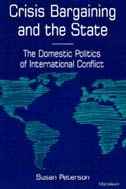
cover of Crisis Bargaining and the State: The Domestic Politics of International Conflict

Crisis Bargaining and the State

The Domestic Politics of International Conflict

Susan Peterson

University of Michigan Press, 1996

The first book to systematically explore the importance of domestic institutions to crisis bargaining, Crisis Bargaining and the State argues that the influence of a state's bargaining behavior on its opponents foreign policy depends on the nature of the opposing government--its institutional structures and the strategic beliefs of its leaders. The author shows in three detailed case studies--the Crimean War crisis, the Fashoda crisis, and the Berlin crisis--the significance of domestic factors to questions of war and peace.
Peterson offers a comprehensive analysis of the domestic politics of crisis bargaining. She uses differences in state structure to explain variations in foreign policy processes and outcomes. By introducing domestic structure as a crucial intervening variable between the international environment and a state's foreign policy during an acute conflict, Peterson shows how existing cognitive and bureaucratic approaches provide complementary, not competing, explanations of crisis bargaining.
Crisis Bargaining and the State: The Domestic Politics of International Conflict applies recent research in the field of international political economy on the relationship between ideas, institutions, and the international environment to the issue of crisis bargaining. It will appeal to students, scholars, and policymakers interested in crisis bargaining, international security, and international relations.
Susan Peterson is Assistant Professor, Department of Government, The College of William & Mary.
[more]
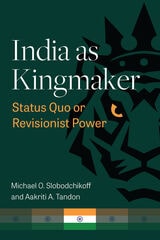
cover of India as Kingmaker: Status Quo or Revisionist Power

India as Kingmaker

Status Quo or Revisionist Power

Michael O. Slobodchikoff and Aakriti A. Tandon

University of Michigan Press, 2022

As India finds itself in the envious position of kingmaker, both the status quo and revisionist major powers are jockeying for India’s support for either upholding or revising the current world order. Using India’s bilateral treaties as a proxy measure of the strength of its relationship with other major powers, Slobodchikoff and Tandon determine whether India will remain neutral in its foreign policy approach or adopt a more assertive role in shaping the future global order. This book provides an in-depth analysis of India’s bilateral ties with major powers that include the United States, Russia, China, Japan, as well as the European Union (including the United Kingdom, France, and Germany) and uses network analysis to study India’s foreign policy positions with other major powers.

[more]
cover of Multipolarity: The Promise of Disharmony

Multipolarity

The Promise of Disharmony

Edited by Peter W. Schulze

Campus Verlag, 2018
The global order that has held sway in world political affairs for decades—dominated by the United States, Russia, China, and the European Union—is now in an uneasy period of instability and turmoil, driven as much by failures of governance as by the rise of smaller powers. Multipolarity explores both the causes of this decline in power—from Brexit and Trump to the rise of autocratic strongmen in Europe and Asia—along with a number of possibilities for a more decentralized world, among them a Russian pivot to the east and the rise of African influence worldwide. The authors examine the diffusion of power among newly emerging leaders on the world stage, offering a multitude of potential roadmaps for creating security and stability in a changing world.
[more]
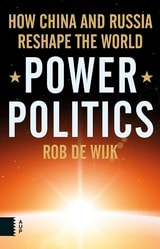
cover of Power Politics: How China and Russia Reshape the World

Power Politics

How China and Russia Reshape the World

Rob de Wijk

Amsterdam University Press, 2015
We tend to think of ourselves as living in a time when nations, for the most part, obey the rule of law - and where they certainly don't engage in the violent grabs for territory that have characterised so much of human history. But as Rob de Wijk shows in this book, power politics very much remains a force on the international scene. Offering analyses of such actions as Putin's annexation of the Crimea and China's attempts to claim large parts of the South China Sea, de Wijk explains why power politics never truly went away-and why, as the West's position weakens, it's likely to play a bigger and bigger role on the global stage in the coming years.
[more]
cover of Power Ties: Economic Interdependence, Balancing, and War

Power Ties

Economic Interdependence, Balancing, and War

Paul A. Papayoanou

University of Michigan Press, 1999
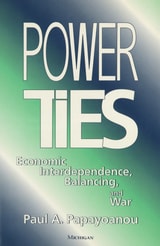
Will the growth of economic interdependence since the Second World War help to maintain the peace that we have seen for more than fifty years among the great powers? Some argue that the benefits that come from being integrated into today's world economy make it unlikely that countries will pursue aggressive policies. Others are not so sanguine, arguing that international economic ties have little effect on the making of national security strategies. Power Ties contradicts both arguments. Analyzing the history of the great-power system since the late nineteenth century, Paul Papayoanou shows that international economic relations have a significant impact on states's security strategies. A great power's economic ties generate powerful domestic economic interests that influence a leader's ability to mobilize support and resources for credibly opposing threatening powers in the international system. This accounts for the strength or weakness of alliance commitments and defense expenditures, and in turn, the likelihood that aspiring revisionist powers will be deterred from initiating a military offensive that upsets the territorial status quo. Power Ties also revises much of the conventional wisdom about the pacifying effects of economic interdependence, for it demonstrates that extensive economic ties are not necessarily associated with peace and can make war more likely. Papayoanou's union of theory and history provides a bold new interpretation of the most significant developments in international politics over the past century. This book will be of interest to students and scholars of political science, history, and international relations.
[more]
cover of Power and Negotiation

Power and Negotiation

I. William Zartman and Jeffrey Z. Rubin, Editors

University of Michigan Press, 2002
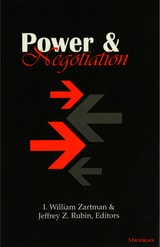
The editors to this volume begin their introduction with an age-old puzzle in negotiation: “How can weaker parties negotiate with stronger parties and still get something?” Addressing this and other paradoxes, Power and Negotiation produces new findings about the concept of power and about its applications in negotiations between countries. Rejecting the notions of power as a resource and power as an ability, the work defines power as an act that is designed to cause another party to move in a desired direction, thus separating the concept both from its source and from its effects and leaving it open to much more detailed analysis.Using this new definition of the concept of power, this book examines the relations between parties in symmetrical and asymmetrical negotiations. I. William Zartman and Jeffrey Z. Rubin argue that negotiations between countries that are not equal in power tend to be more efficient and effective than symmetrical negotiations, as weaker and stronger parties negotiating together know their roles and are able to get appropriate benefits to each side in a negotiated agreement. In cases of symmetry or near symmetry the countries, whether they are equally weak or equally strong, tend to spend most of their time maintaining their status and waste inordinate amounts of time before they ever come to an agreement. At the same time, Power and Negotiation also examines perceived power on the basis of which symmetries and asymmetries in the relations between parties can be identified. It then looks at six cases of clear asymmetry, two cases of symmetry, and one mixed situation. The book ends with a careful examination of lessons for practice and lessons for theory. The book will appeal to students of negotiation strategy and international relations.
[more]
cover of Reconstructing Realpolitik

Reconstructing Realpolitik

Frank W. Wayman and Paul F. Diehl, Editors

University of Michigan Press, 1994
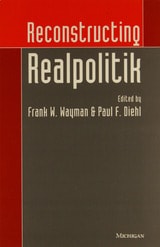
Reconstructing Realpolitik assesses what there is of value in the realpolitik approach to understanding world politics, what must be amended ordiscarded, and what might be needed to replace the classic model. Calling realpolitik, or realism, a “cluster of models, assumptions, hunches, hypotheses, and parameter estimates” united only by their common focus on power, the editors challenged their contributors to test elements of the realpolitik model with empirical evidence and to suggest how the model might be revised to make it square with the evidence. The result is a wealth of original, rigorously tested, data-based findings that advance our understanding of this basic paradigm.The coverage is unusually comprehensive: chapters address the onset, escalation, and expansion phases of conflict; different conflict phenomena, such as economic sanctions, interventions, crisis bargaining, and decolonization, besides the more traditional concerns of military disputes, are examined; and the cases represent a variety of different spatial and temporal domains. In the end, Reconstructing Realpolitik shows that realpolitik factors and insights help to explain and predict a variety of international conflict phenomena while at the same time offen producing incorrect or exaggerated results. While realism remains a valuable proposition, it is clear that it fails to encompass several key factors that influence state behavior.Contributors include Robert A. Baumann, Bruce Bueno de Mesaquita, Gary Goertz, Athanasios Hristoulas, Paul Huth, Patrick James, Daniel M. Jones, Charles W. Kegley, Jr., David Lalman, Russell J. Leng, Frederic S. Pearson, Jeffrey J. Pickering, Brian M. Pollins, and Gregory A. Raymond.
[more]
cover of The Power-Conflict Story: A Dynamic Model of Interstate Rivalry

The Power-Conflict Story

A Dynamic Model of Interstate Rivalry

Kelly M. Kadera

University of Michigan Press, 2001
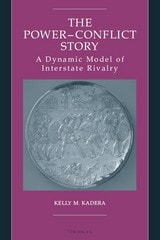
The Power-Conflict Story explains patterns of behavior in major world rivalries since 1816. Kelly M. Kadera carefully lays out the dynamic connections between two rival nations' power relationship and their conflictual interactions with one another. Rivals accumulate power and use conflict as a method of reducing their opponent's power level. But conflict is costly because it invites reciprocation from the opponent who has similar motives. Applying the formal model that she has developed, Kadera makes some interesting and novel predictions about which types of rivals win and what strategies they use. The empirical record on national power levels and interstate conflict convincingly support these predictions. Examples include the rise of the United States as a world power and the corresponding fall of British hegemony near the turn of the last century; Germany's unsuccessful attempt to overtake Britain during the Second World War; and Russia's rivalry with China during the early 1900s.
One of the central contributions of the book's explanation of interstate rivalry is the integration of two opposing schools of thought, balance of power theory and power transition theory. This integration is accomplished by the author's dynamic formal model that emphasizes fluctuations in conflict behavior under different power relationships as well as shifts in power levels resulting from natural growth and resource depletion. The formal model and its analysis are presented in a conversational manner, making it accessible to the reader.
ThePower-Conflict Story will appeal to students and scholars of international relations, world history, formal modeling, applied mathematics, numerical methods, and research methodology.
Kelly M. Kadera is Assistant Professor of Political Science, University of Iowa.
[more]
cover of War and Peace in International Rivalry

War and Peace in International Rivalry

Paul F. Diehl and Gary Goertz

University of Michigan Press, 2001
This book provides the first detailed analysis of international rivalries, the long-standing and often violent confrontations between the same pairs of states. The book addresses conceptual components of rivalries and explores the origins, dynamics, and termination of the most dangerous form of rivalry--enduring rivalry--since 1816.
Paul Diehl and Gary Goertz identify 1166 rivalries since 1816. They label sixty-three of those as enduring rivalries. These include the competitions between the United States and Soviet Union, India and Pakistan, and Israel and her Arab neighbors. The authors explain how rivalries form, evolve, and end.
The first part of the book deals with how to conceptualize and measure rivalries and presents empirical patterns among rivalries in the period 1816-1992. The concepts derived from the study of rivalries are then used to reexamine two central pieces of international relations research, namely deterrence and "democratic peace" studies. The second half of the book builds an explanation of enduring rivalries based on a theory adapted from evolutionary biology, "punctuated equilibrium."
The study of international rivalries has become one of the centerpieces of behavioral research on international conflict. This book, by two of the scholars who pioneered such studies, is the first comprehensive treatment of the subject. It will become the standard reference for all future studies of rivalries.
Paul F. Diehl is Professor of Political Science and University Distinguished Teacher/Scholar, University of Illinois. He is the coeditor of Reconstructing Realpolitik and coauthor of Measuring the Correlates of War. Gary Goertz is Assistant Professor of Political Science, University of Arizona, and is the coauthor with Paul Diehl of Territorial Change and International Conflict.
[more]
cover of When the Stakes Are High: Deterrence and Conflict among Major Powers

When the Stakes Are High

Deterrence and Conflict among Major Powers

Vesna Danilovic

University of Michigan Press, 2002

When the Stakes Are High is based on the premise that powers have continually played a decisive role in international conflicts. Consequently, one of the key questions concerns the conditions that are likely to trigger or abate dispute escalation into major power conflicts. In this book, Vesna Danilovic provides a rigorous theoretical and empirical analysis of these conditions.
Since the most precarious and common form of dispute between major powers arises over third nations, the author's primary focus is on so-called extended deterrence. In this type of deterrence, one side attempts to prevent another side from initiating or escalating conflict with a third nation. When the Stakes Are High addresses such questions as: When is extended deterrence likely to be effective? What happens if deterrence fails? In what circumstances is war likely to result from a deterrence failure? The author's main argument is that a major power's national interests, which shape the inherent credibility of threats and which are shaped by various regional stakes, set the limits to the relevance of other factors, which have received greater scholarly attention in the past. Strongly supported by the empirical findings, the arguments in this work draw important implications for conflict theory and deterrence policy in the post-Cold War era.
This book will appeal to the reader interested in international relations, in general, and in theories of international conflict, deterrence, causes of wars, great power behavior, and geopolitics, in particular.
Vesna Danilovic is Assistant Professor of Political Science, Texas A&M University.
[more]