Results by title
7 books match the query 'Ballads'
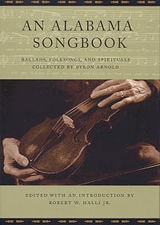
An Alabama Songbook
Ballads, Folksongs, and Spirituals Collected by Byron ArnoldRobert W. Halli Jr.
University of Alabama Press, 2004
Alabama is a state rich in folksong tradition, from old English ballads sung along the Tennessee River to children’s game songs played in Mobile, from the rhythmic work songs of the railroad gandy dancers of Gadsden to the spirituals of the Black Belt. The musical heritage of blacks and whites, rich and poor, hill folk and cotton farmers, these songs endure as a living part of the state’s varied past.
In the mid 1940s Byron Arnold, an eager young music professor from The University of Alabama, set out to find and record as many of these songs as he could and was rewarded by unstinting cooperation from many informants. Mrs. Julia Greer Marechal of Mobile, for example, was 90 years old, blind, and a semi-invalid, but she sang for Arnold for three hours, allowing the recording of 33 songs and exhausting Arnold and his technician. Helped by such living repositories as Mrs. Marechal, the Arnold collection grew to well over 500 songs, augmented by field notes and remarkable biographical information on the singers.
An Alabama Songbook is the result of Arnold’s efforts and those of his informants across the state and has been shaped by Robert W. Halli Jr. into a narrative enriched by more than 200 significant songs-lullabies, Civil War anthems, African-American gospel and secular songs, fiddle tunes, temperance songs, love ballads, play-party rhymes, and work songs. In the tradition of Alan Lomax’s The Folk Songs of North America and Vance Randolph’s Ozark Folksongs, this volume will appeal to general audiences, folklorists, ethnomusicologists, preservationists, traditional musicians, and historians.
Ballads and Songs of Southern Michigan
Collected and Edited by Emelyn Elizabeth Gardner and Geraldine Jencks Chickering
University of Michigan Press, 1939
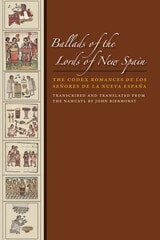
Ballads of the Lords of New Spain
The Codex Romances de los Senores de la Nueva EspanaTranscribed and translated from the Nahuatl by John Bierhorst
University of Texas Press, 2009
Compiled in 1582, Ballads of the Lords of New Spain is one of the two principal sources of Nahuatl song, as well as a poetical window into the mindset of the Aztec people some sixty years after the conquest of Mexico. Presented as a cancionero, or anthology, in the mode of New Spain, the ballads show a reordering—but not an abandonment—of classic Aztec values. In the careful reading of John Bierhorst, the ballads reveal in no uncertain terms the pre-conquest Aztec belief in the warrior's paradise and in the virtue of sacrifice.
This volume contains an exact transcription of the thirty-six Nahuatl song texts, accompanied by authoritative English translations. Bierhorst includes all the numerals (which give interpretive clues) in the Nahuatl texts and also differentiates the text from scribal glosses. His translations are thoroughly annotated to help readers understand the imagery and allusions in the texts. The volume also includes a helpful introduction and a larger essay, "On the Translation of Aztec Poetry," that discusses many relevant historical and literary issues.
In Bierhorst's expert translation and interpretation, Ballads of the Lords of New Spain emerges as a song of resistance by a conquered people and the recollection of a glorious past.
Folk-Songs of the South
Collected Under the Auspices of the West Virginia Folk-Lore SocietyJohn Harrington Cox
West Virginia University Press, 2016

Norwegian Emigrant Songs and Ballads
Theodore Blegen
University of Minnesota Press, 1936
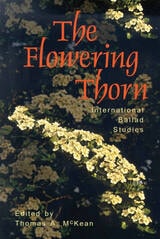
The Flowering Thorn
International Ballad StudiesThomas McKean
Utah State University Press, 2003
The flowering thorn expresses the dual nature of the ballad: at once a distinctive expression of European tradition, but also somewhat tricky to approach from a scholarly perspective, requiring a range of disciplines to illuminate its rich composition. Most of this latter quality has to do with the very features that characterize ballads... or narrative songs. These include an appearance of fragmentation; a wide range of cultural and social referents; complex, evocative symbolic language; and variation. The notable multiformity of meaning, text and tune is mirrored in scholarship, too. The Flowering Thorn is therefore wide ranging, with articles written by world authorities from the fields of folklore, history, literature, and ethnology, employing a variety of methodologies—structuralism to functionalism, repertoire studies to geographical explorations of cultural movement and change. The twenty-five selected contributions represent the latest trends in ballad scholarship, embracing the multi-disciplinary nature of the field today. The essays have their origins in the 1999 International Ballad Conference of the Kommission fur Volksdichtung (KfV), which focused particularly on ballads and social context; performance and repertoire; genre, motif, and classification. The revised, tailored, and expanded essays are divided into five sections—the interpretation of narrative song; structure and motif; context, version, and transmission; regions, reprints, and repertoires; and the mediating collector's offering a range of examples from fifteen different cultures, ten of them drawing on languages other than English, resulting in a series of personal journeys to the heart of one of Europe's richest, most enduring cultural creations. —Thomas McKean, from the Introduction
CONTRIBUTORS: Mary Anne Alburger, David Atkinson, Julia C. Bishop, Valentina Bold, Katherine Campbell, Nicolae Constantinescu, Luisa Del Giudice, Sheila Douglas, David G. Engle, Frances J. Fischer, Simon Furey, Vic Gammon, Marjetka Golez-Kaucic, Pauline Greenhill, Cozette Griffin-Kremer, J. J. Dias Marques, William Bernard McCarthy, Isabelle Peere, Gerald Porter, James Porter, Roger de V. Renwick, Sigrid Rieuwerts, Michèle Simonsen, Larry Syndergaard, Stefaan Top, Larysa Vakhnina, Lynn Wollstadt
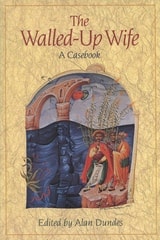
Walled-Up Wife
A CasebookAlan Dundes
University of Wisconsin Press, 1996
For centuries, many Indo-European peoples have sung a poignant ballad about the tragic sacrifice of a female victim to ensure the successful completion of an important undertaking, such as the construction of a building, bridge, or well. The legend, and its many regional and stylistic variations throughout Eastern Europe and India, provides material for an original and engaging casebook of interpretations by folklorists, anthropologists, scholars of comparative religion, and literary critics.
Alan Dundes brings together eighteen essays on this classic ballad, each introduced by his headnotes. Some contributors offer competing nationalistic claims concerning the ballad’s origin, claims now in dispute because of previously overlooked South Asian versions; Ruth Mandel examines gender and power issues in the ballad; Lyubomira Parpulova-Gribble presents a structuralist reading; Krstivoj Kotur proposes a Christian interpretation; Mircea Eliade advocates a myth-ritual reading of blood sacrifices with cosmogonic connections in the Romanian text; and other readings explore female victimization and heroism by seeing the ballad’s theme as a metaphor for marriage, a male-constructed trap seriously restricting women’s freedom and mobility. Dundes concludes the collection with his own feminist and psychoanalytic interpretations of the ballad, followed by suggestions for further reading.
By emphasizing the ballad’s variant forms in diverse cultural contexts, analyzed from different disciplinary perspectives, this volume asks students of folklore to be aware of the multiplicity of approaches available to them in researching folk narrative.