Results by title
7 books match the query 'Ballet'

Bronislava Nijinska
Early MemoirsIrina Nijinska, Jean Rawlinson, eds. and trans.
Duke University Press, 1992
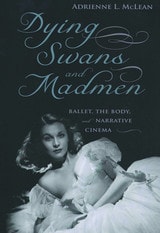
Dying Swans and Madmen
Ballet, the Body, and Narrative CinemaMcLean, Adrienne L
Rutgers University Press, 2008
Drawing on examples that range from musicals to tragic melodramas, she shows how commercial films have produced an image of ballet and its artists that is associated both with joy, fulfillment, fame, and power and with sexual and mental perversity, melancholy, and death. Although ballet is still received by many with a lack of interest or outright suspicion, McLean argues that these attitudes as well as ballet's popularity and its acceptability as a way of life and a profession have often depended on what audiences first learned about it from the movies.
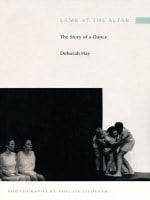
Lamb at the Altar
The Story of a DanceDeborah Hay
Duke University Press, 1994
Her movements are uncharacteristic, her words subversive, her dances unlike anything done before—and this is the story of how it all works. A founding member of the famed Judson Dance Theater and a past performer in the Merce Cunningham Dance Company, Deborah Hay is well known for choreographing works using large groups of trained and untrained dancers whose surprising combinations test the limits of the art. Lamb at the Altar is Hay’s account of a four-month seminar on movement and performance held in Austin, Texas, in 1991. There, forty-four trained and untrained dancers became the human laboratory for Hay’s creation of the dance Lamb, lamb, lamb . . . , a work that she later distilled into an evening-length solo piece, Lamb at the Altar. In her book, in part a reflection on her life as a dancer and choreographer, Hay tells how this dance came to be. She includes a movement libretto (a prose dance score) and numerous photographs by Phyllis Liedeker documenting the dance’s four-month emergence.
In an original style that has marked her teaching and writing, Hay describes her thoughts as the dance progresses, commenting on the process and on the work itself, and ultimately creating a remarkable document on the movements—precise and mysterious, mental and physical—that go into the making of a dance. Having replaced traditional movement technique with a form she calls a performance meditation practice, Hay describes how dance is enlivened, as is each living moment, by the perception of dying and then involves a freeing of this perception from emotional, psychological, clinical, and cultural attitudes into movement. Lamb at the Altar tells the story of this process as specifically practiced in the creation of a single piece.
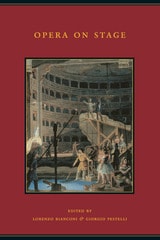
Opera on Stage
Edited by Lorenzo Bianconi and Giorgio Pestelli
University of Chicago Press, 2002
Opera on Stage, the second book of this multi-volume work to be published in English-in an expanded and updated version-focuses on staging and viewing Italian opera, from the court spectacles of the late sixteenth century to modern-day commercial productions. Mercedes Viale Ferrero describes the history of theater and stage design, detailing the evolution of the art well into the twentieth century. Gerardo Guccini does the same for stage and opera direction and the development of the director's role as an autonomous creative force. Kathleen Kuzmick Hansell discusses the interrelationships between theatrical ballet and Italian opera, from the age of Venetian opera to the early twentieth century. The visual emphasis of all three contributions is supplemented by over one hundred illustrations, and because much of this material-on the more "spectacular" visual aspects of Italian opera-has never before appeared in English, Opera on Stage will be welcomed by scholars and opera enthusiasts alike.
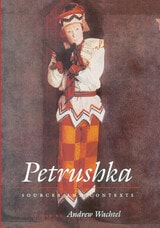
Petrushka
Sources and ContextsAndrew Baruch Wachtel
Northwestern University Press, 1998
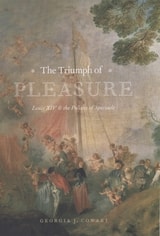
The Triumph of Pleasure
Louis XIV and the Politics of SpectacleGeorgia J. Cowart
University of Chicago Press, 2008
With bold revisionist strokes, Cowart traces this strain of artistic dissent through the comedy-ballets of Jean-Baptiste Lully and Molière, the late operatic works of Lully and the operas of his sons, the opera-ballets of André Campra and his contemporaries, and the related imagery of Antoine Watteau’s well-known painting The Pilgrimage to Cythera. She contends that through a variety of means, including the parody of old-fashioned court entertainments, these works reclaimed traditional allegories for new ideological aims, setting the tone for the Enlightenment. Exploring these arts from the perspective of spectacle as it emerged from the court into the Parisian public sphere, Cowart ultimately situates the ballet and related genres as the missing link between an imagery of propaganda and an imagery of political protest.
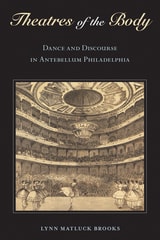
Theatres of the Body
Dance and Discourse in Antebellum PhiladelphiaLynn Matluck Brooks
Temple University Press, 2025
Reviewing print culture in the 1840s, Brooks shows how newspapers, magazines, and popular fiction provided documentation of dancing in Philadelphia as well as the responses of dance commentators, practitioners, and moralists. Theatres of the Body also considers the interplay of science with dance in the 1850s, which impacted both dance practices and reception.
Providing an expansive historiography of these significant contributions to dance in the United States, Brooks deepens our understanding of antebellum culture and history.