Results by title
4 books match the query 'Bandits'
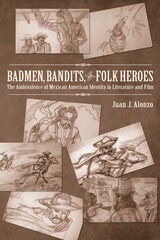
Badmen, Bandits, and Folk Heroes
The Ambivalence of Mexican American Identity in Literature and FilmJuan J. Alonzo
University of Arizona Press, 2009
Alonzo opens his provocative study with a fresh look at the adventure stories of Stephen Crane and the silent Western movies of D. W. Griffith. He also investigates the conflation of the greaser, the bandit, and the Mexican revolutionary into one villainous figure in early Western movies and, more broadly, traces the development of the badman in Westerns. He newly interrogates the writings of Américo Paredes regarding the makeup of Mexican masculinity, and productively trains his analytic eye on the recent films of Jim Mendiola and the contemporary poetry of Evangelina Vigil.
Throughout Badmen, Bandits, and Folk Heroes, Alonzo convincingly demonstrates how fiction and films that formerly appeared one-dimensional in their treatment of Mexicans and Mexican Americans actually offer surprisingly multifarious and ambivalent representations. At the same time, his valuation of indeterminacy, contingency, and hybridity in contemporary cultural production creates new possibilities for understanding identity formation.
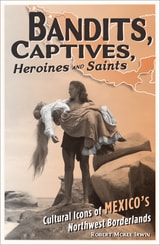
Bandits, Captives, Heroines, and Saints
Cultural Icons of Mexico’s Northwest BorderlandsRobert McKee Irwin
University of Minnesota Press, 2007
Bandits, Captives, Heroines, and Saints investigates cultural icons of the late nineteenth century from Mexico’s largely unstudied northwest borderlands, present-day Sonora, Baja California, and western Chihuahua. Robert McKee Irwin looks at popular figures such as Joaquín Murrieta, the gold rush social bandit; Lola Casanova, the anti-Malinche, whose marriage to a Seri Indian symbolized a forbidden form of mestizaje; and la Santa de Cabora, a young faith healer who inspired armed insurgencies and was exiled to Arizona.
Cultural icons such as Murrieta, Lola Casanova, and la Santa de Cabora are products of intercultural dialogue, Irwin reveals, and their characterizations are unstable. They remain relevant for generations because there is no consensus regarding their meanings, and they are weapons in struggles of representation in the borderlands. The figures studied here are especially malleable, he argues, because they are marginalized from the mainstream of historiography.
A timely analysis, Bandits, Captives, Heroines, and Saints challenges current paradigms of border studies and presents a rich understanding of the ways in which cultural icons influence people’s minds and lives.
Robert McKee Irwin is associate professor of Spanish at the University of California, Davis, and the author of Mexican Masculinities (Minnesota, 2003).
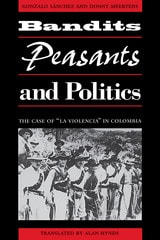
Bandits, Peasants, and Politics
The Case of "La Violencia" in ColombiaBy Gonzalo Sánchez and Donny Meertens
University of Texas Press, 2001
The years 1945-1965 saw heavy partisan conflict in the rural areas of Colombia, with at least 200,000 people killed. This virtual civil war began as a sectarian conflict between the Liberal and Conservative parties, with rural workers (campesinos) constituting the majority of combatants and casualties. Yet La Violencia resists classification as a social uprising, since calls for social reform were largely absent during this phase of the struggle. In fact, once the elite leadership settled on a power-sharing agreement in 1958, the conflict appeared to subside.
This book focuses on the second phase (1958-1965) of the struggle, in which the social dimensions of the conflict emerged in a uniquely Colombian form: the campesinos, shaped by the earlier violence, became social and political bandits, no longer acting exclusively for powerful men above them but more in defense of the peasantry. In comparing them with other regional expressions of bandolerismo, the authors weigh the limited prospects for the evolution of Colombian banditry into full-scale social revolution.
Published originally in 1983 as Bandoleros, gamonales y campesinos and now updated with a new epilogue, this book makes a timely contribution to the discourse on social banditry and the Colombian violencia. Its importance rests in the insights it provides not only on the period in question but also on Colombia's present situation.
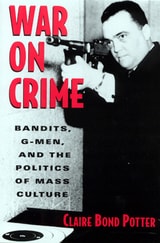
War on Crime
Bandits, G-Men, and the Politics of Mass CulturePotter, Claire Bond
Rutgers University Press, 1998
Anxieties about crime today have become a familiar route for the creation of new government agencies and the extension of state authority. It is important to remember the original "war on crime" in the 1930s-and the opportunities it afforded to New Dealers and established bureaucrats like J. Edgar Hoover-as scholars grapple with the ways states assert influence over populations, local authority, and party politics while they pursue goals such as reducing popular violence and protecting private property.