Results by title

6 books match the query 'Bangalore'
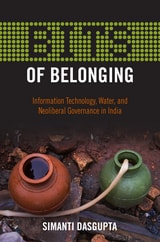
cover of BITS of Belonging: Information Technology, Water, and Neoliberal Governance in India

BITS of Belonging

Information Technology, Water, and Neoliberal Governance in India

Simanti Dasgupta

Temple University Press, 2015

India’s global success in the Information Technology industry has also prompted the growth of neoliberalism and the re-emergence of the middle class in contemporary urban areas, such as Bangalore. In her significant study, BITS of Belonging, Simanti Dasgupta shows that this economic shift produces new forms of social inequality while reinforcing older ones. She investigates this economic disparity by looking at IT and water privatization to explain how these otherwise unrelated domains correspond to our thinking about citizenship, governance, and belonging. 

Dasgupta’s ethnographic study shows how work and human processes in the IT industry intertwine to meet the market stipulations of the global economy. Meanwhile, in the recasting of water from a public good to a commodity, the middle class insists on a governance and citizenship model based upon market participation. Dasgupta provides a critical analysis of the grassroots activism involved in a contested water project where different classes lay their divergent claims to the city.
[more]
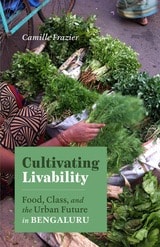
cover of Cultivating Livability: Food, Class, and the Urban Future in Bengaluru

Cultivating Livability

Food, Class, and the Urban Future in Bengaluru

Camille Frazier

University of Minnesota Press, 2024

What urban food networks reveal about middle class livability in times of transformation

In recent years, the concept of “livability” has captured the global imagination, influencing discussions about the implications of climate change on human life and inspiring rankings of “most livable cities” in popular publications. But what really makes for a livable life, and for whom?


Cultivating Livability takes Bengaluru, India, as a case study—a city that is alternately described as India’s most and least livable megacity, where rapid transformation is undergirded by inequalities evident in the food networks connecting peri-urban farmers and the middle-class public. Anthropologist Camille Frazier probes the meaning of “livability” in Bengaluru through ethnographic work among producers and consumers, corporate intermediaries and urban information technology professionals.


Examining the varying efforts to reconfigure processes of food production, distribution, retail, and consumption, she reveals how these intersections are often rooted in and exacerbate ongoing forms of disenfranchisement that privilege some lives at the expense of others.
[more]
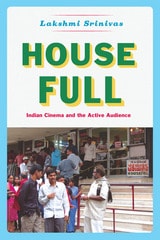
cover of House Full: Indian Cinema and the Active Audience

House Full

Indian Cinema and the Active Audience

Lakshmi Srinivas

University of Chicago Press, 2016

India is the largest producer and consumer of feature films in the world, far outstripping Hollywood in the number of movies released and tickets sold every year. Cinema quite simply dominates Indian popular culture, and has for many decades exerted an influence that extends from clothing trends to music tastes to everyday conversations, which are peppered with dialogue quotes.
            With House Full, Lakshmi Srinivas takes readers deep into the moviegoing experience in India, showing us what it’s actually like to line up for a hot ticket and see a movie in a jam-packed theater with more than a thousand seats. Building her account on countless trips to the cinema and hundreds of hours of conversation with film audiences, fans, and industry insiders, Srinivas brings the moviegoing experience to life, revealing a kind of audience that, far from passively consuming the images on the screen, is actively engaged with them. People talk, shout, whistle, cheer; others sing along, mimic, or dance; at times audiences even bring some of the ritual practices of Hindu worship into the cinema, propitiating the stars onscreen with incense and camphor. The picture Srinivas paints of Indian filmgoing is immersive, fascinating, and deeply empathetic, giving us an unprecedented understanding of the audience’s lived experience—an aspect of Indian film studies that has been largely overlooked.
[more]
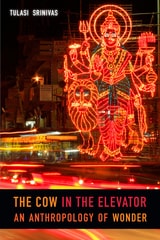
cover of The Cow in the Elevator: An Anthropology of Wonder

The Cow in the Elevator

An Anthropology of Wonder

Tulasi Srinivas

Duke University Press, 2018

In The Cow in the Elevator Tulasi Srinivas explores a wonderful world where deities jump fences and priests ride in helicopters to present a joyful, imaginative, yet critical reading of modern religious life. Drawing on nearly two decades of fieldwork with priests, residents, and devotees, and her own experience of living in the high-tech city of Bangalore, Srinivas finds moments where ritual enmeshes with global modernity to create wonder—a feeling of amazement at being overcome by the unexpected and sublime. Offering a nuanced account of how the ruptures of modernity can be made normal, enrapturing, and even comical in a city swept up in globalization's tumult, Srinivas brings the visceral richness of wonder—apparent in creative ritual in and around Hindu temples—into the anthropological gaze. Broaching provocative philosophical themes like desire, complicity, loss, time, money, technology, and the imagination, Srinivas pursues an interrogation of wonder and the adventure of writing true to its experience. The Cow in the Elevator rethinks the study of ritual while reshaping our appreciation of wonder's transformative potential for scholarship and for life.
[more]
cover of The Future of Futurity: Affective Capitalism and Potentiality in a Global City

The Future of Futurity

Affective Capitalism and Potentiality in a Global City

Purnima Mankekar and Akhil Gupta

Duke University Press, 2025
In The Future of Futurity, Purnima Mankekar and Akhil Gupta examine the lives and experiences of call center agents in India’s business process outsourcing (BPO) industry, who live in Bengaluru and work for customers in the Global North. Mankekar and Gupta show how futurity—an affective-temporal potentiality and mode of being that emphasizes the unfolding of time—enables BPO workers to strive for hopeful futures despite their experiences of growing inequality, volatility, and violence. Drawing on long-term fieldwork with managers, owners, and workers of BPO companies, the authors explore how workers find pathways for navigating a globalized world and for imagining their futures in it. They point to the heterogeneous lives, yearnings, and anxieties of BPO workers, foregrounding the disjunctions and conjunctions between labor, corporeality, intimacy, family life, and mobility. Mankekar and Gupta show how workers’ daily lives and imaginings of the future point to the relationships between futurity, capital, and technology as well as futurity’s imbrications with contemporary racial capitalism. In so doing, the authors insist on the transformative potential of futurity even in conditions of extreme precarity.
[more]
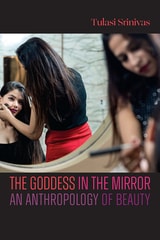
cover of The Goddess in the Mirror: An Anthropology of Beauty

The Goddess in the Mirror

An Anthropology of Beauty

Tulasi Srinivas

Duke University Press, 2025

In The Goddess in the Mirror, Tulasi Srinivas offers a pathbreaking ethnography of contemporary Indian beauty parlors in Bangalore. Exploring the gendered world of beauty in the intimate spaces of the salon, whose popularity has exploded amid an urban tech revolution, Srinivas invites readers to consider what beauty is and what it does. Visiting diverse salons that cater to various classes, castes, and queer sexualities, she tracks the relationships between clients and workers, revealing the beauty industry’s painful political, religious, and economic stakes. Embodiment, religion, and narrative intersect as clients and beauticians tell well-known stories of beautiful Hindu goddesses, heroines, queens, and apsaras, thereby weaving their own ethical subjectivities every day. Following the goddess’s allure, radiance, woundedness, fluidity, and fertility, Srinivas situates ideas of beauty within a larger moral and political context where beauty is both a fleeting pursuit and a rich resource for navigating a patriarchal present.
[more]