Results by title
8 books match the query 'Bangkok'
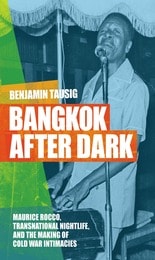
Bangkok after Dark
Maurice Rocco, Transnational Nightlife, and the Making of Cold War IntimaciesBenjamin Tausig
Duke University Press, 2025
From the 1930s to the 1950s, jazz pianist Maurice Rocco was a mainstay in Hollywood and American nightlife scenes. As rock and roll surpassed jazz as America’s most popular music in the 1950s, the queer Black pianist’s fortunes faded and he was forced to go abroad for new opportunities. In 1964 Rocco settled in Bangkok, where he thrived and enjoyed a relatively privileged life until he was murdered by two young male sex workers in 1976. In Bangkok after Dark, Benjamin Tausig uses Rocco’s intriguing story to trace the history of transnational nightlife encounters between Thais and Americans during the long American war in Vietnam. Tausig shows how these encounters, which included musical collaborations, romantic and sexual relationships, and new labor, identity, and geopolitical configurations, remade Thailand in crucial and enduring ways. As Tausig demonstrates, Rocco’s Blackness, queerness, and musical life in Thailand illuminate how Thai-American relationships complicated neat distinctions between the two countries. In teasing out these complexities through the figure of Rocco, Tausig challenges conventional understandings of the global Cold War on individual and transnational scales.
[more]
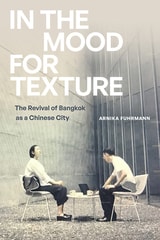
In the Mood for Texture
The Revival of Bangkok as a Chinese CityArnika Fuhrmann
Duke University Press, 2026
In the Mood for Texture considers the revival of Chinese pasts and the aesthetics of colonial modernity in contemporary Southeast Asian cultural production, both virtual and material. By analyzing how twentieth-century Shanghai and Hong Kong have been revived in modern Bangkok’s architecture, design, fashion, and nightlife, Arnika Fuhrmann shows how Chinese pasts are redeployed in contemporary film, literature, and hospitality venues to shape present visions of Asia. At the heart of this inquiry stand Shanghai and Hong Kong’s anomalous colonial temporalities and Thailand’s semi-colonial temporality of the “never” and “yet still” of colonization. Attending to the textures of built environments and agentive female subjects, Fuhrmann reconceptualizes the revival of Bangkok’s Chinese pasts and demonstrates how Southeast Asian imaginations can challenge both domestic and diasporic narratives of identity and collectivity beyond China.
[more]
Queer Bangkok
21st Century Markets, Media, and RightsEdited by Peter A. Jackson
Hong Kong University Press, 2011
The Thai capital Bangkok is the unrivalled centre of the country’s gay, lesbian, and transgender communities. These communities are among the largest in Southeast Asia, and indeed in the world, and have a diversity, social presence, and historical depth that set them apart from the queer cultures of many neighbouring societies. The first years of the twenty-first century have marked a significant transition moment for all of Thailand’s LGBT cultures, with a multidimensional expansion in the geographical extent, media presence, economic importance, political impact, social standing, and cultural relevance of Thai queer communities. This book analyses the roles of the market and media — especially cinema and the Internet — in these transformations, and considers the ambiguous consequences that the growing commodification and mediatization of queer lives have had for LGBT rights in Thailand. A key finding is that in the early twenty-first century processes of global queering are leading to a growing Asianization of Bangkok’s queer cultures. This book traces Bangkok’s emergence as a central focus of an expanding regional network linking gay, lesbian, and transgender communities in Hong Kong, Singapore, Taiwan, Indonesia, the Philippines and other rapidly developing East and Southeast Asian societies.
[more]
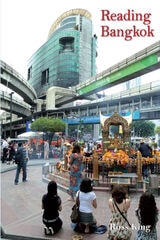
Reading Bangkok
Ross King
National University of Singapore Press, 2011
Reading Bangkok presents stories and meanings derived from the built fabric and spaces of Thailand's capital city. The narrative shifts from King Taksin's mostly forgotten but wondrous Thonburi to the tourist spectacle of Rattanakosin, Dusit and Ratchadamnoen (King Rama V's superficial emulation of an admired, imperialist Europe), Sukhumvit "Road" (consumer land), and the slums that are an integral part of the modern city.
The author structures the book around external intrusions and local resistance. Geographically, this process is seen in movement from centre to periphery (Thonburi, Rattanakosin, Ratchadamnoen, Sukhumvit, Ratchadapisek, Khlong Toei, the universities). Chronologically, the city underwent various forms of colonization: incorporation of the periphery, which in turn colonized Bangkok; the economic colonization of the 19th and 20th centuries; colonization by consumption brought on in large part by globalized tourism; colonization by the "better" ideas of others (typically from the West); and finally colonization by "better" ways of thinking - notably the intrusions of the universities and of popular democracy.
This exceptionally innovative study draws on urban planning and development, history, anthropology, and political economy, and a rich body of empirical data to provide insights into the maze of power relations, inequalities and global influences that is normally hidden from view. Reading Bangkok is that rare thing, a study that genuinely changes the way its subject is seen and understood.
[more]
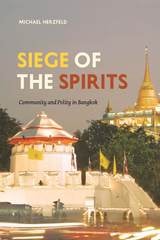
Siege of the Spirits
Community and Polity in BangkokMichael Herzfeld
University of Chicago Press, 2016
What happens when three hundred alleged squatters go head-to-head with an enormous city government looking to develop the place where they live? As anthropologist Michael Herzfeld shows in this book, the answer can be surprising. He tells the story of Pom Mahakan, a tiny enclave in the heart of old Bangkok whose residents have resisted authorities’ demands to vacate their homes for a quarter of a century. It’s a story of community versus government, of old versus new, and of political will versus the law.
Herzfeld argues that even though the residents of Pom Mahakan have lost every legal battle the city government has dragged them into, they have won every public relations contest, highlighting their struggle as one against bureaucrats who do not respect the age-old values of Thai/Siamese social and cultural order. Such values include compassion for the poor and an understanding of urban space as deeply embedded in social and ritual relations. In a gripping account of their standoff, Herzfeld—who simultaneously argues for the importance of activism in scholarship—traces the agile political tactics and styles of the community’s leadership, using their struggle to illuminate the larger difficulties, tensions, and unresolved debates that continue to roil Thai society to this day.
Herzfeld argues that even though the residents of Pom Mahakan have lost every legal battle the city government has dragged them into, they have won every public relations contest, highlighting their struggle as one against bureaucrats who do not respect the age-old values of Thai/Siamese social and cultural order. Such values include compassion for the poor and an understanding of urban space as deeply embedded in social and ritual relations. In a gripping account of their standoff, Herzfeld—who simultaneously argues for the importance of activism in scholarship—traces the agile political tactics and styles of the community’s leadership, using their struggle to illuminate the larger difficulties, tensions, and unresolved debates that continue to roil Thai society to this day.
[more]
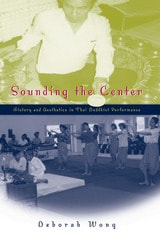
Sounding the Center
History and Aesthetics in Thai Buddhist PerformanceDeborah Wong
University of Chicago Press, 2001
Sounding the Center is an in-depth look at the power behind classical music and dance in Bangkok, the capital and sacred center of Buddhist Thailand. Focusing on the ritual honoring teachers of music and dance, Deborah Wong reveals a complex network of connections among kings, teachers, knowledge, and performance that underlies the classical court arts.
Drawing on her extensive fieldwork, Wong lays out the ritual in detail: the way it is enacted, the foods and objects involved, and the people who perform it, emphasizing the way the performers themselves discuss and construct aspects of the ceremony.
Drawing on her extensive fieldwork, Wong lays out the ritual in detail: the way it is enacted, the foods and objects involved, and the people who perform it, emphasizing the way the performers themselves discuss and construct aspects of the ceremony.
[more]
Subversive Archaism
Troubling Traditionalists and the Politics of National HeritageMichael Herzfeld
Duke University Press, 2021
In Subversive Archaism, Michael Herzfeld explores how individuals and communities living at the margins of the modern nation-state use nationalist discourses of tradition to challenge state authority under both democratic and authoritarian governments. Through close attention to the claims and experiences of mountain shepherds in Greece and urban slum dwellers in Thailand, Herzfeld shows how these subversive archaists draw on national histories and past polities to claim legitimacy for their defiance of bureaucratic authority. Although vilified by government authorities as remote, primitive, or dangerous—often as preemptive justification for violent repression—these groups are not revolutionaries and do not reject national identity, but they do question the equation of state and nation. Herzfeld explores the political strengths and vulnerabilities of their deployment of heritage and the weaknesses they expose in the bureaucratic and ethnonational state in an era of accelerated globalization.
[more]
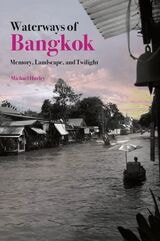
Waterways of Bangkok
Memory, Landscape and TwilightMichael Hurley
National University of Singapore Press, 2025
The Chao Phraya River is a maternal being at the heart of Bangkok. Long before the invention of Thailand, the river shaped life in Siam. In the 19th century, Bangkok had an extensive canal system, numerous floating dwellings, and people traveled primarily by water. Even now, although many canals have become roads, the river remains a vital artery of the metropolis. Furthermore, the waterways are full of meaning.
This ethnographic study explores memory along the waterways, a realm of boats and hovels, merchants and war captives, temples and ghosts. The river also flows into the dissonant realities of Thailand, a country of deep conflicts over power and national ideology. Based on research in a time of political turmoil, centered on the late years of the long-reigning monarch, Rama IX, this book invites readers to look beyond established images of Thai society. More broadly, this work will speak to readers interested in water, cities, and the bonds of memory and landscape.
This ethnographic study explores memory along the waterways, a realm of boats and hovels, merchants and war captives, temples and ghosts. The river also flows into the dissonant realities of Thailand, a country of deep conflicts over power and national ideology. Based on research in a time of political turmoil, centered on the late years of the long-reigning monarch, Rama IX, this book invites readers to look beyond established images of Thai society. More broadly, this work will speak to readers interested in water, cities, and the bonds of memory and landscape.
[more]