Results by title

4 books match the query 'Banjo'
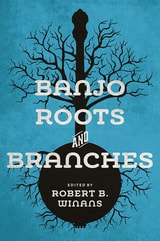
cover of Banjo Roots and Branches

Banjo Roots and Branches

Edited by Robert B. Winans

University of Illinois Press, 2018

The story of the banjo's journey from Africa to the western hemisphere blends music, history, and a union of cultures. In Banjo Roots and Branches, Robert B. Winans presents cutting-edge scholarship that covers the instrument's West African origins and its adaptations and circulation in the Caribbean and United States. The contributors provide detailed ethnographic and technical research on gourd lutes and ekonting in Africa and the banza in Haiti while also investigating tuning practices and regional playing styles. Other essays place the instrument within the context of slavery, tell the stories of black banjoists, and shed light on the banjo's introduction into the African- and Anglo-American folk milieus.

Wide-ranging and illustrated with twenty color images, Banjo Roots and Branches offers a wealth of new information to scholars of African American and folk musics as well as the worldwide community of banjo aficionados.

Contributors: Greg C. Adams, Nick Bamber, Jim Dalton, George R. Gibson, Chuck Levy, Shlomo Pestcoe, Pete Ross, Tony Thomas, Saskia Willaert, and Robert B. Winans.
[more]
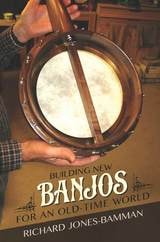
cover of Building New Banjos for an Old-Time World

Building New Banjos for an Old-Time World

Richard Jones-Bamman

University of Illinois Press, 2017
Banjo music possesses a unique power to evoke a bucolic, simpler past. The artisans who build banjos for old-time music stand at an unusual crossroads ”asked to meet the modern musician's needs while retaining the nostalgic qualities so fundamental to the banjo's sound and mystique. Richard Jones-Bamman ventures into workshops and old-time music communities to explore how banjo builders practice their art. His interviews and long-time personal immersion in the musical culture shed light on long-overlooked aspects of banjo making. What is the banjo builder's role in the creation of a specific musical community? What techniques go into the styles of instruments they create? Jones-Bamman explores these questions and many others while sharing the ways an inescapable sense of the past undergirds the performance and enjoyment of old-time music. Along the way he reveals how antimodernism remains integral to the music's appeal and its making.
[more]
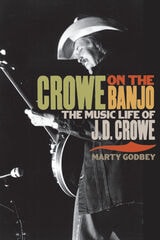
cover of Crowe on the Banjo: The Music Life of J.D. Crowe

Crowe on the Banjo

The Music Life of J.D. Crowe

Marty Godbey

University of Illinois Press, 2011
In this first biography of legendary banjoist J. D. Crowe, Marty Godbey charts the life and career of one of bluegrass's most important innovators. Born and raised in Lexington, Kentucky, Crowe picked up the banjo when he was thirteen years old, inspired by a Flatt & Scruggs performance at the Kentucky Barn Dance. Godbey relates the long, distinguished career that followed, as Crowe performed and recorded both solo and as part of such varied ensembles as Jimmy Martin's Sunny Mountain Boys, the all-acoustic Kentucky Mountain Boys, and the revolutionary New South, who created an adventurously eclectic brand of bluegrass by merging rock and country music influences with traditional forms. Over the decades, this highly influential group launched the careers of many other fresh talents such as Keith Whitley, Ricky Skaggs, Tony Rice, Jerry Douglas, and Doyle Lawson.
 
With a selective discography and drawing from more than twenty interviews with Crowe and dozens more with the players who know him best, Crowe on the Banjo: The Music Life of J. D. Crowe is the definitive music biography of a true bluegrass original.
[more]
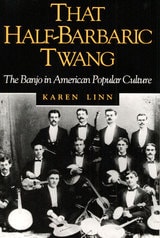
cover of That Half-Barbaric Twang: The Banjo in American Popular Culture

That Half-Barbaric Twang

The Banjo in American Popular Culture

Karen Linn

University of Illinois Press, 1991

Long a symbol of American culture, the banjo actually originated in Africa before European-Americans adopted it. Karen Linn shows how the banjo--despite design innovations and several modernizing agendas--has failed to escape its image as a "half-barbaric" instrument symbolic of antimodernism and sentimentalism. 

Caught in the morass of American racial attitudes and often used to express ambivalence toward modern industrial society, the banjo stood in opposition to the "official" values of rationalism, modernism, and belief in the beneficence of material progress. Linn uses popular literature, visual arts, advertisements, film, performance practices, instrument construction and decoration, and song lyrics to illustrate how notions about the banjo have changed. 

Linn also traces the instrument from its African origins through the 1980s, alternating between themes of urban modernization and rural nostalgia. She examines the banjo fad of bourgeois Northerners during the late nineteenth century; the African-American banjo tradition and the commercially popular cultural image of the southern black banjo player; the banjo's use in ragtime and early jazz; and the image of the white Southerner and mountaineer as banjo player.

[more]