Results by title
13 books match the query 'Bankruptcy'
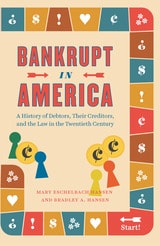
Bankrupt in America
A History of Debtors, Their Creditors, and the Law in the Twentieth CenturyMary Eschelbach Hansen and Bradley A. Hansen
University of Chicago Press, 2020
Interweaving careful legal history and rigorous economic analysis, Bankrupt in America is the first work to trace how bankruptcy was transformed from an intermittently used constitutional provision, to an indispensable tool for business, to a central element of the social safety net for ordinary Americans. To do this, the authors track federal bankruptcy law, as well as related state and federal laws, examining the interaction between changes in the laws and changes in how people in each state used the bankruptcy law. In this thorough investigation, Hansen and Hansen reach novel conclusions about the causes and consequences of bankruptcy, adding nuance to the discussion of the relationship between bankruptcy rates and economic performance.

Bankruptcy and Debt Collection in Liberal Capitalism
Switzerland, 1800–1900Mischa Suter
University of Michigan Press, 2021
Drawing on perspectives from anthropology and social theory, this book explores the quotidian routines of debt collection in nineteenth-century capitalism. It focuses on Switzerland, an exemplary case of liberal rule. Debt collection and bankruptcy relied on received practices until they were standardized in a Swiss federal law in 1889. The vast array of these practices was summarized by the idiomatic Swiss legal term “Rechtstrieb” (literally, “law drive”). Analyzing these forms of summary justice opens a window to the makeshift economies and the contested political imaginaries of nineteenth-century everyday life. Ultimately, the book advances an empirically grounded and theoretically informed history of quotidian legal practices in the everyday economy; it is an argument for studying capitalism from the bottom up.
Bankruptcy's Universal Pragmatist
Festschrift in Honor of Jay WestbrookChristoph G. Paulus and John A. E. Pottow, Editors
Michigan Publishing Services, 2021
Bending the Law
The Story of the Dalkon Shield BankruptcyRichard B. Sobol
University of Chicago Press, 1991
"Mr. Sobol has produced a readable yet fully researched and detailed study of the operation of the bankruptcy and its effects upon all concerned—the women who were injured, the swarms of lawyers who represented parties in the bankruptcy, and the court which oversaw the bankruptcy in Richmond. . . . This book adds greatly to the current debate about how strong a managerial federal judge our system should have."—Paul D. Rheingold, New York Law Journal
"Bending the Law is polemical and relentless. It is also minutely researched, fluidly written, and persuasive."—Paul Reidinger, ABA Journal
"Bending the Law is a must read for bankruptcy practitioners, and for anyone else concerned about the use of bankruptcy law to deal with mass torts. Although its author is a civil rights lawyer, he details the subtle art of practicing bankruptcy law with a discerning eye, and is a gifted storyteller as well."—Joryn Jenkins, Federal Bar News and Journal
"This is an accessible history of the case by a veteran civil-rights lawyer."—Washington Post Book World
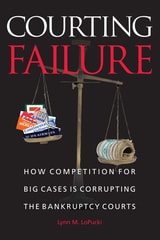
Courting Failure
How Competition for Big Cases Is Corrupting the Bankruptcy CourtsLynn Lopucki
University of Michigan Press, 2006
-Douglas Baird, University of Chicago Law School
"This book is smart, shocking and funny. This story has everything-professional greed, wrecked companies, and embarrassed judges. Insiders are already buzzing."
-Elizabeth Warren, Leo Gottlieb Professor of Law, Harvard Law School
"LoPucki provides a scathing attack on reorganization practice. Courting Failure recounts how lawyers, managers and judges have transformed Chapter 11. It uses empirical data to explore how the interests of the various participants have combined to create a system markedly different from the one envisioned by Congress. LoPucki not only questions the wisdom of these changes but also the free market ideology that supports much of the general regulation of the corporate sector."
-Robert Rasmussen, University of Chicago Law School
A sobering chronicle of our broken bankruptcy-court system, Courting Failure exposes yet another American institution corrupted by greed, avarice, and the thirst for power.
Lynn LoPucki's eye-opening account of the widespread and systematic decay of America's bankruptcy courts is a blockbuster story that has yet to be reported in the media. LoPucki reveals the profound corruption in the U.S. bankruptcy system and how this breakdown has directly led to the major corporate failures of the last decade, including Enron, MCI, WorldCom, and Global Crossing.
LoPucki, one of the nation's leading experts on bankruptcy law, offers a clear and compelling picture of the destructive power of "forum shopping," in which corporations choose courts that offer the most favorable outcome for bankruptcy litigation. The courts, lured by big money and prestige, streamline their requirements and lower their standards to compete for these lucrative cases. The result has been a series of increasingly shoddy reorganizations of major American corporations, proposed by greedy corporate executives and authorized by case-hungry judges.
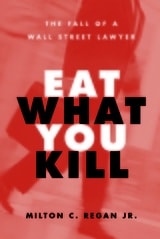
Eat What You Kill
The Fall of a Wall Street LawyerMilton C. Regan, Jr.
University of Michigan Press, 2005
-Nancy Rapoport, University of Houston Law Center
"Eat What You Kill is gripping and well written. . . . It weaves in academic commentary and understanding of professional ethics issues in a way that makes it accessible to everyone."
-Frank Partnoy, University of San Diego Law School
He had it all, and then he lost it. But why did he do it, risking everything-wealth, success, livelihood, freedom, and the security of family?
Eat What You Kill is the story of John Gellene, a rising star and bankruptcy partner at one of Wall Street's most venerable law firms. But when Gellene became entangled in a web of conflicting corporate and legal interests involving one of his clients, he was eventually charged with making false statements, indicted, found guilty of a federal crime, and sentenced to prison.
Milton C. Regan Jr. uses Gellene's case to prove that such conflicting interests are now disturbingly commonplace in the world of American corporate finance. Combining a journalist's eye with sharp psychological insight, Regan spins Gellene's story into a gripping drama of fundamental tensions in modern-day corporate practice and describes in perfect miniature the inexorable confluence of the interests of American corporations and their legal counselors.
This confluence may seem natural enough, but because these law firms serve many masters-corporations, venture capitalists, shareholder groups-it has paradoxically led to deep, pervasive conflicts of interest. Eat What You Kill gives us the story of a man trapped in this labyrinth, and reveals the individual and systemic factors that contributed to Gellene's demise.
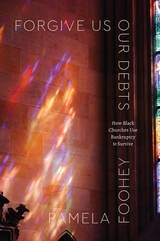
Forgive Us Our Debts
How Black Churches Use Bankruptcy to SurvivePamela Foohey
University of Chicago Press, 2026
A revelatory study of how Black churches turn the financial system back against predatory lenders.
When American churches face financial difficulties, a disproportionately high number of Black churches reorganize under chapter 11 bankruptcy. There are no easy explanations for this distinction: not location, denomination, leadership structure, or the reasons for the loans. In Forgive Us Our Debts, legal scholar Pamela Foohey asks why, then, Black churches account for two-thirds of all congregations that file for chapter 11 bankruptcy every year.
Drawing on case studies of six Black churches and one white church, and 150 interviews with church leaders, members, and attorneys, Foohey finds answers in a long history of predatory lending. Unable to negotiate with recalcitrant loan officers, Black churches turn to the legal system to force reasonable concessions from lenders to prevent the stripping of their wealth and the destruction of their communities. While the structural discrimination remains, these churches have found in the bankruptcy system a refuge and some power to fight back.
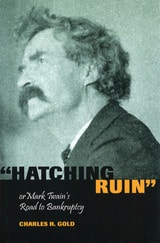
Hatching Ruin
Or Mark Twain's Road to BankruptcyCharles H. Gold
University of Missouri Press, 2003
In “Hatching Ruin,” Charles H. Gold provides a complete description of Samuel L. Clemens’s business relationships with Charles L. Webster and James W. Paige during the 1880s. Gold analyzes how these relationships affected Clemens as a person and an artist, most notably in A Connecticut Yankee in King Arthur’s Court.
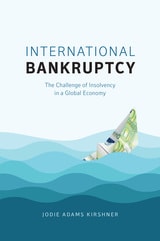
International Bankruptcy
The Challenge of Insolvency in a Global EconomyJodie Adams Kirshner
University of Chicago Press, 2018
With International Bankruptcy, Jodie Adams Kirshner explores the issues involved in determining which courts should have jurisdiction and which laws should apply in addressing problems within. Kirshner brings together theory with the discussion of specific cases and legal developments to explore this developing area of law. Looking at the key issues that arise in cross-border proceedings, International Bankruptcy offers a guide to this legal environment. In addition, she explores how globalization has encouraged the creation of new legal practices that bypass national legal systems, such as the European Insolvency Framework and the Model Law on Cross-Border Insolvency of the United Nations Commission on International Trade Law. The traditional comparative law framework misses the nuances of these dynamics. Ultimately, Kirshner draws both positive and negative lessons about regulatory coordination in the hope of finding cleaner and more productive paths to wind down or rehabilitate failing international companies.

Technology and the Character of Contemporary Life
A Philosophical InquiryAlbert Borgmann
University of Chicago Press, 1987

The Bankruptcy
A NovelJúlia Lopes de Almeida
University College London, 2023
Set in the early years of Brazil’s Old Republic after the abolition of slavery, Júlia Lopes de Almeida's The Bankruptcy depicts the rise and fall of a wealthy coffee exporter against a kaleidoscopic background of glamour, poverty, seduction, and financial speculation. The novel introduces readers to a turbulent period in Brazilian history seething with new ideas about democracy, women’s emancipation, and the role of religion in society. Originally published in 1901, its prescient critiques of financial capitalism and the patriarchal family remain relevant today.
In her lifetime, Júlia Lopes de Almeida was compared to Machado de Assis, the most important Brazilian writer of the nineteenth century. She was also considered for the inaugural list of members of the Brazilian Academy of Letters but was excluded because of her gender. In the decades after her death, her work was largely forgotten. This publication, a winner of the English PEN award, includes an introduction to the novel and a translators' preface and accompanies a general rediscovery of her extraordinary body of work in Brazil.
The Fall and Rise of Freedom of Contract
F. H. Buckley, ed.
Duke University Press, 1999
The 1970s was a decade of regulatory triumphalism in North America, marked by a surge in consumer, securities, and environmental regulation. Legal scholars predicted the “death of contract” and its replacement by regulation and reliance-based theories of liability. Instead, we have witnessed the reemergence of free bargaining norms. This revival can be attributed to the rise of law-and-economics, which laid bare the intellectual failure of anticontractarian theories. Scholars in this school note that consumers are not as helpless as they have been made out to be, and that intrusive legal rules meant ostensibly to help them often leave them worse off. Contract law principles have also been very robust in areas far afield from traditional contract law, and the essays in this volume consider how free bargaining rights might reasonably be extended in tort, property, land-use planning, bankruptcy, and divorce and family law.
This book will be of particular interest to legal scholars and specialists in contract law. Economics and public policy planners will also be challenged by its novel arguments.
Contributors. Gregory S. Alexander, Margaret F. Brinig, F. H. Buckley, Robert Cooter, Steven J. Eagle, Robert C. Ellickson, Richard A. Epstein, William A. Fischel, Michael Klausner, Bruce H. Kobayashi, Geoffrey P. Miller, Timothy J. Muris, Robert H. Nelson, Eric A. Posner, Robert K. Rasmussen, Larry E. Ribstein, Roberta Romano, Paul H. Rubin, Alan Schwartz, Elizabeth S. Scott, Robert E. Scott, Michael J. Trebilcock
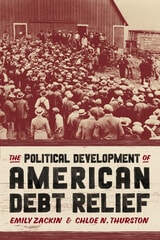
The Political Development of American Debt Relief
Emily Zackin and Chloe N. Thurston
University of Chicago Press, 2024
A political history of the rise and fall of American debt relief.
Americans have a long history with debt. They also have a long history of mobilizing for debt relief. Throughout the nineteenth century, indebted citizens demanded government protection from their financial burdens, challenging readings of the Constitution that exalted property rights at the expense of the vulnerable. Their appeals shaped the country’s periodic experiments with state debt relief and federal bankruptcy law, constituting a pre-industrial safety net. Yet, the twentieth century saw the erosion of debtor politics and the eventual retrenchment of bankruptcy protections.
The Political Development of American Debt Relief traces how geographic, sectoral, and racial politics shaped debtor activism over time, enhancing our understanding of state-building, constitutionalism, and social policy.