Results by title
4 books match the query 'Banks, William P.'
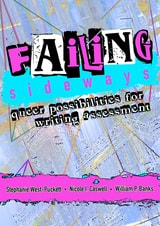
Failing Sideways
Queer Possibilities for Writing AssessmentStephanie West-Puckett
Utah State University Press, 2023
A failure-oriented assessment model unsettles some of the most common practices, like rubrics and portfolios, and challenges many deeply held assumptions about validity and reliability in order to ask what could happen if assessment was oriented toward possibility and potential. Working to engage a more capacious writing construct, the authors propose queer validity inquiry (QVI) as a model for assessment that values failure, affect, identity, and materiality. These overlapping lenses help teachers honor parts of writing and learning that writing studies faculty have struggled to hold onto in a world overly focused on quickness and efficiency in schools.
Through programmatic and classroom examples, Failing Sideways privileges what is valued in the classroom but traditionally ignored in assessments. Reimagining what matters in the teaching and learning of writing and using assessment data differently, this book demonstrates what writing can be and could do in a more diverse and just world.
Practicing Digital Activisms
Nicole E. Allen
Utah State University Press, 2027
Practicing Digital Activisms reframes digital activism as embodied, situated work that extends across classrooms, communities, institutions, streets, and ecosystems. It develops frameworks for studying and practicing activism in an era shaped by social media, datafication, and artificial intelligence. At the heart of the collection is a rethinking of digital activism for the twenty-first century that traces activism through networks of people, platforms, infrastructures, and material practices.
Bringing together scholars in rhetoric, writing studies, technical communication, and community engagement, contributors show how activism now unfolds across interconnected media ecologies, through affective and material infrastructures, and at multiple tempos ranging from viral moments to the quieter practices of organizing, care, and persistence. Through case studies of food activism, environmental advocacy, reproductive health, social media movements, and emerging data practices, contributors demonstrate digital activism as a sustained practice of coalition building, circulation, documentation, and persistence. The chapters provide theoretical tools for making infrastructures visible, negotiating ethical responsibility, and designing interventions responsive to local needs and broader struggles for justice.
Attending to the risks that shape contemporary digital life—including surveillance, commodification, algorithmic bias, harassment, platform control, and unequal access—the collection offers language, methods, and examples for understanding how communities build power, sustain movements, and imagine just futures through digital practice. For scholars, teachers, students, organizers, and readers interested in digital rhetoric and social change, Practicing Digital Activisms invites attention to digital participation as a vital site where collective action is imagined, contested, and practiced.
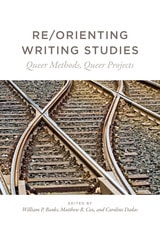
Re/Orienting Writing Studies
Queer Methods, Queer ProjectsWilliam P. Banks
Utah State University Press, 2018
While the humanities have engaged queer theory extensively, research methods have often been hermeneutic or interpretive. At the same time, social science approaches in composition research have foregrounded inquiry on human participants but have often struggled to understand where lesbian, gay, bisexual, transgender, and queer people fit into empirical research projects. Re/Orienting Writing Studies works at the intersections of humanities and social science methodologies to offer new insight into using queer methods for data collection and queer practices for framing research.
Contributors: Chanon Adsanatham, Jean Bessette, Nicole I. Caswell, Michael J. Faris, Hillery Glasby, Deborah Kuzawa, Maria Novotny, G Patterson, Stacey Waite, Stephanie West-Puckett
Reclaiming Accountability
Improving Writing Programs through Accreditation and Large-Scale AssessmentsWendy Sharer
Utah State University Press, 2016
Reclaiming Accountability brings together a series of critical case studies of writing programs that have planned, implemented, and/or assessed the impact of large-scale accreditation-supported initiatives. The book reimagines accreditation as a way to leverage institutional or programmatic change.
Contributions to the volume are divided into three parts. Part 1 considers how specialists in composition and rhetoric can work most productively with accrediting bodies to design assessments and initiatives that meet requirements while also helping those agencies to better understand how writing develops and how it can most effectively be assessed. Parts 2 and 3 present case studies of how institutions have used ongoing accreditation and assessment imperatives to meet student learning needs through programmatic changes and faculty development. They provide concrete examples of productive curricular (part 2) and instructional (part 3) changes that can follow from accreditation mandates while providing guidance for navigating challenges and pitfalls that WPAs may encounter within shifting and often volatile local, regional, and national contexts.
In addition to providing examples of how others in the profession might approach such work, Reclaiming Accountability addresses assessment requirements beyond those in the writing program itself. It will be of interest to department heads, administrators, writing program directors, and those involved with writing teacher education, among others.
Contributors: Linda Adler-Kassner, William P. Banks, Remica Bingham-Risher, Melanie Burdick, Polina Chemishanova, Malkiel Choseed, Kyle Christiansen, Angela Crow, Maggie Debelius, Michelle F. Eble, Jonathan Elmore, Lorna Gonzalez, Angela Green, Jim Henry, Ryan Hoover, Rebecca Ingalls, Cynthia Miecznikowski, Susan Miller-Cochran, Cindy Moore, Tracy Ann Morse, Joyce Magnotto Neff, Karen Nulton, Peggy O’Neill, Jessica Parker, Mary Rist, Rochelle Rodrigo, Tulora Roeckers, Shirley K. Rose, Iris M. Saltiel, Wendy Sharer, Terri Van Sickle, Jane Chapman Vigil, David M. Weed