Results by title
7 books match the query 'Bar'
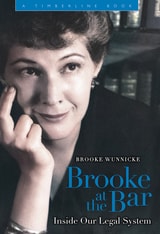
Brooke at the Bar
Inside Our Legal SystemBrooke Wunnicke
University Press of Colorado, 2023
Brooke at the Bar is a candid, lively, and sometimes humorous autobiography by Brooke Wunnicke, the first woman to be a trial and appellate attorney in Wyoming and who went on to become a legal legend in Colorado. In conversational writing, Brooke provides insights from a lawyer, mentor, and educator. She advocates that, while not perfect, the United States has the world’s best legal system and that all citizens need to understand and protect their rights, freedoms, and responsibilities.
Brooke shares vignettes of her early life—California in the Great Depression, college at Stanford, law school in Colorado during World War II, and the 1946 opening of her Cheyenne law office, a precedent for women in law. She vividly describes memorable and amusing experiences with clients, witnesses, lawyers, juries, and judges and explains some significant cases. She recounts important and dynamic events from her twelve years as Denver’s chief appellate deputy district attorney, an era during which she was an inestimable mentor to many young lawyers who became prominent in the private and public sectors.
Brooke passionately believed “the law has been and will continue to be civilization’s hope.” In her book’s final part, she demystifies many legal terms and procedures and describes the parts of a civil jury trial—including information for jurors and witnesses—and provides an enthusiastic and clear refresher on the US Constitution and Bill of Rights.
Brooke at the Bar is a unique and historically important contribution that will be of interest to general readers, scholars, and students interested in US law, political science, government, women’s history, twentieth-century western history, civil rights, and legal communities, including those in Wyoming and Colorado, where Brooke was “at the Bar.”
[more]
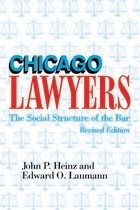
Chicago Lawyers, Revised Edition
The Social Structure of the BarJohn Heinz and Edward Laumann
Northwestern University Press, 1994
The legal profession is stratified primarily by the character of the clients served, not by the type of legal service rendered, as John P. Heinz and Edward O. Laumann convincingly demonstrate. In their classic study of the Chicago bar, the authors draw on interviews with nearly 800 lawyers to show that the profession is divided into two distinct hemispheres–corporate and individual–and that this dichotomy is reflected in the distribution of prestige among lawyers.
[more]
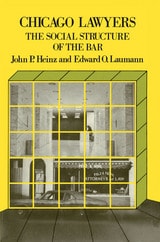
Chicago Lawyers
The Social Structure of the BarJohn P. Heinz
Russell Sage Foundation, 1982
What determines the systematic allocation of status, power, and economic reward among lawyers? What kind of social structure organizes lawyers' roles in the bar and in the larger community? As Heinz and Laumann convincingly demonstrate, the legal profession is stratified primarily by the character of the clients served, not by the type of legal service rendered. In fact, the distinction between corporate and individual clients divides the bar into two remarkably separate hemispheres. Using data from extensive personal interviews with nearly 800 Chicago lawyers, the authors show that lawyers who serve one type of client seldom serve the other. Furthermore, lawyers' political, ethno-religious, and social ties are very likely to correspond to those of their client types. Greater deference is consistently shown to corporate lawyers, who seem to acquire power by association with their powerful clients. Heinz and Laumann also discover that these two "hemispheres" of the legal profession are not effectively integrated by intraprofessional organizations such as the bar, courts, or law schools. The fact that the bar is structured primarily along extraprofessional lines raises intriguing questions about the law and the nature of professionalism, questions addressed in a provocative and far-ranging final chapter. This volume, published jointly with the American Bar Foundation, offers a uniquely sophisticated and comprehensive analysis of lawyers' professional lives. It will be of exceptional importance to sociologists and others interested in the legal profession, in the general study of professions, and in social stratification and the distribution of power.
[more]
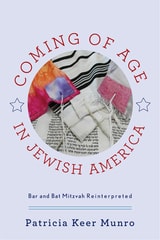
Coming of Age in Jewish America
Bar and Bat Mitzvah ReinterpretedPatricia Keer Munro
Rutgers University Press, 2016
The Jewish practice of bar mitzvah dates back to the twelfth century, but this ancient cultural ritual has changed radically since then, evolving with the times and adapting to local conditions. For many Jewish-American families, a child’s bar mitzvah or bat mitzvah is both a major social event and a symbolic means of asserting the family’s ongoing connection to the core values of Judaism. Coming of Age in Jewish America takes an inside look at bar and bat mitzvahs in the twenty-first century, examining how the practices have continued to morph and exploring how they serve as a sometimes shaky bridge between the values of contemporary American culture and Judaic tradition.
Interviewing over 200 individuals involved in bar and bat mitzvah ceremonies, from family members to religious educators to rabbis, Patricia Keer Munro presents a candid portrait of the conflicts that often emerge and the negotiations that ensue. In the course of her study, she charts how this ritual is rife with contradictions; it is a private family event and a public community activity, and for the child, it is both an educational process and a high-stakes performance.
Through detailed observations of Conservative, Orthodox, Reform, and independent congregations in the San Francisco Bay Area, Munro draws intriguing, broad-reaching conclusions about both the current state and likely future of American Judaism. In the process, she shows not only how American Jews have forged a unique set of bar and bat mitzvah practices, but also how these rituals continue to shape a distinctive Jewish-American identity.
[more]
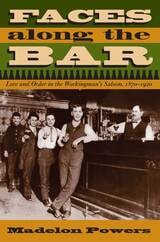
Faces along the Bar
Lore and Order in the Workingman's Saloon, 1870-1920Madelon Powers
University of Chicago Press, 1998
In this lively and engaging history, Madelon Powers recreates the daily life of the barroom, exploring what it was like to be a "regular" in the old-time saloon of pre-prohibition industrial America. Through an examination of saloongoers across America, her investigation offers a fascinating look at rich lore of the barroom—its many games, stories, songs, free lunch customs, and especially its elaborate system of drinking rituals that have been passed on for decades.
"A free-pouring blend of astonishing facts, folklore and firsthand period observations. . . . It's the rich details that'll inspire the casual reader to drink deep from this tap of knowledge."—Don Waller, USA Today recommended reading
"A surprise on every page."—Publishers Weekly
"Here we get social history that appreciates the bar talk even while dissecting its marvelous rituals."—Library Journal, starred review
"Careful scholarship with an anecdotal flair to please even the most sober of readers."—Nina C. Ayoub, Chronicle of Higher Education
[more]
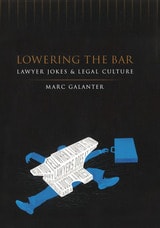
Lowering the Bar
Lawyer Jokes and Legal CultureMarc Galanter
University of Wisconsin Press, 2006
What do you call 600 lawyers at the bottom of the sea? Marc Galanter calls it an opportunity to investigate the meanings of a rich and time-honored genre of American humor: lawyer jokes. Lowering the Bar analyzes hundreds of jokes from Mark Twain classics to contemporary anecdotes about Dan Quayle, Johnnie Cochran, and Kenneth Starr. Drawing on representations of law and lawyers in the mass media, political discourse, and public opinion surveys, Galanter finds that the increasing reliance on law has coexisted uneasily with anxiety about the “legalization” of society. Informative and always entertaining, his book explores the tensions between Americans’ deep-seated belief in the law and their ambivalence about lawyers.
[more]
Urban Lawyers
The New Social Structure of the BarJohn P. Heinz, Robert L. Nelson, Rebecca L. Sandefur, and Edward O. Laumann
University of Chicago Press, 2005
Over the past several decades, the number of lawyers in large cities has doubled, women have entered the bar at an unprecedented rate, and the scale of firms has greatly expanded. This immense growth has transformed the nature and social structure of the legal profession. In the most comprehensive analysis of the urban bar to date, Urban Lawyers presents a compelling portrait of how these changes continue to shape the field of law today.
Drawing on extensive interviews with Chicago lawyers, the authors demonstrate how developments in the profession have affected virtually every aspect of the work and careers of urban lawyers-their relationships with clients, job tenure and satisfaction, income, social and political values, networks of professional connections, and patterns of participation in the broader community. Yet despite the dramatic changes, much remains the same. Stratification of income and power based on gender, race, and religious background, for instance, still maintains inequality within the bar.
The authors of Urban Lawyers conclude that organizational priorities will likely determine the future direction of the legal profession. And with this landmark study as their guide, readers will be able to make their own informed predictions.
[more]