Results by title
2 books match the query 'Bar-Nadav, Hadara'

Fountain and Furnace
Hadara Bar-Nadav
Tupelo Press, 2016
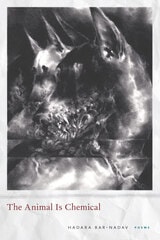
The Animal Is Chemical
Hadara Bar-Nadav
Four Way Books, 2024
Lyrically enacting the cognitive dissonance and embodied contradictions of our contemporary age, Hadara Bar-Nadav’s The Animal Is Chemical collects innovative poems that straddle the frontiers of language and scientific knowledge. She brilliantly draws on her own experience as a medical editor and her family’s history of Holocaust survival to write into the hybrid legacy of Western medicine: part clinical empiricism, part human fallibility and moral bankruptcy. Displaying a robust formal range, these poems move from feverish elegies to drug-pamphlet erasures, tangible articulations of Bar-Nadav’s epigenetic, cultural, and memorial inheritance as a writer navigating chronic illness and pain. In these pages, Nazi medical experiments, pharmaceutical literature, and manifestations of intergenerational trauma collide in the lyrical archive of Bar-Nadav’s latest collection, winner of the 2022 Four Way Books Levis Prize in Poetry. Just as she illuminates the paradox of time — that we may think of the past as something gone and yet always present in context and legacy — Bar-Nadav proves the enduring ambivalence of pharmakon, that antidote which poisons us, the medicine that kills. This febrile, fierce book casts spells and confronts illusions, ignites grief and awe, and challenges our assumptions about what it means to heal our bodies, our families, and our shared histories. Perhaps this work fulfills the specious salvation it describes in its opening pages, performing an exorcism of truth-telling that harnesses the heat of a “myth in which a god sets us / on fire and then sets us free.”