Results by title
7 books match the query 'Barbecuing'
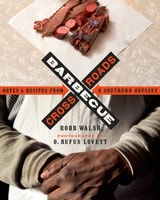
Barbecue Crossroads
Notes and Recipes from a Southern OdysseyBy Robb Walsh
University of Texas Press, 2013
In stories, recipes, and photographs, James Beard Award–winning writer Robb Walsh and acclaimed documentary photographer O. Rufus Lovett take us on a barbecue odyssey from East Texas to the Carolinas and back. In Barbecue Crossroads, we meet the pitmasters who still use old-fashioned wood-fired pits, and we sample some of their succulent pork shoulders, whole hogs, savory beef, sausage, mutton, and even some barbecued baloney. Recipes for these and the side dishes, sauces, and desserts that come with them are painstakingly recorded and tested.
But Barbecue Crossroads is more than a cookbook; it is a trip back to the roots of our oldest artisan food tradition and a look at how Southern culture is changing. Walsh and Lovett trace the lineage of Southern barbecue backwards through time as they travel across a part of the country where slow-cooked meat has long been part of everyday life. What they find is not one story, but many. They visit legendary joints that don’t live up to their reputations—and discover unknown places that deserve more attention. They tell us why the corporatizing of agriculture is making it difficult for pitmasters to afford hickory wood or find whole hogs that fit on a pit.
Walsh and Lovett also remind us of myriad ways that race weaves in and out of the barbecue story, from African American cooking techniques and recipes to the tastes of migrant farmworkers who ate their barbecue in meat markets, gas stations, and convenience stores because they weren’t welcome in restaurants. The authors also expose the ways that barbecue competitions and TV shows are undermining traditional barbecue culture. And they predict that the revival of the community barbecue tradition may well be its salvation.
Barbecue
The History of an American InstitutionRobert F. Moss
University of Alabama Press, 2010
The history of barbecue in the United States has until now remained virtually untold. Barbecue has a long, rich history—a history that could be found only through scattered references in old letters, journals, newspapers, diaries, and travel narratives until this book was written.
Barbecue
The History of an American Institution, Revised and Expanded Second EditionRobert F. Moss
University of Alabama Press, 2020
The definitive history of an iconic American food, with new chapters, sidebars, and updated historical accounts.
Expert Robert F. Moss researched hundreds of sources—newspapers, letters, journals, diaries, and travel narratives—to document the origins and evolution of barbecue from its origins among Native Americans to its present status as an icon of American culture. In this definitive guide, he maps out the development of the rich array of regional barbecue styles, chronicles the rise of barbecue restaurants, and profiles the famed pitmasters who made the tradition what it is today.
Barbecue is the story not just of a dish but also of a social institution that helped shape many regional cultures of the United States. The history begins with British colonists’ adoption of barbecuing techniques from Native Americans in the 17th and 18th centuries, moves to barbecue’s establishment as the preeminent form of public celebration in the 19th century, and is carried through to barbecue’s ubiquitous standing today.
From the very beginning, barbecues were powerful social magnets, drawing together people from a wide range of classes and geographic backgrounds. Barbecue played a key role in three centuries of American history, both reflecting and influencing the direction of an evolving society. By tracing the story of barbecue from its origins to today, Barbecue: The History of an American Institution traces the very thread of American social history.
Moss has made significant updates in this new edition, offering a wealth of new historical research, sources, illustrations, and anecdotes.
Goldee's Bar-B-Q
A CookbookJalen Heard, Lane Milne, and Jonny White, with Lisa Fain. Photography by Wiil Milne.
University of Texas Press, 2025
The top joint in Texas shares its secrets to award-winning barbecue.
Goldee's Bar-B-Q, which sits in a quiet corner of Dallas–Fort Worth, opened only a few weeks before COVID-19 closed the dining room, and for months the restaurant eked out a living with curbside service and catering. The owners didn’t expect their barbecue to be crowned the best in the state by Texas Monthly, yet they earned that honor in 2021. What separates Goldee's from other joints is their pitmasters’ attention to craft and an inclusive attitude toward sharing their work. They understand that the secret ingredient in barbecue is not a particular spice in the rub, but hours of paying attention to fire and meat.
Goldee’s Bar-B-Q shows you how to make classics such as brisket, ribs, sausages, beans, coleslaw, potato salad, and banana pudding. Goldee’s pitmasters share how to trim, season, and smoke meat, as well as tips for managing a fire and monitoring temperature, which are key to elevating your barbecue. Goldee’s Bar-B-Q also captures the heart of the restaurant, the story of best friends coming together to make a place where they could share their love of cooking. A must-have for barbecue aficionados, meat lovers, and chefs looking to perfect their techniques, Goldee’s Bar-B-Q will help you make your barbecue exceptional.
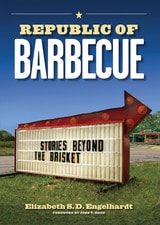
Republic of Barbecue
Stories Beyond the BrisketBy Elizabeth S. D. Engelhardt
University of Texas Press, 2009
Winner, Barbara Sudler Award, Colorado Historical Society, 2010
It's no overstatement to say that the state of Texas is a republic of barbecue. Whether it's brisket, sausage, ribs, or chicken, barbecue feeds friends while they catch up, soothes tensions at political events, fuels community festivals, sustains workers of all classes, celebrates brides and grooms, and even supports churches. Recognizing just how central barbecue is to Texas's cultural life, Elizabeth Engelhardt and a team of eleven graduate students from the University of Texas at Austin set out to discover and describe what barbecue has meant to Texans ever since they first smoked a beef brisket.
Republic of Barbecue presents a fascinating, multifaceted portrait of the world of barbecue in Central Texas. The authors look at everything from legendary barbecue joints in places such as Taylor and Lockhart to feedlots, ultra-modern sausage factories, and sustainable forests growing hardwoods for barbecue pits. They talk to pit masters and proprietors, who share the secrets of barbecue in their own words. Like side dishes to the first-person stories, short essays by the authors explore a myriad of barbecue's themes—food history, manliness and meat, technology, nostalgia, civil rights, small-town Texas identity, barbecue's connection to music, favorite drinks such as Big Red, Dr. Pepper, Shiner Bock, and Lone Star beer—to mention only a few. An ode to Texas barbecue in films, a celebration of sports and barbecue, and a pie chart of the desserts that accompany brisket all find homes in the sidebars of the book, while photographic portraits of people and places bring readers face-to-face with the culture of barbecue.
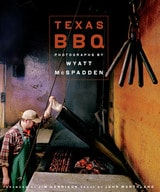
Texas BBQ
Photographs by Wyatt McSpaddenBy Wyatt McSpadden
University of Texas Press, 2009
To Texans, barbecue is elemental. Succulent, savory, perfumed with smoke and spice, it transcends the term "comfort food." It's downright heavenly, and it's also a staff of Texas life. Like a dust storm or a downpour, barbecue is a force of Texas nature, a stalwart tie to the state's cultural and culinary history. Though the word is often shortened to "BBQ," the tradition of barbecue stands Texas-tall.
Photographer Wyatt McSpadden has spent some twenty years documenting barbecue—specifically, the authentic family-owned cafes that are small-town mainstays. Traveling tens of thousands of miles, McSpadden has crisscrossed the state to visit scores of barbecue purveyors, from fabled sites like Kreuz's in Lockhart to remote spots like the Lazy H Smokehouse in Kirbyville. Color or black-and-white, wide angle or close up, his pictures convey the tradition and charm of barbecue. They allow the viewer to experience each place through all five senses. The shots of cooking meat and spiraling smoke make taste and smell almost tangible. McSpadden also captures the shabby appeal of the joints themselves, from huge, concrete-floored dining halls to tiny, un-air-conditioned shacks. Most of all, McSpadden conveys the primal physicality of barbecue—the heat of fire, the heft of meat, the slickness of juices—and also records ubiquitous touches such as ancient scarred carving blocks, torn screen doors and peeling linoleum, and toothpicks in a recycled pepper sauce jar.
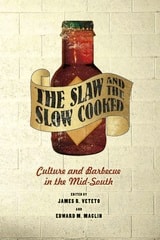
The Slaw and the Slow Cooked
Culture and Barbecue in the Mid-SouthJames R. Veteto
Vanderbilt University Press, 2011
In developing the book, Veteto and Maclin cast a wide net for divergent approaches. Food writer John Edge introduces us to Jones Bar-B-Q Diner in Marianna, Arkansas, a possibly century-old restaurant serving top-notch pork and simultaneously challenging race and class boundaries. Kristen Bradley-Shurtz explores the 150-plus-year tradition of the St. Patrick's Irish Picnic in McEwen, Tennessee. And no barbecue book would be complete without an insider's story, provided here by Jonathan Deutsch's "embedded" reporting inside a competitive barbecue team. Veteto and Maclin conclude with a glimpse into the future of barbecue culture: online, in the smoker, and fresh from the farm.
The Slaw and the Slow Cooked stands as a challenge to barbecue aficionados and a statement on the Mid-South's important place at the table. Intended for food lovers, anthropologists, and sociologists alike, The Slaw and the Slow Cooked demonstrates barbecue's status as a common language of the South.