Results by title
3 books match the query 'Barnhisel, Greg'
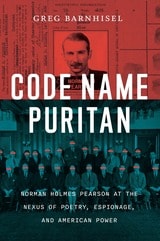
Code Name Puritan
Norman Holmes Pearson at the Nexus of Poetry, Espionage, and American PowerGreg Barnhisel
University of Chicago Press, 2024
An insightful biography of an unassuming literary scholar—and spy—who transformed postwar American culture.
Although his impact on twentieth-century American cultural life was profound, few people know the story of Norman Holmes Pearson. Pearson’s life embodied the Cold War alliances among US artists, scholars, and the national-security state that coalesced after World War II. As a Yale professor and editor, he helped legitimize the study of American culture and shaped the public’s understanding of literary modernism—significantly, the work of women poets such as Hilda Doolittle and Gertrude Stein. At the same time, as a spy, recruiter, and cultural diplomat, he connected the academy, the State Department, and even the CIA.
In Code Name Puritan, Greg Barnhisel maps Pearson’s life, from his childhood injury that led to a visible, permanent disability to his wartime counterespionage work neutralizing the Nazis’ spy network to his powerful role in the cultural and political heyday sometimes called the American Century. Written with clarity and informed by meticulous research, Barnhisel’s revelatory portrait of Pearson details how his unique experiences shaped his beliefs about the American character, from the Puritans onward.
[more]

James Laughlin, New Directions Press, and the Remaking of Ezra Pound
Greg Barnhisel
University of Massachusetts Press, 2005
Although James Laughlin (1914–1997) came from one of Pittsburgh's leading steel-making families, his passions were literary rather than industrial—he wanted to be a poet. Laughlin was a freshman at Harvard when he traveled to Rapallo, Italy, in 1933 to meet Ezra Pound (1885–1972), and he returned the following year to enroll in the poet's "Ezuversity." Pound dismissed Laughlin's poetic talents, advising the wealthy young man to make himself over into a publisher. Laughlin did just that, founding New Directions Press in 1936.
For much of the 1930s prior to World War II, Laughlin and Pound were friends, business associates, collaborators, student and teacher, and even at times son and surrogate father. But Laughlin's investment in Pound—and their friendship—was severely tested by Pound's wartime propaganda broadcasts for Italian state radio, his capture and abortive trial for treason, and his thirteen-year stay as a mental patient in St. Elizabeth's Hospital. Following this scandal and disgrace, the reading public no longer wanted to buy Pound's books, and the critical establishment dismissed him as a Fascist crank.
Laughlin and New Directions responded by marketing Pound in such a way as to convince consumers that the poet's importance needed to be judged solely on aesthetic grounds, and that his political beliefs were irrelevant to his accomplishments as a pioneering literary artist. With Pound's encouragement, and despite the poet's oft-expressed opposition to the mixture of commerce and art, Laughlin used such marketing tools as advertising, the cultivation of friendly critics, and the development of the trade paperback to enhance Pound's reputation.
Drawing on a wide range of sources—including interviews with Laughlin and other New Directions staffers and published materials from numerous literary archives—Gregory Barnhisel tells the story of the personal and professional relationship between one of the twentieth century's most controversial writers and his loyal and innovative American publisher—a relationship that eventually helped remake literary history and continues to shape our understanding of modernism itself
[more]
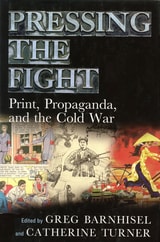
Pressing the Fight
Print, Propaganda, and the Cold WarGreg Barnhisel
University of Massachusetts Press, 2010
Although often framed as an economic, military, and diplomatic confrontation, the Cold War was above all a conflict of ideas. In official pronouncements and publications as well as via radio broadcasts, television, and film, the United States and the Soviet Union both sought to extend their global reach as much through the power of persuasion as by the use of force. Yet of all the means each side employed to press its ideological case, none proved more reliable or successful than print.
In this volume, scholars from a variety of disciplines explore the myriad ways print was used in the Cold War. Looking at materials ranging from textbooks and cookbooks to art catalogs, newspaper comics, and travel guides, they analyze not only the content of printed matter but also the material circumstances of its production, the people and institutions that disseminated it, and the audiences that consumed it. Among the topics discussed are the infiltration of book publishing by propagandists East and West; the distribution of pro-American printed matter in postwar Japan through libraries, schools, and consulates; and the collaboration of foundations, academia, and the government in the promotion of high culture as evidence of the superiority of Western values.
At the same time, many of the qualities that made print the preferred medium of official propaganda also made it an effective instrument for challenging Cold War orthodoxies at home and abroad. Because printed materials were relatively easy to transport, to copy, and to share, they could just as well be used to bridge differences among people and cultures as to exploit them. They also provided a vehicle for disseminating satire and other expressions of dissent.
In addition to the volume editors, contributors include Ed Brunner, Russell Cobb, Laura Jane Gifford, Patricia Hills, Christian Kanig, Scott Laderman, Amanda Laugesen, Martin Manning, Kristin Matthews, Hiromi Ochi, Amy Reddinger, and James Smith. Together their essays move beyond traditional Cold War narratives to gauge the role of a crucial cultural medium in the ideological battle between the superpowers and their surrogates.
[more]