Results by title

10 books match the query 'Barrett, James R.'
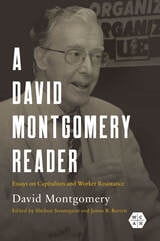
cover of A David Montgomery Reader: Essays on Capitalism and Worker Resistance

A David Montgomery Reader

Essays on Capitalism and Worker Resistance

David Montgomery. Edited by Shelton Stromquist and James R. Barrett

University of Illinois Press, 2024

A foundational figure in modern labor history, David Montgomery both redefined and reoriented the field. This collection of Montgomery’s most important published and unpublished articles and essays draws from the historian’s entire five-decade career.

Taken together, the writings trace the development of Montgomery’s distinct voice and approach while providing a crucial window into an era that changed the ways scholars and the public understood working people’s place in American history. Three overarching themes and methods emerge from these essays: that class provided a rich reservoir of ideas and strategies for workers to build movements aimed at claiming their democratic rights; that capital endured with the power to manage the contours of economic life and the capacities of the state but that workers repeatedly and creatively mounted challenges to the terms of life and work dictated by capital; and that Montgomery’s method grounded his gritty empiricism and the conceptual richness of his analysis in the intimate social relations of production and of community, neighborhood, and family life.
[more]
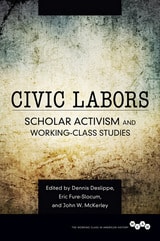
cover of Civic Labors: Scholar Activism and Working-Class Studies

Civic Labors

Scholar Activism and Working-Class Studies

Edited by Dennis Deslippe, Eric Fure-Slocum, and John W. McKerley

University of Illinois Press, 2016
Labor studies scholars and working-class historians have long worked at the crossroads of academia and activism. The essays in this collection examine the challenges and opportunities for engaged scholarship in the United States and abroad. A diverse roster of contributors discuss how participation in current labor and social struggles guides their campus and community organizing, public history initiatives, teaching, mentoring, and other activities. They also explore the role of research and scholarship in social change, while acknowledging that intellectual labor complements but never replaces collective action and movement building. Contributors: Kristen Anderson, Daniel E. Atkinson, James R. Barrett, Susan Roth Breitzer, Susan Chandler, Sam Davies, Dennis Deslippe, Eric Fure-Slocum, Colin Gordon, Michael Innis-Jiménez, Stephanie Luce, Joseph A. McCartin, John W. McKerley, Matthew M. Mettler, Stephen Meyer, David Montgomery, Kim E. Nielsen, Peter Rachleff, Ralph Scharnau, Jennifer Sherer, Shelton Stromquist, Emily E. LB. Twarog, and John Williams-Searle.
[more]
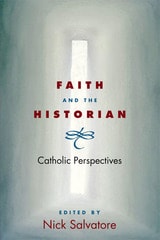
cover of Faith and the Historian: CATHOLIC PERSPECTIVES

Faith and the Historian

CATHOLIC PERSPECTIVES

Edited by Nick Salvatore

University of Illinois Press, 2006

Faith and the Historian collects essays from eight experienced historians discussing the impact of being "touched" by Catholicism on their vision of history. That first graduate seminar, these essays suggest, did not mark the inception of one's historical sensibilities; rather, that process had deeper, and earlier, roots. The authors--ranging from "cradle to the grave" Catholics to those who haven’t practiced for forty years, and everywhere in between--explicitly investigate the interplay between their personal lives and beliefs and the sources of their professional work. A variety of heartfelt, illuminating, and sometimes humorous experiences emerge from these stories of intelligent people coming to terms with their Catholic backgrounds as they mature and enter the academy. Contributors include: Philip Gleason, David Emmons, Maureen Fitzgerald, Joseph A. McCartin, Mario T. Garcia, Nick Salvatore, James R. Barrett, and Anne M. Butler. 
[more]
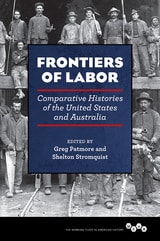
cover of Frontiers of Labor: Comparative Histories of the United States and Australia

Frontiers of Labor

Comparative Histories of the United States and Australia

Edited by Greg Patmore and Shelton Stromquist

University of Illinois Press, 2018

Alike in many aspects of their histories, Australia and the United States diverge in striking ways when it comes to their working classes, labor relations, and politics.

Greg Patmore and Shelton Stromquist curate innovative essays that use transnational and comparative analysis to explore the two nations’ differences. The contributors examine five major areas: World War I’s impact on labor and socialist movements; the history of coerced labor; patterns of ethnic and class identification; forms of working-class collective action; and the struggles related to trade union democracy and independent working-class politics. Throughout, many essays highlight how hard-won transnational ties allowed Australians and Americans to influence each other’s trade union and political cultures.

Contributors: Robin Archer, Nikola Balnave, James R. Barrett, Bradley Bowden, Verity Burgmann, Robert Cherny, Peter Clayworth, Tom Goyens, Dianne Hall, Benjamin Huf, Jennie Jeppesen, Marjorie A. Jerrard, Jeffrey A. Johnson, Diane Kirkby, Elizabeth Malcolm, Patrick O’Leary, Greg Patmore, Scott Stephenson, Peta Stevenson-Clarke, Shelton Stromquist, and Nathan Wise
[more]
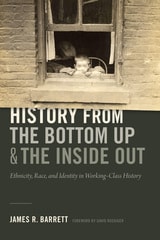
cover of History from the Bottom Up and the Inside Out: Ethnicity, Race, and Identity in Working-Class History

History from the Bottom Up and the Inside Out

Ethnicity, Race, and Identity in Working-Class History

James R. Barrett

Duke University Press, 2017
In History from the Bottom Up and the Inside Out James R. Barrett rethinks the boundaries of American social and labor history by investigating the ways in which working-class, radical, and immigrant people's personal lives intersected with their activism and religious, racial, ethnic, and class identities. Concerned with carving out space for individuals in the story of the working class, Barrett examines all aspects of individuals' subjective experiences, from their personalities, relationships, and emotions to their health and intellectual pursuits. Barrett's subjects include American communists, "blue-collar cosmopolitans"—such as well-read and well-traveled porters, sailors, and hoboes—and figures in early twentieth-century anarchist subculture. He also details the process of the Americanization of immigrant workers via popular culture and their development of class and racial identities, asking how immigrants learned to think of themselves as white. Throughout, Barrett enriches our understanding of working people’s lives, making it harder to objectify them as nameless cogs operating within social and political movements. In so doing, he works to redefine conceptions of work, migration, and radical politics.
[more]
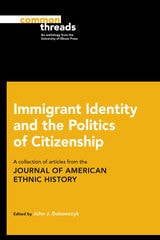
cover of Immigrant Identity and the Politics of Citizenship: A Collection of Articles from the Journal of American Ethnic History

Immigrant Identity and the Politics of Citizenship

A Collection of Articles from the Journal of American Ethnic History

John J Bukowczyk

University of Illinois Press, 2016
The next volume in the Common Threads book series, Immigrant Identity and the Politics of Citizenship assembles fourteen articles from the Journal of American Ethnic History . The chapters discuss the divisions and hierarchies confronted by immigrants to the United States, and how these immigrants shape, and are shaped by, the social and cultural worlds they enter. Drawing on scholarship of ethnic groups from around the globe, the articles illuminate the often fraught journey many migrants undertake from mistrusted Other to sometimes welcomed citizen. Contributors: James R. Barrett, Douglas C. Baynton, Vibha Bhalla, Julio Capó, Jr., Robert Fleegler, Gunlög Fur, Hidetaka Hirota, Karen Leonard, Willow Lung-Amam, Raymond A. Mohl, Mark Overmyer-Velázquez, Lara Putnam, David Reimers, David Roediger, and Allison Varzally.
[more]
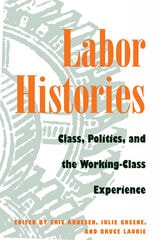
cover of Labor Histories: Class, Politics, and the Working-Class Experience

Labor Histories

Class, Politics, and the Working-Class Experience

Edited by Eric Arnesen, Julie Greene, and Bruce Laurie

University of Illinois Press, 1998
Is class outmoded as a basis for understanding labor history? This collection emphatically answers, "No!" These thirteen essays delve into subjects like migrant labor, religion, ethnicity, agricultural history, and gender. Written by former students of preeminent labor figure and historian David Montgomery, the works advance the argument that class remains indispensable to the study of working Americans and their place in the broad drama of our shared national history.
[more]
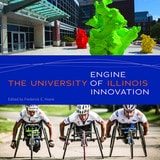
cover of The University of Illinois: Engine of Innovation

The University of Illinois

Engine of Innovation

Edited by Frederick E. Hoxie

University of Illinois Press, 2017

The founding of the university in 1867 created a unique community in what had been a prairie. Within a few years, this creative mix of teachers and scholars produced innovations in agriculture, engineering and the arts that challenged old ideas and stimulated dynamic new industries. Projects ranging from the Mosaic web browser to the discovery of Archaea and pioneering triumphs in women's education and wheelchair accessibility have helped shape the university's mission into a double helix of innovation and real-world change. These essays explore the university's celebrated accomplishments and historic legacy, candidly assessing both its successes and its setbacks. Experts and students tell the eye-opening stories of campus legends and overlooked game-changers, of astonishing technical and social invention, of incubators of progress as diverse as the Beckman Institute and Ebertfest. Contributors: James R. Barrett, George O. Batzli, Claire Benjamin, Jeffrey D. Brawn, Jimena Canales, Stephanie A. Dick, Poshek Fu, Marcelo H. Garcia, Lillian Hoddeson, Harry Liebersohn, Claudia Lutz, Kathleen Mapes, Vicki McKinney, Elisa Miller, Robert Michael Morrissey, Bryan E. Norwood, Elizabeth H. Pleck, Leslie J. Reagan, Susan M. Rigdon, David Rosenboom, Katherine Skwarczek, Winton U. Solberg, Carol Spindel, William F. Tracy, and Joy Ann Williamson-Lott.
[more]
cover of William Z. Foster and the Tragedy of American Radicalism

William Z. Foster and the Tragedy of American Radicalism

James R. Barrett

University of Illinois Press, 1999

In this trenchant work, James Barrett traces the political journey of a leading worker radical whose life and experiences encapsulate radicalism's rise and fall in the United States.

A self-educated wage earner raised in the slums of a large industrial city, William Z. Foster became a brilliant union organizer who helped build the American Federation of Labor and, later, radical Trade Union Educational League. Embracing socialism, syndicalism, and communism in turn, Foster rose through the ranks of the American Communist Party to stand at the forefront of labor politics throughout the 1920s. Yet by the time he died in 1961, in a Moscow hospital far from the meat-packing plants and steel mills where he had built his reputation, Foster's political marginalism stood as a symbol for the isolation of American labor radicalism in the postwar era.

Integrating both the indigenous and the international factors that determined the fate of American communism, William Z. Foster and the Tragedy of American Radicalism provides a new understanding of the basis for radicalism among twentieth-century American workers.
 
[more]
cover of Work and Community in the Jungle: Chicago's Packinghouse Workers, 1894-1922

Work and Community in the Jungle

Chicago's Packinghouse Workers, 1894-1922

James R. Barrett

University of Illinois Press, 1987

Mythologized by Upton Sinclair as hopeless, Chicago's packinghouse workers were in fact active agents in the early twentieth century transformation that swept urban industrial America. James R. Barrett's award-winning study explores how the lives and neighborhoods of packinghouse workers convey the experience of mass production work, the quality of working class life, the process of class formation and fragmentation, the effects of unionization, and the changing character of class relations. Merging history and analysis with contemporary social surveys and a computer-assisted analysis of census data, Barrett delves into a wide range of social, economic, and cultural factors that resulted in class cohesion and fragmentation.
[more]