Results by title
2 books match the query 'Barry, Andrew'

Chemical Exposures
Toxicity in the AnthropoceneEdited by Sahra Gibbon, Emilie Glazer, Lucy Sabin, and Andrew Barry
University College London, 2026
This cutting-edge study traces how chemical exposures are lived, experienced, sensed, and registered, foregrounding new conceptual and methodological approaches in science and technology studies.
Exposure to toxic chemicals has become commonplace, yet the study of both chemicals and toxicity has tended to remain at the margins of the social sciences. This volume addresses the entangled landscape of toxic chemicals in the Anthropocene, drawing together research by anthropologists, geographers, artists, and scholars in science and technology studies. The contributors understand chemical pollution as not simply pervasive, but multiple, situated, unequal, and profoundly relational and affective, traversing temporal and spatial scales as it continuously disrupts and reconfigures the relations between the geological and the human, the political and the material, and the social and natural sciences and humanities. Chemical Exposures explores the accumulation of toxic substances in society, the multiple scales of exposure, and the diverse ways in which exposure can be both sensed and visualized.
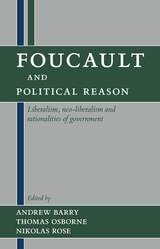
Foucault and Political Reason
Liberalism, Neo-Liberalism, and Rationalities of GovernmentEdited by Andrew Barry, Thomas Osborne, and Nikolas Rose
University of Chicago Press, 1996
These twelve essays provide a critical introduction to Foucault's work on politics, exploring its relevance to past and current thinking about liberal and neo-liberal forms of government. Moving away from the great texts of liberal political philosophy, this book looks closely at the technical means with which the ideals of liberal political rationalities have been put into practice in such areas as schools, welfare, and the insurance industry.
This fresh approach to one of the seminal thinkers of the twentieth century is essential reading for anyone interested in social and cultural theory, sociology, and politics.