Results by title
2 books match the query 'Bartley, W. W.'
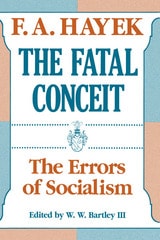
The Fatal Conceit
The Errors of SocialismF. A. Hayek
University of Chicago Press, 1988
Hayek gives the main arguments for the free-market case and presents his manifesto on the "errors of socialism." Hayek argues that socialism has, from its origins, been mistaken on factual, and even on logical, grounds and that its repeated failures in the many different practical applications of socialist ideas that this century has witnessed were the direct outcome of these errors. He labels as the "fatal conceit" the idea that "man is able to shape the world around him according to his wishes."
"The achievement of The Fatal Conceit is that it freshly shows why socialism must be refuted rather than merely dismissed—then refutes it again."—David R. Henderson, Fortune.
"Fascinating. . . . The energy and precision with which Mr. Hayek sweeps away his opposition is impressive."—Edward H. Crane, Wall Street Journal
F. A. Hayek is considered a pioneer in monetary theory, the preeminent proponent of the libertarian philosophy, and the ideological mentor of the Reagan and Thatcher "revolutions."
[more]
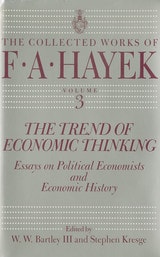
The Trend of Economic Thinking
Essays on Political Economists and Economic HistoryF. A. Hayek
University of Chicago Press, 1991
The Iron Curtain has been cast aside. The Berlin Wall has fallen. Germany has been reunited. And F. A. Hayek's forceful predictions of the inevitable failure of socialism and central economic planning are now rendered irrefutable. Yet Hayek still rightfully cautions us to heed his arguments, warning that "in economics you can never establish a truth once and for all but have always to convince every generation anew."
The Trend of Economic Thinking captures Hayek's views on political economists and economic history—on Mandeville, Hume, Cantillon, Adam Smith, and Henry Thornton. Framed by insightful editorial notes, fifteen newly collected essays—including five previously unpublished pieces and two others never before available in English—provide a fascinating introduction to the historical context of political economy and the evolution of monetary practices. In a highlight of the collection, "On Being an Economist," Hayek reflects on the influence of economists, the time required for new ideas to take hold, the best way to educate economic theorists, and the need to follow one's own interests, often in opposition to fashionable beliefs. As always, the words of this outspoken scholar are sure to provoke debate.
The Trend of Economic Thinking captures Hayek's views on political economists and economic history—on Mandeville, Hume, Cantillon, Adam Smith, and Henry Thornton. Framed by insightful editorial notes, fifteen newly collected essays—including five previously unpublished pieces and two others never before available in English—provide a fascinating introduction to the historical context of political economy and the evolution of monetary practices. In a highlight of the collection, "On Being an Economist," Hayek reflects on the influence of economists, the time required for new ideas to take hold, the best way to educate economic theorists, and the need to follow one's own interests, often in opposition to fashionable beliefs. As always, the words of this outspoken scholar are sure to provoke debate.
[more]