Results by title
3 books match the query 'Basic needs'
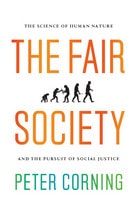
The Fair Society
The Science of Human Nature and the Pursuit of Social JusticePeter Corning
University of Chicago Press, 2011
We’ve been told, again and again, that life is unfair. But what if we’re wrong simply to resign ourselves to this situation? What if we have the power—and more, the duty—to change society for the better?
We do. And our very nature inclines us to do so. That’s the provocative argument Peter Corning makes in The Fair Society. Drawing on the evidence from our evolutionary history and the emergent science of human nature, Corning shows that we have an innate sense of fairness. While these impulses can easily be subverted by greed and demagoguery, they can also be harnessed for good. Corning brings together the latest findings from the behavioral and biological sciences to help us understand how to move beyond the Madoffs and Enrons in our midst in order to lay the foundation for a new social contract—a Biosocial Contract built on a deep understanding of human nature and a commitment to fairness. He then proposes a sweeping set of economic and political reforms based on three principles of fairness—equality, equity, and reciprocity—that together could transform our society and our world.
At this crisis point for capitalism, Corning reveals that the proper response to bank bailouts and financial chicanery isn’t to get mad—it’s to get fair.
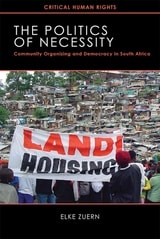
The Politics of Necessity
Community Organizing and Democracy in South AfricaElke Zuern
University of Wisconsin Press, 2011
The end of apartheid in South Africa broke down political barriers, extending to all races the formal rights of citizenship, including the right to participate in free elections and parliamentary democracy. But South Africa remains one of the most economically polarized nations in the world. In The Politics of Necessity Elke Zuern forcefully argues that working toward greater socio-economic equality—access to food, housing, land, jobs—is crucial to achieving a successful and sustainable democracy.
Drawing on interviews with local residents and activists in South Africa’s impoverished townships during more than a decade of dramatic political change, Zuern tracks the development of community organizing and reveals the shifting challenges faced by poor citizens. Under apartheid, township residents began organizing to press the government to address the basic material necessities of the poor and expanded their demands to include full civil and political rights. While the movement succeeded in gaining formal political rights, democratization led to a new government that instituted neo-liberal economic reforms and sought to minimize protest. In discouraging dissent and failing to reduce economic inequality, South Africa’s new democracy has continued to disempower the poor.
By comparing movements in South Africa to those in other African and Latin American states, this book identifies profound challenges to democratization. Zuern asserts the fundamental indivisibility of all human rights, showing how protest movements that call attention to socio-economic demands, though often labeled a threat to democracy, offer significant opportunities for modern democracies to evolve into systems of rule that empower all citizens.
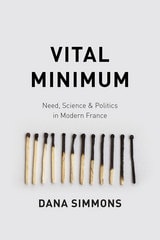
Vital Minimum
Need, Science, and Politics in Modern FranceDana Simmons
University of Chicago Press, 2015
The result was the concept of the "vital minimum"--the living wage, a measure of physical and social needs. In this book, Dana Simmons traces the history of this concept, revealing the intersections between technologies of measurement, such as calorimeters and social surveys, and technologies of wages and welfare, such as minimum wages, poor aid, and welfare programs. In looking at how we define and measure need, Vital Minimum raises profound questions about the authority of nature and the nature of inequality.