Results by title
3 books match the query 'Bateson, Gregory'
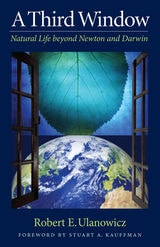
A Third Window
Natural Life beyond Newton and DarwinRobert W. Ulanowicz
Templeton Press, 2009
Thus far, the dominant paradigms through which modern scientists have viewed nature have been structured primarily around Newtonian and Darwinian approaches. As theoretical ecologist Robert E. Ulanowicz observes in his new work, A Third Window, neither of these models is sufficient for explaining how real change—in the form of creative advance or emergence—takes place in nature.
The metaphysical foundations laid by these great thinkers centuries ago are ill suited to sustain today's search for a comprehensive description of complex living systems. Ecosystem dynamics, for example, violate each and every one of the Newtonian presuppositions. Hence, Ulanowicz offers his titular "third window"—a new way of understanding evolution and other natural processes beyond the common mechanistic or materialistic philosophies of nature.
Drawing on the writings of Walter Elsasser, Karl Popper, Gregory Bateson, Robert Rosen, and Alfred North Whitehead, as well as his own experience as a theoretical ecologist, Ulanowicz offers a new set of axioms for how nature behaves. Chance and disarray in natural processes are shown to be necessary conditions for real change. Randomness is shown to contribute richness and autonomy to the natural world.
Drawing on the writings of Walter Elsasser, Karl Popper, Gregory Bateson, Robert Rosen, and Alfred North Whitehead, as well as his own experience as a theoretical ecologist, Ulanowicz offers a new set of axioms for how nature behaves. Chance and disarray in natural processes are shown to be necessary conditions for real change. Randomness is shown to contribute richness and autonomy to the natural world.
The metaphysical implications of these new axioms will lend A Third Window a wide appeal not only among scientists, but also among philosophers, theologians, and general readers who follow the science and religion dialogue. Ulanowicz's fresh perspective adds a new voice to the discussion.
[more]

Margaret Mead, Gregory Bateson, and Highland Bali
Fieldwork Photographs of Bayung Gede, 1936-1939Gerald Sullivan
University of Chicago Press, 1999
In 1936 anthropologist Margaret Mead and her husband, Gregory Bateson, retreated from lowland Bali, which was the focal point of much scholarly and tourist activity, to the remote village of Bayung Gedé in the island's central highlands. Although they wrote relatively little about their work in this place, which Mead called "our village, way up in the mountains, a lovely self-contained village," they did leave behind a remarkably rich and extensive photographic record of their time there.
Margaret Mead, Gregory Bateson, and Highland Bali includes 200 photographs that the couple took between 1936 and 1939, the vast majority of which have never before been published. They vividly capture the everyday lives of the men, women, and children of Bayung Gedé, their homes and their temples, and many other fascinating details of village life not featured in Mead and Bateson's publications.
In a substantial introductory essay, Gerald Sullivan, who selected the photographs, uses excerpts from fieldnotes and correspondence to illuminate Mead and Bateson's ethnographic work. Tracing the project from its inception in their proposals to the publication of their work, Sullivan shows how they used the photographs both as fieldnotes and as elements in their theoretical argument. Finally, he explores what the photographs reveal—independently of Mead and Bateson's project—about the Balinese character to the contemporary viewer.
The result is a both a substantial contribution to visual anthropology and an invaluable supplement to the published works of Margaret Mead and Gregory Bateson.
[more]
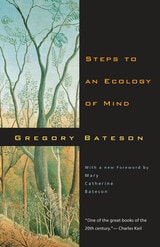
Steps to an Ecology of Mind
Collected Essays in Anthropology, Psychiatry, Evolution, and EpistemologyGregory Bateson
University of Chicago Press, 2000
A landmark work that broke new ground in anthropology, psychology, cybernetics, and more--and remains relevant today
Gregory Bateson was a philosopher, anthropologist, photographer, naturalist, and poet, as well as the husband and collaborator of Margaret Mead. In 1972, he published this career-spanning collection, and it has remained highly influential in multiple fields ever since. Ranging across anthropology, psychology and psychiatry, cybernetics, and much more, Bateson addresses culture, the self and the mind, addiction, the then-nascent field of computer science, and the very components of thought itself. This edition offers a new foreword by his daughter Mary Catherine Bateson reflecting on his career and thought, showing why this astonishing book continues to delight and inform readers, decades after its original publication.
[more]