Results by title
3 books match the query 'Batinski, Michael C.'
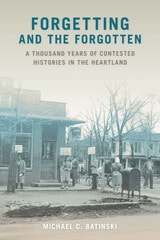
Forgetting and the Forgotten
A Thousand Years of Contested Histories in the HeartlandMichael C. Batinski
Southern Illinois University Press, 2022
WINNER, 2023 Illinois State Historical Society Superior Achievement Award in “Books, Scholarly”!
Revealing the forgotten in community histories
Histories try to forget, as this evocative study of one community reveals. Forgetting and the Forgotten details the nature of how a community forged its story against outsiders. Historian Michael C. Batinski explores the habits of forgetting that enable communities to create an identity based on silencing competing narratives. The white settlers of Jackson County, Illinois, shouldered the hopes of a community and believed in the justice of their labor as it echoed the national story. The county’s pastkeepers, or keepers of the past, emphasizing the white settlers’ republican virtue, chose not to record violence against Kaskaskia people and African Americans and to disregard the numerous transient laborers. Instead of erasing the presence of outsiders, the pastkeepers could offer only silence, but it was a silence that could be broken.
Batinski’s historiography critically examines local historical thought in a way that illuminates national history. What transpired in Jackson County was repeated in countless places throughout the nation. At the same time, national history writing rarely turns to experiences that can be found in local archives such as court records, genealogical files, archaeological reports, coroner’s records, and veterans’ pension files. In this archive, juxtaposed with the familiar actors of Jackson County history—Benningsen Boon, John A. Logan, and Daniel Brush—appear the Sky People, Italian immigrant workers, black veterans of the Civil War and later champions of civil rights whose stories challenge the dominant narrative.
[more]

Growing Up with Southern Illinois, 1820 to 1861
From the Memoirs of Daniel Harmon BrushDaniel Harmon Brush, with a Foreword by Michael C. Batinski
Southern Illinois University Press, 2017
Daniel Harmon Brush came to southern Illinois from Vermont with his parents in the 1820s and found a frontier region radically different from his native New England. In this memoir, Brush, the eventual founder of Carbondale, Illinois, describes his early life in the northeast, his pioneer family’s move west, and their settlement near the Illinois River in Greene County, Illinois. Beginning as a store clerk, Brush worked hard and became very successful, serving in a number of public offices before founding the town of Carbondale in the 1850s, commanding a regiment in the Civil War, and practicing law, among other pursuits. Brush never let go of his pious New England roots, which often put him at odds with most other citizens in the region, many of whose families emigrated from the southern states and thus had different cultural and religious values. The memoir ends in 1861, as the Civil War starts, and Brush describes the growing unrest of Southern sympathizers in southern Illinois. Brush’s story shows how an outsider achieved success through hard work and perseverance and provides a valuable look at life on the western frontier.
[more]
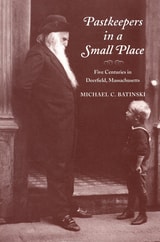
Pastkeepers in A Small Place
Five Centuries in Deerfield, MassachusettsMichael C. Batinski
University of Massachusetts Press, 2004
People know who they are by fixing themselves in place and time. They keep the past in numerous ways—not simply by writing histories but also by telling stories, creating pictures, collecting memorabilia, preserving old homes, and tracing genealogies. As Michael C. Batinski shows in this imaginative study, the pastkeepers of Deerfield, Massachusetts, have long illustrated this human yearning to connect with past and place. For five centuries people in this small New England town have passed stories from one generation to the next, preserved homes, and established one of the nation's first historical societies and local history museums.
Like many small places in the American landscape, Batinski points out, Deerfield does not fit into the history we learn in textbooks. With the exception of the famous French and Indian raid on the town in 1704, nothing of national significance has happened there. Yet that has not diminished the interest of local inhabitants in establishing and maintaining a vital connection to the past.
Different groups, from Native Pocumtuck to Puritan settlers to the grandchildren of Polish immigrants, have told the Deerfield story in varied and sometimes conflicting ways, each drawing on the past to shape its own sense of collective identity. Together their efforts at pastkeeping reveal how people organize and explain the motion of time, why they feel it important to pass on family stories, and why they keep family heirlooms. In doing so, Batinski argues, they illustrate why the preservation of the past remains a civic concern to us all.
[more]