Results by title
5 books match the query 'Battlefields'
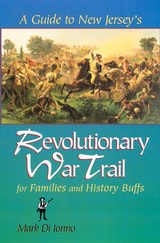
A Guide to New Jersey's Revolutionary War Trail
for Families and History BuffsDi Ionno, Mark
Rutgers University Press, 2000
New Jersey’s role in the Revolutionary War is widely overlooked. Every school kid learns about the Boston Tea Party but not the Greenwich tea burning; and about the miserable winter at Valley Forge but not Jockey Hollow. Schools fund class trips to Philadelphia’s Independence Hall but not Princeton’s Nassau Hall. To find history in New Jersey, all you need is DiIonno’s book as your guide. His easy-to-read volume helps readers explore the cities and the countryside from Bergen to Cape May County to find out exactly what happened there during the Revolutionary War.
While previously published books center on the highlights — Fort Lee and Washington’s retreat across the state, victories at Trenton and Princeton, the brutal winter encampment at Jockey Hollow and the Battle of Monmouth — DiIonno fills in the blanks. Battlefields, churches, homes of the famous and infamous, cemeteries, parks, taverns, liberty poles, bridges, creeks, hills, museums, encampment sites, lighthouses, historical societies, walking trails, monuments, plaques—if it played a part in or commemorates the Revolutionary War in New Jersey, DiIonno tells you what happened there, the personalities involved, and how to see it for yourself.
The sites are conveniently cataloged by county, with a helpful summary of the area’s war history beginning each chapter. Each entry lists the town and directions to each site, and where appropriate, a complete address, telephone numbers, and hours of operation. Both public and private sites are described, and DiIonno advises readers of which private sites tours can be arranged.
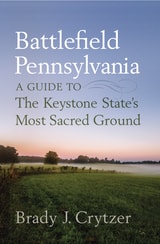
Battlefield Pennsylvania
A Guide to the Keystone State's Most Sacred GroundBrady J. Crytzer
Westholme Publishing, 2018
Pennsylvania is a battlefield. Fort Necessity. Brandywine. Gettysburg. The Homestead Strike. Flight 93. In many ways battlefields are like scars on the landscape. They remind us that history is real, and their effects stay with us forever. In Battlefield Pennsylvania: A Guide to the Keystone State’s Most Sacred Ground, award-winning historian Brady J. Crytzer takes the reader on a fascinating tour of over three hundred years of Pennsylvania history through twenty-nine of the state’s most significant battlegrounds, based on his popular Pennsylvania Cable Network television program. The author shows that debates and neighborly disputes have been present throughout the history of William Penn’s “Peaceable Kingdom,” but that battles are not the natural resolution of these conflicts; they are a failure of the system. Understanding how these systems break down and descend into violence and chaos is one of the most important purposes of this book. When the forces of Britain and France met on the battleground of North America, they each waged war in the name of a vision—a defense of the future, not merely the present. The same can be said for the Indian warriors and settlers of the backcountry, and the striking workers of the industrial age. When the young men of the American Civil War era donned the Butternut and Blue, they were not just fighting over a hill or a railroad junction, but for an American future. Illustrated with maps and period and contemporary images, Battlefield Pennsylvania presents each event through background information, a description of the battle itself, the legacy of the battle, and what a visitor can see today. Rather than viewing preserved battlefields as a hollow tribute to days gone by, the author demonstrates that these sites are a great inheritance provided by past generations, and just as they entrusted them to us, we will entrust them to future generations as well.
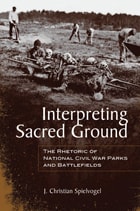
Interpreting Sacred Ground
The Rhetoric of National Civil War Parks and BattlefieldsJ. Christian Spielvogel
University of Alabama Press, 2013
A rhetorical analysis of Civil War battlefields and parks, and the ways various commemorative traditions—and their ideologies of race, reconciliation, emancipation, and masculinity—compete for dominance.
The National Park Service (NPS) is known for its role in the preservation of public sites deemed to have historic, cultural, and natural significance. In Interpreting Sacred Ground, J. Christian Spielvogel studies the NPS’s secondary role as an interpreter or creator of meaning at such sites, specifically Gettysburg National Military Park, Harpers Ferry National Historical Park, and Cold Harbor Visitor Center.
Spielvogel studies in detail the museums, films, publications, tours, signage, and other media at these sites, and he studies and analyzes how they shape the meanings that visitors are invited to construct. Though the NPS began developing interpretive exhibits in the 1990s that highlighted slavery and emancipation as central facets to understanding the war, Spielvogel argues that the NPS in some instances preserves outmoded narratives of white reconciliation and heroic masculinity, obscuring the race-related causes and consequences of the war as well as the war’s savagery.
The challenges the NPS faces in addressing these issues are many, from avoiding unbalanced criticism of either the Union or the Confederacy, to foregrounding race and violence as central issues, preserving clear and accurate renderingsof battlefield movements and strategies, and contending with the various public constituencies with their own interpretive stakes in the battle for public memory.
Spielvogel concludes by arguing for the National Park Service’s crucial role as a critical voice in shaping twentieth-first-century Civil War public memory and highlights the issues the agency faces as it strives to maintain historical integrity while contending with antiquated renderings of the past.
On European Ground
Alan Cohen
University of Chicago Press, 2001
Cohen's images achieve a solemn beauty even as they engage history at its most topical. Pictures of trenches and bunkers at the battlefields of Somme and Verdun explore the tension between the violence of the past and the inscrutability of its remnants. Photographs from the grounds of Dachau and Auschwitz solicit a provocative dialogue between the ordinariness of these sites today and their haunting memory. They teach us, as the New Art Examiner notes, "that the living perceptual connection to the Holocaust is vanishing." Images of the Berlin Wall show only the footprint of the barricade that once separated two hostile ideologies. They record the physical erosion and looming disappearance of the Wall while capturing its reappearance as a memorialized abstraction.
Accompanying the photographs in On European Ground are essays by Sander Gilman and Jonathan Bordo, as well as an interview with Cohen by critic Roberta Smith of the New York Times. The essays present both an introduction to and aesthetic analysis of Cohen's work, while the interview discusses the intractable problems of history and memory that his photographs so uniquely capture.
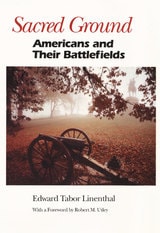
Sacred Ground
AMERICANS AND THEIR BATTLEFIELDSEdward Tabor Linenthal
University of Illinois Press, 1991
famous battlefields through patriotic rhetoric, monument building, physical
preservation, and battle reenactment. But each site is also a place where
different groups of Americans come to compete for ownership of cherished
national stories and to argue about the meaning of war, the importance
of martial sacrifice, and the significance of preserving the nation's
patriotic landscape.
From the anniversary speeches at Lexington and Concord that shaped the
image of the minuteman to Alamo Day speeches invoking the Texas "freedom
fighters" of 1836 in support of the contras in Nicaragua; from passionate
arguments over the placement of Confederate monuments at Gettysburg to
confrontations between militant American Indian Movement and "Custer
loyalists" during the Little Bighorn centennial in 1976; from the
treatment of the USS Arizona at Pearl Harbor to continuing attempts
to maintain the purity of these places in the face of commercialization---Sacred
Ground details the ongoing struggles to define, control, and subvert
patriotic faith as expressed at these ceremonial sites.